
I watched a robot walk across a stage in Beijing last month and beat Usain Bolt’s 100 metre world record. It clocked 9.39 seconds. The crowd cheered, cameras flashed, and the clip went viral within hours. But the moment that stayed with me came later, when I read what actually happened after the applause. That same robot, and thousands like it, are now moving into factories, warehouses, hospitals, and farms across China. The rise of Chinese robotics is not a story about viral videos. It is a story about an industrial system that has quietly become the most powerful in the world.
This article is for Nigerian entrepreneurs, policymakers, students, and anyone who wants to understand what is happening in robotics and why it matters for Africa. I have spent years working with importers and watching Chinese technology move through Nigerian markets. What I have learned is that the products we see today are always the tail end of a revolution that started years earlier. The robotics wave is different because it is arriving faster than any technology wave before it. In this piece, I will show you the scale of China’s robotics industry, the companies leading the charge, the supply chain advantages that make it possible, what this means for Nigeria and Africa, the real problems that remain, and three specific steps you can take to position yourself for what is coming.
The Numbers That Define the Rise
Start with the scale, because the scale is what makes this different from anything that came before. In the first half of 2026, China’s robotics industry generated 165.5 billion yuan in revenue from enterprises above a designated size, a 24.5 percent increase from the previous year, according to China’s Ministry of Industry and Information Technology. The country’s robotics industry revenue crossed 300 billion yuan in 2025, with average annual growth above 20 percent over the past five years.
The humanoid robot sector tells an even more dramatic story. China shipped 18,500 humanoid robots in the first half of 2026, capturing 97 percent of the global total of 19,100 units. That shipment volume jumped 272 percent from a year earlier and nearly matched the roughly 18,000 units sold worldwide in all of 2025. The Ministry of Industry and Information Technology projects that China’s total output of humanoid robot complete machines will exceed 100,000 units in 2026, a fivefold leap from about 20,000 units in 2025.
The industrial robot numbers are equally striking. China installed 295,000 new industrial robots in 2024, capturing 54 percent of the global total, according to the International Federation of Robotics. The country now operates more than 2 million industrial robots, about 4.5 times more than Japan, the second ranked nation. In 2025, China’s industrial robot exports grew 48.7 percent, and the country became a net exporter of industrial robots for the first time.
These are not projections or forecasts. They are shipments and revenue that have already happened. The robots are not in laboratories anymore. They are on factory floors, in warehouses, and in commercial service.
The Companies Leading the Charge
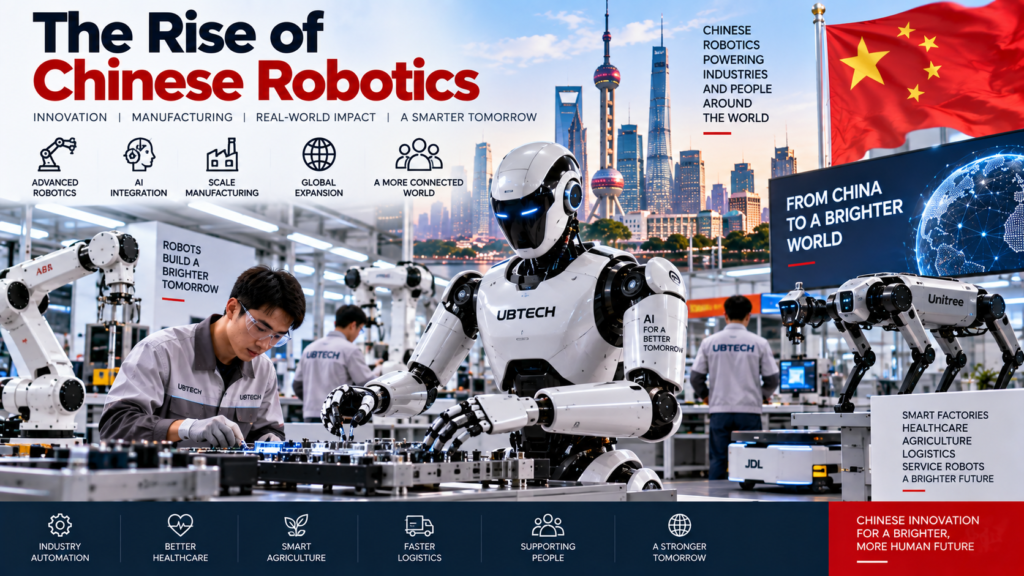
The rise of Chinese robotics is not driven by a single company. It is driven by a cluster of companies, each with a different approach, competing fiercely with each other.
Unitree: The Viral Sensation Turned Public Company
Unitree Technology is the company that most resembles the public face of Chinese robotics. It started with quadruped robots, became famous for making robotic dogs at consumer grade prices, and then moved into humanoid robots with the same philosophy of motion control and extreme cost effectiveness.
Unitree shipped roughly 5,900 humanoid robots in the first half of 2026, holding 31 percent of global market share. In 2025, the company achieved revenue of 1.699 billion yuan, a 335 percent increase, with a gross profit margin of 60 percent. The company’s compact R1 humanoid was introduced at a price starting at 39,900 yuan, which is about 5,900 dollars.
In August 2026, Unitree became the first humanoid robot company to list on China’s A share market. The stock opened at 1,100 yuan per share on its first day of trading, a 629 percent increase from its issuance price, and the company’s market value briefly reached 444.9 billion yuan. That kind of market reception tells you something about how investors view the sector.
AgiBot: The Volume Leader
AgiBot was the world’s largest humanoid robot vendor by shipment volume in the first half of 2026, shipping about 8,400 units, a 562 percent year on year increase. That gave the company a 44 percent global market share.
AgiBot’s partner, Yao Maoqing, described mass production as the core foundation for stepping out of the lab and into industry. The company’s deployment solutions now cover seven real scenarios, including production line loading, industrial handling, logistics sorting, guide services, retail, security patrol, and commercial cleaning. By June 2026, AgiBot had cumulatively produced 15,000 robots.
UBTECH: The Companion Robot Pioneer
UBTECH took a different route. Rather than focusing exclusively on industrial applications, the company launched the U1 series, a consumer humanoid designed primarily as an AI powered emotional companion. The three models range from partial body machines to full sized humanoids and cost between 119,800 and 990,000 yuan.
The U1 received 13,361 orders by June 30, 2026, less than a month after pre sales began. A Beijing investor who paid 159,800 yuan for a female version of the U1 Pro told reporters he knew it would not cook or clean. What mattered was becoming one of China’s first individual owners of a consumer humanoid.
The Duopoly and the Challengers
Together, AgiBot and Unitree account for nearly 75 percent of global humanoid robot shipments. But the market is not a duopoly for long. More than 140 humanoid robot companies operate in China. Galbot, UBTECH, Leju, EngineAI, Matrix Robotics, and XPeng are all competing for market share.
Chery, the Chinese automaker, incubated a robot brand called Mojia that has cumulatively delivered more than 2,000 robots across more than 60 countries, anchored by Malaysia, the UAE, Thailand, and South Africa. Mojia’s general manager argued that the company’s competitive moat is not the robot hardware itself, but Chery’s three decade globalization stack, including research and development, manufacturing, supply, sales, and after sales systems.
That is a significant insight. The companies that win in robotics may not be the ones with the best technology. They may be the ones with the best industrial systems.
Why China Dominates: The Supply Chain Advantage
The numbers are impressive, but they do not explain why China dominates. The answer lies in the supply chain.
Reducers, lead screws, and motors account for roughly 45 percent of a humanoid robot’s bill of materials. Actuators and sensors push that share to 60 to 70 percent of total cost. China’s advantage is proximity. A motor factory in Dongguan sits a 40 minute drive from Unitree’s assembly line. Battery technology from CATL transfers directly from electric vehicles to robots.
China holds 63 percent of the key enterprises in the global humanoid robot component supply chain, including actuators and the rare earth permanent magnets needed for motors. The country’s manufacturing ecosystem allows firms to move from prototype to small batch production and then to larger scale delivery relatively quickly.
The speed is remarkable. In Shenzhen, companies have created what they call a 72 hour prototyping circle. A firm can go from design to 3D printed robot prototype in as little as three days. That kind of iteration speed is almost impossible to match anywhere else in the world.
The domestic market provides another advantage. Chinese customers represented over 85 percent of global humanoid robot demand in the first half of 2026. That means Chinese companies can test their robots in real operating conditions, collect feedback, improve their products, and deploy again. A robot deployed in a logistics center or factory generates data that improves design, software, and hardware integration. More applications produce more operational data. Better products reduce costs and increase confidence. Lower costs support wider deployment.
From Demonstrations to Real Work
The most important shift in Chinese robotics is not the number of robots produced. It is what the robots are actually doing.
At the 2026 World Robot Conference in Beijing, 373 companies showcased 3,000 innovative products. Unlike previous years, when exhibitors focused on robots’ ability to run and jump, this year’s show emphasised humanoid robots’ capacity to perform practical tasks like inspecting facilities, sorting goods, folding laundry, and cooking.
At the booth of Robbyant, a robotics company under Ant Group, a robotic arm fulfilled a simulated pharmacy order, retrieving medicine from shelves in one fluid motion. The system is meant to ease staffing pressure at busy pharmacies, freeing pharmacists to counsel customers rather than move back and forth between the register and shelves.
At the Beijing Humanoid Robot Innovation Center’s booth, a Tiangong robot used a thermal imaging device to inspect electrical control cabinets, work that can pose safety risks to people in high voltage areas. The robot has been tested at substations in Beijing and the provinces of Sichuan and Zhejiang.
At UBTECH’s booth, nearly 10 Cruzr Y1 and Cruzr S2 humanoid robots worked in tandem on a mock production line, loading and unloading automotive sheet metal and machined parts and independently stacking material boxes.
At Haier’s booth, a household robot called Haiwa picked up a T shirt, loaded it into a washing machine, and pressed start, while a second unit sorted groceries, placing items needing refrigeration in the fridge.
These are not demonstrations of what robots might do one day. They are examples of what robots are doing now.
What This Means for Nigeria and Africa
You might be reading this and wondering what any of it has to do with Nigeria. The robots are in China. The factories are in China. The supply chains are in China. What does that mean for a Nigerian entrepreneur, a Nigerian student, or a Nigerian policymaker?
The answer is that the rise of Chinese robotics will affect Africa in three ways.
Cheaper and Better Goods
The first effect is indirect but powerful. Chinese factories that use robots to build products can produce goods more cheaply and consistently than factories that rely on manual labour. That means the phones, appliances, vehicles, and electronics that Nigeria imports from China will continue to get cheaper and better. The robotics revolution is one of the reasons why.
The shift from China’s old export model of clothing, furniture, and appliances to what analysts call the new industrial champions of robotics, artificial intelligence, and innovative drugs is already visible in trade data. In the first five months of 2026, China exported 10.377 million robot units worth around 3 billion dollars across the world. Chinese made industrial hardware and robotic arms are extensively used in Africa, South America, and the Middle East.
Direct Applications in African Industry
The second effect is direct. Chinese robots are already being deployed in African industries, though at a smaller scale than in China.
Chery’s Mojia robot brand has delivered more than 2,000 robots across more than 60 countries, with South Africa as one of its anchor markets. China is helping Africa break through its own industrialization through research and scientific collaboration, including joint laboratories and technology transfer.
Medical robotics is one area where the impact is already visible. The China Africa Robotic Surgery Training Center and the China Africa Endoscopic Technology Training Center are advanced specialized training hubs that help African health systems use minimally invasive tools to deliver quality health services.
In agriculture, Chinese made drones are being used across Ghana, Mozambique, Ethiopia, Kenya, and South Africa to boost precision agriculture, reducing water consumption and pesticide use significantly.
The Opportunity for Nigerian Businesses
The third effect is the opportunity. The rise of Chinese robotics creates business opportunities for Nigerian entrepreneurs in importing, distributing, servicing, training, and adapting these technologies for local conditions.
A Nigerian technician who learns to maintain and repair industrial robots is a valuable asset to any factory that uses them. A Nigerian entrepreneur who imports and distributes agricultural drones is providing a service that farmers need. A Nigerian company that adapts Chinese robotic systems for local conditions, whether in manufacturing, logistics, or healthcare, is adding value that a Chinese factory cannot provide.
The key insight is that the robotics revolution is not just about building robots. It is about the entire ecosystem that surrounds them. Installation, maintenance, training, software adaptation, and after sales service are all parts of the value chain. Nigerian businesses can participate in those parts without needing to build robots from scratch.
The Problems and the Reality
It would be dishonest to write about the rise of Chinese robotics without acknowledging the real problems and challenges.
The first challenge is commercial sustainability. Unitree’s financials show that revenue growth does not always translate into profit growth. Even though the company’s 2025 revenue grew 335 percent, its recurring net profit was projected to decline 6 to 22 percent in 2026, and first quarter profit fell 52.55 percent. The company’s market value has fallen from its peak of 444.9 billion yuan to around 270 billion yuan. That pattern reflects a broader reality. Manufacturing capacity is established, but real user demand and sustainable commercial loops are still being built.
The second challenge is the gap between production and deployment. Through the first three quarters of 2025, more than 70 percent of Unitree’s humanoid robot revenue came from research and education customers, with industrial applications only 9 percent. That means most shipped robots did not actually enter factory work. A robotics analyst estimated that 50 to 70 percent of humanoids produced in 2026 could end up in data factories, where human operators remotely control robots through physical tasks to generate training data, rather than performing productive work.
The third challenge is cost. Price remains a hurdle for wider adoption. A robot that costs tens of thousands of dollars is not accessible to most small and medium businesses, whether in China or Nigeria. Companies are working to bring costs down, but the process takes time.
The fourth challenge is the global competitive landscape. The United States retains major strengths in foundational artificial intelligence research, advanced semiconductors, computing platforms, and software ecosystems. Japan and several European countries remain highly competitive in precision components, industrial reliability, specialized automation, and safety systems. China’s advantage is in scaling and supply chain coordination, not in every dimension of robotics.
For Nigerian readers, these challenges mean that the robotics revolution is real, but it is not simple. The technology works. The business models are still being proven. The opportunities are real, but they require careful assessment.
Three Steps You Can Take Today
If you are a Nigerian entrepreneur, student, or professional who wants to position yourself for the rise of Chinese robotics, here are three specific things you can do this week.
Learn One Robotics Adjacent Skill
You do not need to become a robotics engineer to benefit from the robotics revolution. The ecosystem needs people with a wide range of skills. Learn one skill that the ecosystem needs. It could be industrial maintenance. It could be programming. It could be logistics management. It could be training and support. The goal is to develop a skill that makes you valuable to the companies that will deploy robots in Nigeria.
Write down one skill you could learn in the next six months. Then find one online course or training programme that teaches it. Start this week.
Research One Application for Your Sector
Look at your industry, whether it is agriculture, manufacturing, logistics, healthcare, or retail. Then research how robots are being used in that industry in China or other markets. Do not look at the most advanced applications. Look at the simplest ones. A robotic arm that sorts packages. A drone that sprays crops. A machine that inspects products for defects.
Write down one application that could work in your context. Then research what it would cost to import, install, and maintain. The goal is not to buy a robot tomorrow. The goal is to understand the economics so you can make an informed decision when the time is right.
Connect with the Supply Chain
If you are an importer or distributor, research Chinese robotics companies that are expanding into Africa. Chery’s Mojia is already in South Africa. Other companies are looking for partners. Find out who they are, what they need, and what they offer. Write down one company you could contact. Then spend thirty minutes researching how to reach them.
The goal is not to sign a deal this month. The goal is to start building relationships before the market becomes crowded. The early movers capture the most value.
Conclusion
The rise of Chinese robotics is one of the most significant industrial shifts of the decade. China shipped 97 percent of the world’s humanoid robots in the first half of 2026. The country’s robotics industry revenue crossed 300 billion yuan in 2025. Unitree became the first humanoid robot company to list on China’s A share market. AgiBot shipped 8,400 units in six months. The supply chain advantage, the manufacturing ecosystem, and the speed of iteration are unlike anything the world has seen before.
The three most important takeaways for Nigerian readers are these. First, the robotics revolution will reach Africa, not as a wave of Chinese robots flooding Nigerian factories, but as a gradual shift in what is possible and what is affordable. Second, the opportunity is not just to consume these technologies but to build businesses around them. Importing, distributing, servicing, training, and adapting are all valuable roles. Third, the technology works, but the business models are still being proven. The winners will be the ones who understand both the technology and the economics.
If you take one step today, let it be this. Pick one skill or one application from this article and spend thirty minutes researching it. Not the whole robotics industry. Just one thing. One skill. One application. One company. Write down what you learn. Then do it again next week. That is how you prepare for a revolution that is already arriving. The robots are not coming. They are here. The question is whether you will be ready when they reach your market.
For a deeper look at how Chinese technology is changing agriculture in Nigeria, you can read our article on drones, satellites, and mechanization in African farming. If you want to understand the broader technology revolution that is coming, our guide on the next Chinese technology revolution covers the breakthroughs that will define the next decade.