
I sat in traffic on the Third Mainland Bridge last year and counted the cars around me. Hundreds of them, all burning petrol, all contributing to the haze that hangs over Lagos most mornings. Then I noticed something that stopped me. A small blue hatchback with no exhaust pipe, gliding silently through the gridlock. It was a BYD, one of the first electric vehicles I had seen on a Nigerian road. The driver noticed me staring and gave a small nod, the way people do when they know they are early to something big. That moment stayed with me because it raised a question I could not answer at the time. Was that car a novelty, or was it the beginning of something that would change how Africa moves? The future of Chinese electric vehicles in Africa is the answer to that question, and the evidence is now coming in fast enough to see the shape of what is coming.
This article is for Nigerian drivers, fleet operators, importers, policymakers, and anyone trying to understand where electric mobility is heading on the continent. I have spent years working with importers and watching how Chinese vehicles move through Nigerian markets. What I have learned is that the EV story in Africa is not a copy of what happened in Europe or China. It is different, and the differences matter. In this piece, I will show you the numbers behind the current surge, explain the specific strategies Chinese automakers are using to win African buyers, name the real obstacles that remain, and give you three concrete steps you can take if you want to position yourself for what is coming.
The Numbers That Show This Is Real
Start with the data, because the data is unambiguous. Africa’s electric vehicle market more than doubled in the first half of 2026, with sales exceeding 30,000 units, according to the International Energy Agency’s Global EV Outlook report published in May 2026. South Africa recorded a more than fivefold increase in EV sales year on year, while Egypt more than tripled its sales in the same period. These are not projections or pilot programmes. These are vehicles that people paid for and are driving.
The growth is being driven almost entirely by Chinese brands. BYD alone held 35 percent of Africa’s EV market in 2025, up from just 4 percent in 2023, according to the IEA. In Morocco, BYD sold 300 vehicles in January 2026, a 295 percent increase year on year, making it the top Chinese brand in that market. In South Africa, Chinese brands’ share of the passenger car market climbed from 11.2 percent a year earlier to nearly 20 percent in 2026, with Chery Group’s sales jumping to second place in the industry for the first five months of the year, behind only Toyota and ahead of Suzuki and Volkswagen.
Kenya tells a similar story. Registered electric vehicles in the country jumped from fewer than 1,400 in 2022 to more than 39,000 in 2025, after President William Ruto declared that the first 100,000 EVs imported into Kenya would be duty free. Ethiopia took an even bolder step, banning imports of gasoline and diesel vehicles in 2024 to accelerate the transition to electric mobility and reduce spending on imported fuel. More than 140,000 EVs are now on Ethiopian roads, and the government aims to have up to 500,000 by 2030.
For Nigerian readers, the most relevant number is this. The Federal Government approved tax waivers for nearly 4,000 electric vehicles imported into Nigeria in the first half of 2026, the first batch processed under a new programme designed to promote cleaner transport through tax incentives and local vehicle assembly. Nigeria exempted EVs from value-added tax in 2024 and reduced import duties on electric vehicles to zero in 2026, down from 5 percent. The policy signals are clear. The question is whether the infrastructure and the market can keep up.
The Chinese Playbook for African EV Adoption
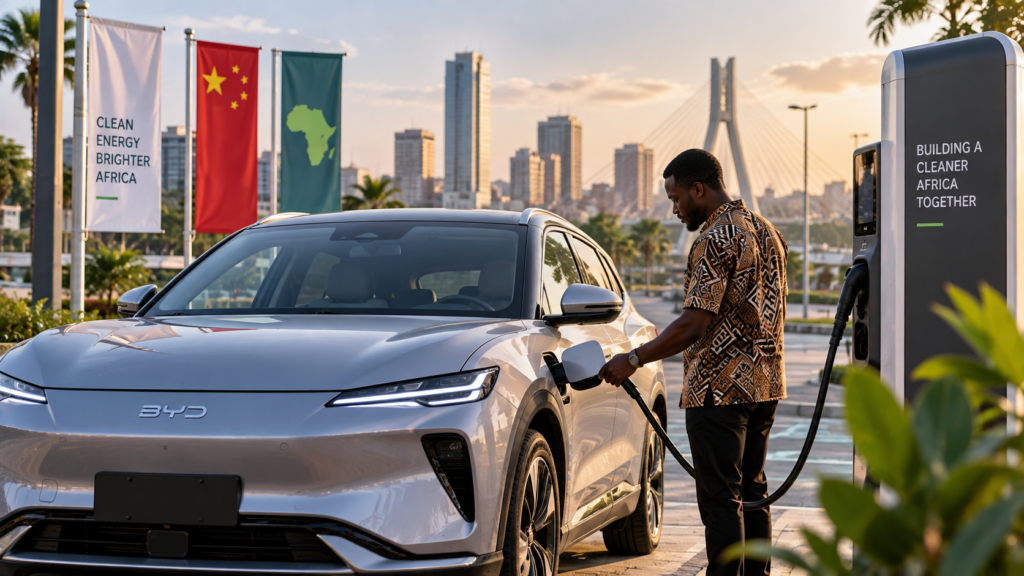
Chinese automakers are not succeeding in Africa by accident. They are following a playbook that was refined in other emerging markets, and it is working. The playbook has three main plays.
Build Locally, Not Just Export
The first play is local manufacturing. Chinese automakers have realized that exporting finished vehicles to Africa is a dead end. Import duties, shipping costs, currency volatility, and political risk all eat into margins. The solution is to build where you sell.
Chery, China’s largest auto exporter, made this shift in dramatic fashion in July 2026. The company acquired Nissan’s former Rosslyn plant near Pretoria, South Africa. The plant was built in 1963 and had been sitting idle. Chery plans to produce plug-in hybrids, battery electric vehicles, and models under its Jetour brand there. This is not a small bet. It is a signal that Chery intends to be a permanent presence in Africa, not a temporary visitor.
Chery is not alone. Beijing Automotive Group already has a manufacturing and assembly facility in Gqeberha, formerly Port Elizabeth, in South Africa. Great Wall Motor has localized assembly and component distribution capacity in the country. In Kenya, a Chinese-backed company called Rideence Africa Limited is investing 320 million Kenyan shillings to build an EV assembly line in Mombasa, focused on electric hatchbacks and 16-seater electric vans for public transport. Chinese EV maker Okla Global has appointed an investment bank to spearhead its Africa expansion, with assembly plants planned for Kenya, Nigeria, South Africa, Egypt, and Zimbabwe.
The logic is straightforward. Local assembly avoids import duties, lowers prices, creates jobs, and positions companies closer to fast growing markets. For Nigerian policymakers, this is the play to watch. If Nigeria wants Chinese EV manufacturers to build factories here rather than in South Africa or Kenya, the policy environment needs to be competitive.
Price Aggressively, But Not Cheaply
The second play is pricing. Chinese EVs are not the cheapest cars on the road, but they offer more value at every price point than their competitors. That distinction matters.
In Nigeria, the BYD Seagull EV is priced between 25.5 million and 37.8 million naira, depending on trim and model year. The BYD Atto 3, a compact SUV, ranges from 32.3 million to 48.6 million naira for the 2026 model. The GAC Aion Y EV, a fully electric SUV, was available at a special pre-order price of 36 million naira in May 2026, reduced from 40 million naira. These are not cheap cars by Nigerian standards. But compare them to a comparable petrol SUV from a Japanese or European brand, and the value proposition becomes clear. The EV has lower running costs, fewer moving parts, and no fuel bill.
The pricing strategy is supported by vertical integration. BYD makes its own batteries, its own semiconductors, and controls more of its supply chain than almost any other carmaker in the world. That control allows it to price aggressively without losing money on every unit. Chinese battery giant CATL signed a contract with Egyptian company BME in September 2026 to build a battery systems plant in Egypt with an initial annual capacity of 1 gigawatt hour, expanding to 5 gigawatt hours in a second phase. When battery production is local, the cost of the entire vehicle comes down.
Target the Segments That Actually Matter
The third play is segment targeting. Chinese automakers are not just selling passenger cars to wealthy early adopters. They are targeting the segments where electric mobility makes the most economic sense in Africa.
The first segment is ride hailing and commercial transport. In Lagos, electric cars are already rewriting the economics of ride hailing. A driver who switches from petrol to electric cuts their fuel costs by roughly two thirds, according to industry estimates. For a full time driver covering 150 kilometres a day, that saving is significant enough to change the entire business model. Chinese EV makers are positioning their vehicles for this segment, with lower purchase prices, longer warranties, and partnerships with ride hailing platforms.
The second segment is two and three wheelers. Africa’s imports of electric motorcycles and three-wheelers from China rose 60 percent in the first half of 2026, reaching 114.6 million dollars. In Uganda, electric motorcycles now account for roughly 20 percent of new motorcycle sales. In Kenya, they account for about 15 percent. The economics are compelling. A petrol motorcycle rider in Kampala or Nairobi spends a significant portion of daily income on petrol. An electric motorcycle with a battery swap model reduces that cost dramatically. Battery swapping networks, where riders exchange depleted batteries for fully charged ones within minutes, are being built by companies like MAX and Spiro.
The third segment is public transport. Chinese companies are supplying electric buses and vans to African cities. The Rideence plant in Mombasa is focused on 16-seater electric vans for public transport. Electric buses are being tested in Lagos, Nairobi, and Addis Ababa. These are high mileage vehicles where the fuel savings are largest and the environmental benefits are most visible.
The Obstacles That Could Slow the Transition
It would be dishonest to write about the future of Chinese EVs in Africa without acknowledging the obstacles. There are four that matter most.
Charging Infrastructure Is the Biggest Barrier
The single biggest obstacle to mass EV adoption in Nigeria is charging infrastructure. Nigeria had only about a dozen EV charging locations in mid 2025, compared with roughly 27,000 filling stations, according to specialist website EVCarLatest. The ratio of charging stations to petrol stations is about one to 2,250.
That gap is beginning to close. The Nigerian National Petroleum Company announced plans to roll out between 50 and 70 smart self-service fuelling stations across the country, combining fuel, EV charging, and solar power. The first of these stations, on Bill Clinton Drive in Abuja, has six EV charging points installed in partnership with African Motor Works, capable of charging a vehicle from about 20 percent battery level to full capacity within 30 to 40 minutes. A separate partnership between CAWIN Mobility, Blue Camel Energy, and Joint Sustainable Energy plans to deploy 10 solar powered EV charging stations across Nigeria.
But even with these investments, the charging network is thin. For a driver in Lagos who wants to travel to Ibadan, a distance of about 130 kilometres, there is no guarantee of a charging station along the route. For a driver in Kano or Port Harcourt, the situation is worse. The infrastructure gap is not just about the number of stations. It is about their distribution, their reliability, and their compatibility with different vehicle models.
Electricity Supply Is Unreliable
The second obstacle is electricity. Nigeria’s national grid supplies around 4,000 megawatts to a population of more than 200 million people, leaving households and businesses heavily dependent on petrol and diesel generators. That challenge is spilling into the EV ecosystem. Charging stations, dealerships, and battery-swapping operators increasingly rely on generators whenever grid electricity fails, which undermines the environmental rationale for EVs and adds to operating costs.
This is the paradox at the heart of Nigeria’s EV transition. The country wants to move away from petrol dependence, but the electric grid is not reliable enough to support that transition at scale. The solution, at least in the short term, is solar powered charging. A charging station that runs on solar panels and battery storage can operate independently of the grid. The CAWIN partnership and the NNPC’s plans both include solar components. But solar charging is slower and more expensive to install than grid connected charging. It is a stopgap, not a complete solution.
The Grid Is Not the Only Problem
The third obstacle is the vehicle supply chain. When a Chinese EV breaks down in Nigeria, where do you get spare parts? Who repairs it? How long does it take? These are not abstract questions. They are the questions that determine whether a vehicle is a practical purchase or a headache.
Some progress is being made. Chinese automakers are establishing dealer networks and service centres in major Nigerian cities. BYD entered Nigeria through LOXEA Nigeria, a subsidiary of CFAO Mobility, and partnered with Stanbic IBTC Bank to promote electric vehicle financing. That partnership addresses one of the biggest barriers to EV adoption, the upfront cost. But outside Lagos and Abuja, the service network is thin. A farmer in Kebbi who buys an electric pickup truck may struggle to find a technician who can service it.
Regulatory Uncertainty Remains
The fourth obstacle is policy consistency. Nigeria’s EV incentives are generous on paper. Zero import duty. No VAT. Tax waivers for imported vehicles. But policies can change. The removal of the petrol subsidy in 2023 made fuel more expensive and electric mobility more attractive. If a future government decides to reintroduce subsidies or change the import duty structure, the economics of EV ownership could shift overnight.
There is also the question of local content. If Nigeria wants Chinese automakers to build factories here, it needs to offer something in return. South Africa offers production incentives and customs duty rebates. Kenya offers duty free import quotas. Nigeria’s current policy mix is attractive for importers but less clear for manufacturers. Okla Global’s plan to build an assembly plant in Nigeria is a positive signal, but it is not yet a commitment. The policy framework needs to be stable and predictable if it is to attract long term investment.
The Technologies That Will Change the Game
The obstacles are real, but so are the technologies that could overcome them. Three developments are worth watching.
Battery Swapping for Two and Three Wheelers
Battery swapping is the most promising solution for electric two and three wheelers in Africa. Instead of waiting for a battery to charge, a rider exchanges a depleted battery for a fully charged one at a swap station. The exchange takes minutes, not hours. Companies like MAX and Spiro are building swap networks in Nigeria and Kenya, targeting the commercial riders who cover the most kilometres and spend the most on fuel.
The economics are compelling. Stanley Nwankwo, co-founder of electric mobility start-up Donda X Limited, said electric motorcycles and tricycles had cut operating costs by about two thirds compared with petrol powered alternatives. For a rider who earns a daily income from deliveries or passenger transport, that saving is transformative.
Solar Powered Charging Stations
Solar charging is the second technology that could accelerate adoption. A solar powered charging station with battery storage can operate independently of the grid, providing reliable charging even in areas with poor electricity supply. The CAWIN partnership plans to deploy 10 such stations across Nigeria. Rensource Energy and Metropolitan Electric have partnered to launch Nigeria’s first integrated renewable powered electric mobility platform. These are early stage projects, but they point to a model that could work in areas where grid electricity is unreliable.
The cost of solar panels and batteries has fallen dramatically over the past decade, driven largely by Chinese manufacturing. A solar powered charging station that would have been prohibitively expensive five years ago is now within reach for a small business. This is another example of how Chinese technology is enabling the EV transition in Africa, even when the vehicles themselves are imported.
Extended Range and Hybrid Vehicles
The third technology is extended range electric vehicles and hybrids. These vehicles use a small petrol engine to generate electricity for the battery, extending the range beyond what a pure battery can provide. For drivers who need to travel long distances but do not want to rely entirely on charging infrastructure, extended range vehicles offer a practical compromise.
At the 2026 Johannesburg International Auto Festival, Chinese brands showcased a wide range of vehicles covering pure electric, hybrid, extended range, and pickup segments. The message was clear. Chinese automakers are not betting on a single technology. They are offering options for every use case and every level of infrastructure readiness. For a Nigerian driver who wants to reduce fuel costs but is not ready to commit to a pure electric vehicle, an extended range hybrid offers a middle path.
What This Means for Nigerian Drivers and Businesses
If you are a Nigerian driver, fleet operator, or business owner, the EV transition is not something you can afford to ignore. It is already happening, and it will accelerate over the next five years. Here are three specific steps you can take.
Calculate Your Total Cost of Ownership
The first step is to do the maths. An electric vehicle has a higher purchase price than a comparable petrol vehicle, but lower running costs. The question is whether the savings over the life of the vehicle justify the upfront premium.
Take a driver who covers 150 kilometres a day in Lagos. A petrol SUV at current fuel prices costs roughly 30,000 naira per day in fuel. An electric SUV charged at home overnight costs roughly 10,000 naira in electricity. That is a saving of 20,000 naira per day, or about 600,000 naira per month. Over three years, the savings add up to more than 20 million naira. That is enough to cover the price difference between a petrol and electric vehicle several times over.
Write down your daily mileage. Write down your current fuel costs. Then find out what an electric vehicle would cost to charge. The numbers will tell you whether the switch makes sense for you.
Start with the Vehicle That Fits Your Routine
The second step is to be realistic about what you need. If you drive short distances within a city and have reliable charging at home or work, a pure electric vehicle is practical. If you travel long distances regularly or do not have reliable charging, an extended range hybrid is a better fit. If you are a commercial rider, an electric motorcycle with battery swapping may be the most cost effective option.
Do not buy an electric vehicle because it is fashionable. Buy it because it fits your routine and saves you money. The drivers who are happiest with their EVs are the ones who charge at home overnight and rarely need public charging. The drivers who struggle are the ones who bought an EV without thinking about where they would charge it.
Look for Financing and Partnership Opportunities
The third step is to explore financing options. The upfront cost of an electric vehicle is the biggest barrier for most buyers. But financing is becoming more available. BYD partnered with Stanbic IBTC Bank to promote electric vehicle financing. CIG Motors launched an EasyPay campaign that allows customers to pay a deposit and spread the balance over time. Ride hailing platforms are offering incentives for drivers who switch to electric vehicles.
If you are a fleet operator, talk to your bank about green financing options. If you are a ride hailing driver, ask your platform about EV incentives. If you are an individual buyer, ask the dealer about financing plans. The cost of capital is still high in Nigeria, but the savings from electric mobility are high enough to make the maths work for many buyers.
The Next Five Years: What to Expect
So what does the future actually look like? Here is my read, based on the numbers and the trends I have seen on the ground.
Chinese EV brands will continue to gain market share in Africa. The IEA data shows that Africa’s EV market more than doubled in the first half of 2026, and most of that growth came from Chinese brands. That trend will continue as more models become available, prices come down, and charging infrastructure improves.
Local manufacturing will accelerate. Chery’s acquisition of the Nissan plant in South Africa is a signal of what is coming. Other Chinese automakers will follow, building assembly plants in South Africa, Kenya, Egypt, and possibly Nigeria. Local manufacturing will reduce prices, create jobs, and build the supply chains needed to service a growing EV fleet.
Two and three wheelers will lead the transition. For most African consumers, the first electric vehicle they own will not be a car. It will be a motorcycle, a tricycle, or a small delivery van. These vehicles have the highest fuel costs, the shortest daily ranges, and the clearest economic case for electrification. Battery swapping networks will make them practical for commercial riders who cannot afford to wait for charging.
Charging infrastructure will remain the bottleneck. The number of public charging stations in Nigeria will grow from a dozen to several hundred over the next five years. Solar powered charging will become more common. But the charging network will still be concentrated in major cities and along major highways. Rural areas will lag behind. The drivers who charge at home will have the best experience.
The policy environment will be critical. Nigeria’s zero import duty and VAT exemption are strong incentives for EV adoption. But if the government wants to attract local manufacturing, it needs to offer more. Stable policies, production incentives, and investment in charging infrastructure are all needed. The countries that move first will capture the jobs and the investment. Nigeria has an opportunity, but it is not guaranteed.
Conclusion
The future of Chinese electric vehicles in Africa is not a question of if, but of how fast. Africa’s EV market more than doubled in the first half of 2026, with sales exceeding 30,000 units. BYD holds 35 percent of the market. Chery has acquired a plant in South Africa. Chinese brands are building assembly facilities in Kenya, Egypt, and South Africa. The policy environment in Nigeria is supportive, with zero import duty, no VAT, and tax waivers for nearly 4,000 vehicles in the first half of 2026 alone.
The three most important takeaways for Nigerian readers are these. First, the economic case for electric vehicles is already strong for high mileage drivers. The savings on fuel are large enough to justify the upfront cost, especially for ride hailing drivers and fleet operators. Second, the charging infrastructure is the bottleneck. Nigeria has about a dozen public charging stations compared with more than 500 in South Africa. That gap will close, but it will take time. Third, the transition will start with two and three wheelers. For most Nigerian consumers, the first electric vehicle they own will not be a car. It will be a motorcycle, a tricycle, or a small commercial van.
If you take one step today, let it be this. Open a notebook and write down your daily mileage and your daily fuel cost. Then find out what it would cost to charge an electric vehicle over the same distance. The difference is your potential saving. If the number is large enough to matter, start researching which electric vehicle fits your routine. The cars are here. The policy is supportive. The only question is whether you will be ready when the wave arrives.
For a deeper look at how Chinese brands compete on price, technology, and design, you can read our article on the competitive strategies behind their success. If you want to understand how Chinese technology is changing agriculture in Nigeria, our guide on drones, satellites, and mechanization in African farming covers the tools that are already in use.