
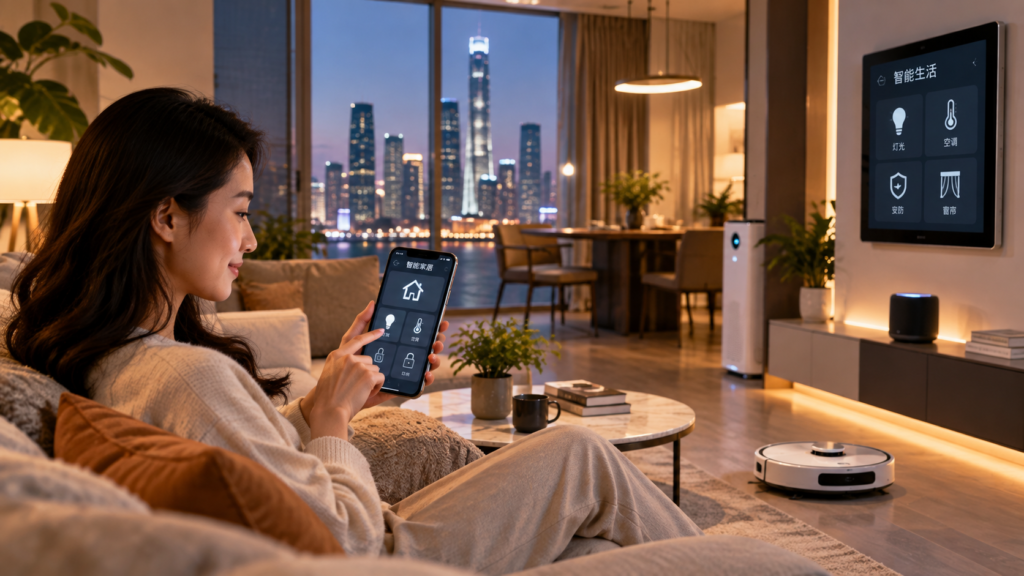
I walked into a home in Lekki last month and the lights came on before I touched a switch. The air conditioner adjusted itself. The curtains closed on their own. The owner, a Nigerian businessman in his forties, smiled and said something that has stayed with me. “I did not plan this. I bought one device, then another, and now the whole house is talking to itself.” That moment captures what is happening in China right now, and what is beginning to reach Nigerian shores. The smart home revolution is not about gadgets. It is about a fundamental shift in how homes work, from devices that respond to commands to spaces that anticipate needs.
I have spent years working with importers and watching Chinese technology move through Nigerian markets. What I have learned is that every major technology wave arrives in stages. First come the products. Then come the platforms that connect them. Then comes the intelligence that makes the whole system greater than the sum of its parts. The smart home revolution is now in that third stage in China, and the early signs are visible in Nigeria. In this article, I will show you the scale of China’s smart home market, explain the companies leading the shift, examine the artificial intelligence that is changing everything, look at what this means for Nigerian homes and businesses, name the real problems that remain, and give you three concrete steps you can take to position yourself for what is coming.
The Scale of China’s Smart Home Market
Start with the numbers, because the numbers tell you how far this has come. China’s smart home market is projected to exceed 800 billion yuan in 2026, with shipments expected to surpass 300 million units, according to iResearch. That is roughly 110 billion dollars in a single market. But the most striking number is not the size. It is the penetration rate.
Only about 16 percent of Chinese households currently use smart home devices, according to iResearch. In the United Kingdom and the United States, that figure exceeds 45 percent. That gap, which analysts describe as a scissors difference, is not a sign of weakness. It is a sign of room to grow. The Chinese market is expected to continue expanding at double digit rates through 2030, when it is projected to reach 1.84 trillion yuan.
The policy environment is accelerating the growth. In September 2026, eight Chinese government departments including the Ministry of Commerce, the National Development and Reform Commission, and the Ministry of Industry and Information Technology jointly issued an action plan to promote smart home consumption. The plan includes seven measures covering supply expansion, standards improvement, consumption support, elderly friendly products, recycling services, community services, and fiscal and financial backing. The government has allocated 250 billion yuan in ultra long special treasury bond funds to support the consumer goods trade in program, which generated 1.1 trillion yuan in sales in the first half of 2026 alone, with home appliance trade ins reaching 63.27 million units.
This is not a market that is emerging. It is a market that is being deliberately built, with policy support, financial incentives, and a coordinated industrial strategy. That is the first lesson for anyone watching from Nigeria.
The Companies Leading the Revolution
China’s smart home market is not dominated by a single company. It is shaped by several giants, each with a different strategy for connecting the home.
Xiaomi: The Ecosystem Play
Xiaomi has built the largest connected device ecosystem in the world. The company reported more than 1.1 billion connected devices, excluding smartphones, tablets, and laptops, serving over 175 million users and households worldwide. Its Mijia smart home brand now covers over 2,000 products across more than 130 categories.
At IFA 2026 in Berlin, Xiaomi unveiled its largest standalone overseas exhibition to date, a 3,300 square metre space showcasing more than 380 products under what it calls the Human × Car × Home ecosystem. The strategy is to link personal devices, vehicles, and home technology through a single operating system. Xiaomi Auto is expected to enter European markets in 2027, bringing cars into the same connected ecosystem as phones and home appliances.
The company is positioning AI as a technology capable of understanding context and user intent rather than simply responding to commands. Through Xiaomi HyperOS, devices coordinate to perform tasks across different scenarios. A car can tell the house that the driver is approaching. The air conditioner can pre cool the living room. The lights can turn on before the door opens.
Huawei: The Operating System Layer
Huawei is taking a different approach. Instead of building devices first, it is building the operating system that connects them. HarmonyOS is the foundation of Huawei’s smart home strategy, and the company’s “1+3+N” architecture places a home brain at the center, supported by three interaction systems (touch, voice, and sensor), and an expanding ecosystem of N devices.
Huawei’s ecosystem now includes over 3,200 partner brands, more than 400 product categories, and over 7,800 smart devices. The company has landed a terminal manufacturer Claw type AI agent called Xiaoyi Claw that has received security certification from the China Academy of Information and Communications Technology. This system changes the passive response mode of traditional smart homes and enables proactive coordinated service across all home devices. It can break down colloquial instructions, autonomously link home appliances, and optimize indoor temperature, humidity, and lighting based on user routines.
Huawei has held the top position in China’s smart home pre installation market for four consecutive years, with projects in major real estate developments. Its DIY tiered packages start at 5,999 yuan for a two bedroom apartment solution, and the installation model avoids wall demolition, significantly lowering the barrier for ordinary households.
Tuya: The Platform Behind the Brands
Tuya Smart is the invisible giant of the smart home industry. The company is not a consumer brand. It is a platform that provides the AI and IoT infrastructure that other companies use to build smart home products. As of June 2026, the Tuya AI Developer Platform had over 2.09 million registered developers from more than 200 countries and regions.
Tuya’s strategy focuses on three core AI application ecosystems: AI Home, AI Robot, and AI Energy. The company’s Hey Tuya assistant now integrates with third party services like Google Mail, Calendar, and Docs, supports Matter and mainstream open source platforms like Home Assistant, and offers scenario based intelligence for use cases like Morning Wake-up, Health Management, and Away from Home Protection. Tuya also unveiled its self-trained Personal Voice Activity Detection model, which enables devices to automatically identify and focus on the intended speaker without prior enrollment, reducing false activations in noisy environments.
For Nigerian importers and entrepreneurs, Tuya represents an opportunity that is often overlooked. The platform allows small and medium sized companies to build smart home products without developing the underlying technology from scratch. A Nigerian company could design a smart switch or a smart socket and use Tuya’s platform to make it work with other smart home devices. That is a lower barrier to entry than competing directly with Xiaomi or Huawei.
The AI Shift: From Passive Response to Spatial Intelligence
The most important change in China’s smart home market is not a new device. It is a new way of thinking about what a smart home is.
The first generation of smart homes was about remote control. You could turn off a light from your phone. The second generation was about voice control. You could tell a speaker to play music. The third generation, which is now arriving, is about proactive intelligence. The home does not wait for a command. It anticipates.
This shift is being driven by large language models and the integration of AI into home systems. A white paper from the China Household Electrical Appliances Association identified four major trends for 2026. A shift from passive response to proactive intelligence. Deeper integration of health related scenarios. The robotization of home appliances. And the development of whole home artificial intelligence ecosystems.
The practical implications are significant. A smart air conditioner in 2026 does not just cool a room to a set temperature. It monitors air quality, adjusts humidity, and learns the user’s preferred conditions over time. A smart lighting system does not just turn on and off. It changes color temperature throughout the day to match circadian rhythms. A smart security system does not just record video. It distinguishes between a family member arriving home and a stranger approaching the door.
The Chinese term for this shift is “space intelligence.” The home is no longer a collection of connected devices. It is a single intelligent space that understands and adapts to the people inside it. Analysts at iResearch describe this as the transition from device interconnection to spatial intelligence, a fundamentally different model of what a home can be.
What This Means for Nigeria
The smart home revolution is not happening only in China. It is arriving in Nigeria, and the early signs are visible.
Chinese Brands Already in Nigeria
TCL launched its 2026 range of AI powered smart televisions, air conditioners, and home appliances in Lagos in July 2026. The lineup includes the C7 SQD Mini-LED television, FreshIN 3.0 smart air conditioners, smart refrigerators, and C5 washing machines. The FreshIN 3.0 air conditioner offers up to 75 percent energy savings compared to conventional models and more than 37 percent savings over standard inverter systems. It includes offline voice control, self cleaning functions, air purification technology, and compatibility with Google Home and Amazon Alexa. TCL is also exploring local assembly in Nigeria in partnership with SIMS Nigeria.
Midea established a South African subsidiary in 2026 to strengthen local operations and better serve consumers and partners with reliable and accessible home appliance and smart home solutions. Haier has been operating in Nigeria for over two decades and recently partnered with the National Agency for Science and Engineering Infrastructure to produce smart appliances and renewable energy systems locally. Hisense has a distribution partnership with Hotpoint Appliances in Kenya and has launched its proprietary smart home platform in Tanzania.
The Nigerian Policy Environment
The Nigerian government is beginning to pay attention. In March 2026, the Ministry of Urban Development launched a pilot programme to integrate smart home accessories into new housing projects, including solar powered lighting, automated security systems, and smart water meters.
The market is growing. Nigeria’s smart house equipment market is projected to expand at a 10 to 14 percent compound annual growth rate from 2026 to 2035, driven by urbanisation and rising demand for energy efficient solutions. The home automation system market is expected to grow at 8 to 12 percent annually over the same period.
The Energy Angle
The most compelling driver for smart home adoption in Nigeria is energy. The country’s grid supplies around 4,000 megawatts to a population of more than 200 million people, leaving households and businesses heavily dependent on petrol and diesel generators. A smart home that can monitor energy usage, automatically switch between grid and solar power, and optimize consumption based on real time prices is not a luxury. It is a practical solution to a daily problem.
This is why the smart energy ecosystem that Tuya and other companies are building matters for Nigeria. A system that connects solar panels, battery storage, and home appliances can reduce energy costs and increase reliability. The technology exists. The question is whether Nigerian businesses will build the local solutions to deploy it.
The Privacy Problem That Cannot Be Ignored
It would be dishonest to write about China’s smart home revolution without addressing the privacy concerns that are emerging, because those concerns will shape how this technology is received in Nigeria and elsewhere.
In August 2026, a court in Beijing’s Tongzhou District ruled on a case involving a smart door lock with a camera. A resident installed a lock that faced a shared corridor, capturing footage of a neighbour’s comings and goings. The court found that the lock infringed the neighbour’s privacy rights and ordered it removed. The judge noted that while the corridor is a shared space, the lock’s automatic recording of the neighbour’s movements, visitors, and daily routines constituted an invasion of private life. The fact that the owner could remotely view and download the footage made the invasion more serious.
The case is significant because it shows that even in China, where data laws prioritize national security over individual privacy in some contexts, courts are willing to protect individual privacy rights against smart home devices. Legal experts note that China’s Personal Information Protection Law establishes requirements for legality, legitimacy, necessity, and minimum scope. They recommend that smart home manufacturers build privacy protection features into their products and that users apply the principle of necessity when installing devices.
For Nigerian consumers, the lesson is direct. A smart home device that collects data about you is also collecting data about your neighbours, your visitors, and your daily routines. The question is not whether the technology is convenient. It is whether the convenience is worth the loss of privacy. Nigerian consumers should ask the same questions that Chinese courts are now asking. What data does this device collect? Who can access it? How long is it stored? Can it be used against me?
Three Steps Nigerian Entrepreneurs and Consumers Can Take Today
If you are a Nigerian business owner, importer, or homeowner who wants to engage with the smart home revolution, here are three specific things you can do this week.
Start With One Room, Not the Whole House
The biggest mistake people make when adopting smart home technology is trying to automate everything at once. They buy a dozen devices, spend a weekend setting them up, and then discover that half of them do not work together. The result is frustration and wasted money.
Start with one room. Your bedroom or your living room is the best choice. Buy one smart light bulb, one smart plug, and one smart speaker. Learn how they work. Learn what you actually use them for and what you do not. Then expand to the next room. The Chinese smart home revolution did not happen in a day. It happened device by device, room by room. That is how you should approach it too.
Look for Products That Work With Multiple Ecosystems
The second step is to check compatibility before you buy. Not all smart home devices work together. A device that only works with one brand’s app is less useful than a device that works with multiple platforms. Look for products that support Matter, the connectivity standard that is designed to make smart home devices work across different ecosystems, or that are compatible with Tuya, Google Home, or Amazon Alexa. Huawei’s HarmonyOS and Xiaomi’s HyperOS are powerful ecosystems, but they are not the only options. A device that works with multiple platforms gives you more flexibility and protects your investment if you change systems later.
Ask About Data Before You Buy
The third step is to ask questions about data. When you buy a smart home device, ask the seller or the manufacturer three questions. What data does this device collect? Where is that data stored? Who has access to it? If the seller cannot answer those questions, that is a warning sign. If the device collects more data than it needs to function, that is a warning sign. If the data is stored on servers in a country with weak privacy laws, that is a warning sign.
The Chinese court case is a reminder that smart home devices create new privacy risks that most consumers do not think about until something goes wrong. Ask the questions before you buy, not after.
Conclusion
China’s smart home revolution is not a story about gadgets. It is a story about a fundamental shift in how homes work, from devices that respond to commands to spaces that anticipate needs. The market is projected to exceed 800 billion yuan in 2026, with shipments surpassing 300 million units. Xiaomi has over 1.1 billion connected devices. Huawei’s ecosystem includes over 3,200 partner brands and 7,800 smart devices. Tuya’s platform serves over 2 million developers worldwide. The Chinese government has allocated 250 billion yuan to support smart home consumption.
The three most important takeaways for Nigerian readers are these. First, the smart home revolution is arriving in Nigeria, but it will not arrive all at once. Start with one room and one device, and build from there. Second, the most compelling driver for smart home adoption in Nigeria is energy, not convenience. A system that monitors and optimizes energy usage solves a real problem. Third, privacy is not an afterthought. Smart home devices collect data about you and the people around you. Ask the questions before you buy.
If you take one step today, let it be this. Pick one room in your home and one problem you want to solve. It might be the lights in your bedroom. It might be the fan in your living room. It might be the security camera at your front door. Find one smart device that solves that problem and fits your budget. Read the reviews. Check the compatibility. Ask about the data. Then buy it and set it up. That is how the revolution starts. Not with a whole house system. With one device that makes one part of your life a little easier.
For a deeper look at how Chinese brands compete on price, technology, and design, you can read our article on the competitive strategies behind their success. If you want to understand how Chinese technology is changing agriculture in Nigeria, our guide on drones, satellites, and mechanization in African farming covers the tools that are already in use.