
I was in Lagos last year, standing in a computer village shop in Ikeja, watching a young man unbox a Xiaomi phone. He turned it over three times, ran his thumb along the edge, and said something I still think about. “This one just feels different.” He was not talking about the processor or the camera. He was talking about the design. That moment sums up a shift happening across global markets right now.
For decades, “Made in China” meant cheap. It meant copied. It meant products that worked but felt like they were assembled by people who did not care how they looked. That story is over. Today, Chinese companies are winning global design awards, filing design patents at a rate no other country can match, and building products that compete on how they look, feel, and work, not just on price. This article is for Nigerian entrepreneurs, designers, and business owners who import, manufacture, or sell products. If you want to understand why your Chinese suppliers are suddenly talking about design, and what that means for your own business, this is for you.
I have spent the last six years working with importers and small manufacturers in Nigeria, and I have watched the quality of Chinese goods change in real time. The Chinese product design advantage is not a marketing slogan. It is a measurable shift with numbers behind it. Let me show you what is actually happening.
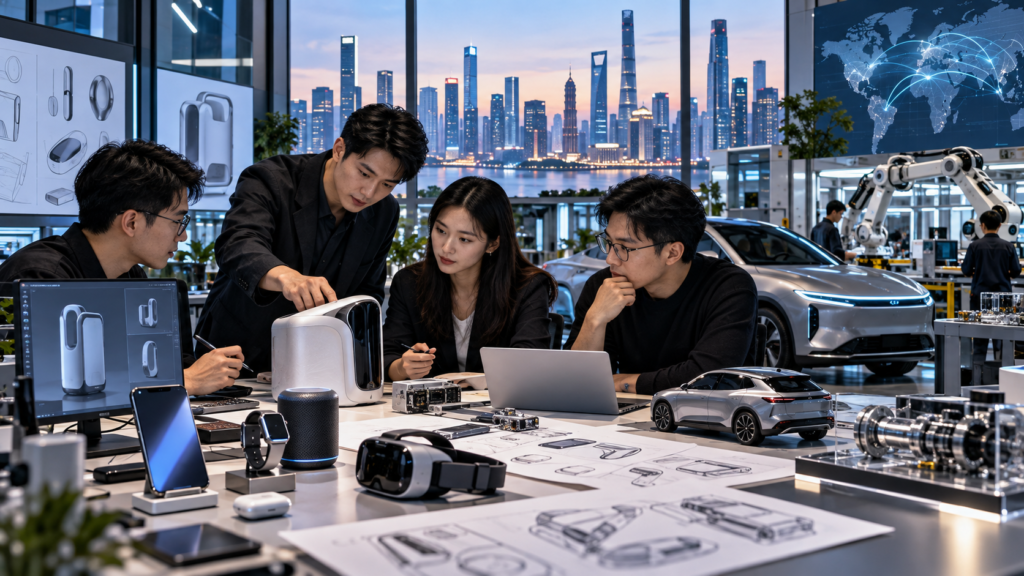
The Numbers Behind the Shift
Start with the raw data. According to the World Intellectual Property Organization, or WIPO, China filed 906,849 design applications in 2024. That is not a typo. Germany, the next closest country, filed 70,212. The United States filed 66,855. China is not leading by a small margin. It is leading by a factor of thirteen over its nearest competitor.
WIPO also reported that the top five design filing countries together accounted for nearly three quarters of all design applications worldwide in 2024. China alone made up more than half of that group. This is not a country that is dabbling in design. This is a country that has made design a core part of its industrial output.
The award data tells the same story. South Korea’s Design Promotion Agency publishes an annual design industry statistics report. Their 2024 edition found that China has held the number one spot in global design awards for years. At the iF Design Awards, one of the three most prestigious design competitions in the world, Chinese products won 1,319 awards in 2024. At the Red Dot Design Awards, another global heavyweight, China won 1,213 awards. China has held the top position at both competitions since 2020.
The growth rate is what really catches your attention. In 2020, China won 657 awards at iF. By 2024, that number had risen to 1,319, an increase of more than one hundred percent in four years. At Red Dot, the increase over the same period was more than ninety percent. This is not a plateau. It is an acceleration.
Government Policy Turned Design into a National Priority
None of this happened by accident. In 2015, the Chinese government launched a program called Made in China 2025. The goal was simple to state and hard to execute. Transform Chinese products into Chinese brands. Turn speed into quality. Turn manufacturing into creation.
The policy explicitly named design as a strategic priority. It was not treated as an afterthought or a luxury for high end products. It was written into the national industrial strategy. The Chinese government understood something that many other countries still miss. Design is not decoration. It is the bridge between what a factory can produce and what a customer actually wants.
Between 2020 and 2024, China’s imports and exports of intellectual property royalties grew at an average annual rate of 5.7 percent. That is a sign of a country that is not just producing ideas but also buying and selling them. The World Intellectual Property Organization ranked China eleventh globally in its Global Innovation Index for 2024, the highest position of any middle income economy.
The policy also invested in design education. Tsinghua University’s Academy of Arts and Design celebrated sixty years of industrial design education in 2024. Hunan University’s industrial design department, one of the oldest in the country, has been training designers since 1982. The Chinese government has funded design programs at universities across the country, building a talent pipeline that now feeds directly into companies like Huawei, Xiaomi, and BYD.
If you want to understand why Chinese design improved so fast, you cannot skip this part. The government treated design as infrastructure. Not as a nice to have, not as something the private sector would figure out on its own, but as a national capability worth building.
The Supply Chain Speed Advantage
Here is where the story gets really interesting for anyone in Nigeria who imports or manufactures. Design is not just about how something looks. It is about how quickly you can test an idea, fix what is wrong, and get a better version to the customer.
China has built the fastest product iteration system in the world. A report from China Daily described the country’s manufacturing sector as defining the global benchmark for industrial speed, with unusually fast feedback loops between production, engineering, and customers. Engineers can make a design change, send it to suppliers, modify tooling within hours, and resume production with minimal disruption.
Shenzhen, the tech hub in southern China, has a saying that captures this. Morning design, afternoon prototype, next day mass production, one week export. That is not a marketing line. It is a description of how the ecosystem actually works.
Think about what that means for design quality. If you can test ten versions of a product in the time it takes a competitor to test one, you will end up with a better product. Chinese companies are not just designing more. They are designing faster, learning from each version, and shipping the improved version before anyone else has finished the first round.
This speed advantage is not something a single company built. It is the result of thousands of suppliers, factories, engineers, and designers all operating in the same geographic and industrial ecosystem. The entire system is set up to compress the time between idea and product.
For Nigerian businesses, this is both a challenge and an opportunity. The challenge is obvious. It is hard to compete on speed when your supply chain is slower and more fragmented. The opportunity is that you can plug into this system. You can work with Chinese design partners and manufacturers to iterate faster than you could on your own.
Education and the Talent Pipeline
You cannot have a design revolution without designers. China has been building its design education system for decades.
Tsinghua University’s industrial design program is sixty years old. Hunan University started its program in 1982. These are not new programs created to chase a trend. They are established departments with alumni networks that stretch across the Chinese manufacturing sector.
The Chinese government has continued to invest. A 2019 policy document from thirteen government departments outlined a plan to develop over 200 national level industrial design centers and create around 100 manufacturing design training bases. The goal was not just to train designers but to connect design education directly to industry.
The result is a deep pool of design talent. Pop Mart, the company behind the Labubu figurines that have become a global phenomenon, has a design team of 2,000 people. That is larger than the entire design department of most global consumer brands. A company representative told China Daily that design is the company’s core competitiveness.
When you have that many trained designers working in the same ecosystem, innovation becomes a numbers game. More designers mean more experiments. More experiments mean more hits. More hits mean more revenue to reinvest in design. It is a virtuous cycle.
Nigeria does not have this pipeline yet. A 2026 study on Nigerian industrial design found that funding and government policy are rated as the most severe barriers to growth in the field. Another study noted that Nigerian industrial design grew out of fine and applied arts departments, which means it is often treated as an artistic pursuit rather than an industrial capability. That is a structural problem. Design that is not connected to manufacturing cannot drive manufacturing growth.
What Chinese Designers Actually Do Differently
The numbers and the policy explain how China built the capability. They do not explain what Chinese designers actually do that is different. Let me get specific.
The first difference is customer obsession. McKinsey’s research on Chinese innovation identified a category they call customer focused innovation. This is where companies succeed by identifying unmet needs and building products around them. Chinese designers are not starting with what the factory can make. They are starting with what the customer is missing.
The second difference is speed of iteration. Chinese companies do not spend years perfecting a product before launch. They launch, watch how people use it, and improve it. The feedback loop between designer and user is short and constant. This is only possible because the supply chain allows rapid changes.
The third difference is cultural confidence. For a long time, Chinese design meant copying Western design. That has changed. Laopu Gold, a Chinese jewelry brand, fuses traditional Chinese craftsmanship with contemporary aesthetics. When it opened its first overseas store in Singapore in June 2025, people queued for hours. Over ninety percent of visitors were first time customers, drawn by the brand’s design and craftsmanship. The company’s revenue and profit grew by 166 percent and 254 percent respectively in 2024.
This is what happens when designers stop trying to look Western and start drawing from their own culture. The result is something that feels new because it is not a copy of anything else.
The fourth difference is integration with engineering. Chinese designers are not working in isolation. They sit alongside engineers, manufacturers, and supply chain specialists. Design decisions are made with production constraints in mind from the beginning. This means fewer designs get stuck in development hell because they are impossible to manufacture at scale.
The Electric Vehicle Example
Nowhere is the Chinese design advantage more visible than in electric vehicles. Companies like BYD, Nio, Xiaomi, and Zeekr are producing cars that compete on design, software, and user experience, not just on price.
At the 2025 Canton Fair, also known as the China Import and Export Fair, more than 350,000 smart products were displayed. The fair’s design innovation awards recognized 167 products, with intelligent products growing by thirty percent and green products growing by thirty seven percent compared to the previous year. The message from Chinese manufacturers was clear. Their competitive advantage now comes from excellent design, good user experience, and technological improvement, not from low prices.
Nio, a Chinese electric vehicle company founded in 2014, has obtained 9,800 global patents. It has built over 3,000 battery swap stations in China and Europe, and it holds the record for the longest range electric vehicle battery in the world. This is a company that is not just designing cars. It is designing an entire ecosystem around how people use electric vehicles.
The speed of Chinese vehicle development is also striking. Some Chinese automakers have compressed the development cycle for a new car to twenty four months, significantly faster than traditional international automakers. Faster development cycles mean more opportunities to test designs in the real world and improve them.
For Nigerian consumers, this matters because it changes what you can expect from a Chinese product. The days when “Chinese” meant a compromise on quality or aesthetics are ending. The electric vehicles, phones, home appliances, and consumer goods coming out of China today are designed to compete with the best in the world.
What This Means for Nigerian Designers and Businesses
You might be reading this and wondering what any of it has to do with you. Nigeria is not China. Our manufacturing sector is smaller. Our design education system is less developed. Our supply chains are less integrated. All of that is true.
But the Chinese design story is not just a story about what China did. It is a story about what design can do for a country that decides to take it seriously. And there are practical lessons for Nigerian businesses and designers.
The first lesson is to stop treating design as decoration. Design is not the logo on the box or the color of the packaging. It is the entire experience of using a product. How does it feel in the hand? How easy is it to understand without a manual? How does it solve a problem the user actually has? Nigerian businesses that start asking these questions will build better products.
The second lesson is to invest in user research. Chinese designers succeed because they know what customers want before they build it. Nigerian businesses often build first and ask questions later. A 2024 article in the Guardian Nigeria noted that product failures in Nigeria often stem from an inability to keep pace with market changes and a lack of product market fit. The solution is not more marketing. It is better listening.
The third lesson is to build local supply chain links. China’s design advantage is inseparable from its manufacturing ecosystem. Nigerian designers who work in isolation from manufacturers will struggle to turn ideas into products. The reverse is also true. Manufacturers who ignore design will keep producing goods that compete only on price.
The fourth lesson is to be patient. China did not build its design capability overnight. It took decades of policy support, educational investment, and industrial development. Nigerian designers and businesses should not expect to match that overnight either. But the direction of travel is clear. Design is where the value is. Countries and companies that build design capability will capture more of that value.
A 2026 study on Nigerian industrial design found that fifty one percent of respondents reported no integration of sustainability into their design work, and only four point four percent treated it as a core principle. That is a gap, but it is also an opportunity. Designers who build sustainability into their work from the beginning will be ahead of the curve as global buyers and consumers demand more responsible products.
The Risk of Copying Instead of Learning
There is a temptation when you see a successful model to copy it directly. Chinese designers copied Western products for years. That phase did not build a competitive advantage. It built a reputation for imitation. The advantage came when Chinese companies started designing for their own market, drawing on their own culture, and solving problems that Western companies had not solved.
Nigerian designers and businesses should avoid the same trap. Do not copy Chinese products. Learn from how Chinese companies approach design. Learn from their obsession with the customer. Learn from their speed of iteration. Learn from their integration of design and manufacturing. Then apply those principles to Nigerian problems.
What does that look like in practice? It could be a furniture company that designs for the way Nigerian families actually live, with products that handle humidity, dust, and multi purpose use. It could be a food packaging company that designs for Nigerian storage conditions and distribution realities. It could be a fintech company that designs for the specific financial behaviors of Nigerian users.
The point is not to be Chinese. The point is to be as serious about design as Chinese companies have become.
What to Watch Next
If you are a Nigerian importer, you will notice the change in your supplier conversations. More Chinese manufacturers are leading with design. They will show you prototypes, user interface mockups, and packaging concepts. They will ask what you want your customers to feel when they open the box. This is not just sales talk. It reflects a real shift in how Chinese companies compete.
If you are a Nigerian designer, you will see more opportunities to work with Chinese companies. Chinese firms are globalizing, and they need designers who understand local markets. A Nigerian designer who understands both the Chinese manufacturing system and the Nigerian consumer is a valuable bridge.
If you are a Nigerian business owner, the lesson is simpler. Design is not a cost center. It is a competitive weapon. Companies that invest in design will build products that people want to buy and keep. Companies that do not will keep competing on price until someone cheaper comes along.
For a deeper look at how to source products from China for your Nigerian business, you can read our guide on working with Chinese manufacturers. If you are still figuring out the import process, our article on understanding import documentation in Nigeria walks you through the basics.
Conclusion
The Chinese product design advantage is real, and it is growing. China filed more design applications in 2024 than the next four countries combined. Chinese companies are winning thousands of global design awards every year. The government has made design a national priority, invested in design education, and built a supply chain that allows for incredibly fast iteration. The result is a generation of Chinese products that compete on design, not just price.
The three most important takeaways for Nigerian readers are these. First, design is a strategic capability, not a decoration. Countries and companies that treat it that way capture more value. Second, speed matters. The ability to test, learn, and improve faster than competitors is a design advantage. Third, culture is a design asset. Chinese designers stopped copying and started drawing from their own traditions, and that is when global audiences started paying attention.
If you take one step today, let it be this. Look at the last product you imported or manufactured. Ask yourself one question. If you took away the price, would anyone still want it because of how it looks, feels, or works? If the answer is no, you have just found your design opportunity. Start there.