
I walked through Computer Village in Lagos last month and watched a young man repair a Tecno phone using a replacement screen he had ordered from a supplier in Shenzhen. He had never been to China. He did not speak Mandarin. But he was plugged into a supply chain that stretches from a factory floor in Guangdong to a market stall in Ikeja, and he understood it better than most people with business degrees. That is the thing about China’s technology ecosystem that outsiders often miss. It is not just about the technology itself. It is about the system that connects factories, universities, governments, and entrepreneurs into a single machine that moves ideas from concept to product faster than almost anywhere else on earth.
This article is for Nigerian policymakers, entrepreneurs, students, and anyone who wants to understand what Africa can actually learn from China’s approach to building a technology ecosystem. I have spent years working with importers and watching how Chinese products move through Nigerian markets. What I have learned is that the products we see are the output. The system that produces them is the real story. In this piece, I will break down the five pillars of China’s technology ecosystem, show how Africa is already applying some of these lessons, name the real obstacles that stand in the way, and give you three specific steps you can take to position yourself for what is coming.
The Three Pillars of China’s Innovation Model
To understand what China built, you need to understand the structure. A 2025 analysis published in Nature, one of the world’s most respected scientific journals, described China’s innovation ecosystem as resting on three pillars. State-led planning, deep university participation, and agile enterprise execution. The three work together in a way that is fundamentally different from the venture capital driven model of Silicon Valley.
In Silicon Valley, private investors dominate. They fund startups, accept that most will fail, and celebrate the ones that succeed. The state plays a limited role. In China, the state plays a central role. Government departments and local innovation funds pour billions of yuan into university affiliated businesses, knowing that most will not achieve commercial success. But the ones that do can redefine entire industries.
This is not a small distinction. It changes how risk is distributed. In the American model, private investors absorb the risk of failure. In the Chinese model, the state absorbs a significant portion of that risk. That allows Chinese companies to attempt things that private investors might consider too risky or too slow to return capital. It also explains why China has been able to build capabilities in fields like batteries, electric vehicles, and semiconductors, where the payoff takes years or decades to materialize.
For African countries, this raises a fundamental question. Should governments play a more active role in funding and directing technology development, or should they leave it to the private sector? The Chinese experience suggests that the answer is not either or. It is about finding the right balance between state direction and private execution.
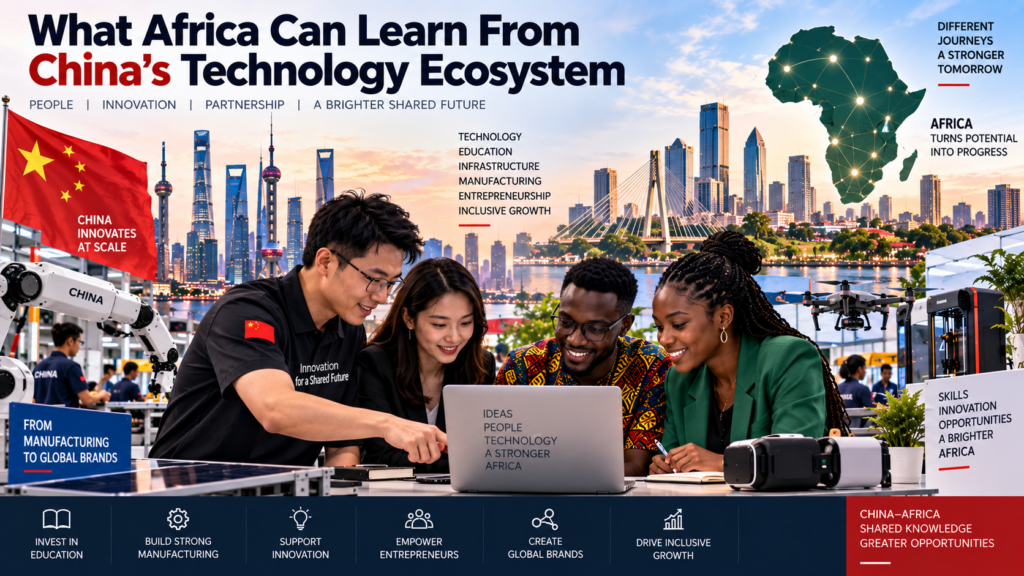
How Shenzhen Became a Blueprint for Ecosystem Building
If you want to understand how China’s ecosystem works in practice, you need to look at Shenzhen. In the late 1970s, Shenzhen was a fishing village across the river from Hong Kong. Today it is one of the most important technology hubs in the world. The transformation did not happen by accident.
Shenzhen began as China’s first Special Economic Zone, an experiment in a Chinese version of capitalism. It started with low cost manufacturing, then moved to knockoff products, then to innovation tailored to specific markets, and finally to the creation of distinctly new products. Each phase built on the capabilities developed in the previous one. A scholar of the Shenzhen ecosystem described it as resembling a farmers market of entrepreneurs who make components and collaborate to quickly bring new products to market.
What makes Shenzhen different from Silicon Valley is the speed at which experiments happen and the focus on collaboration rather than intellectual property protection. In Silicon Valley, companies compete fiercely and protect their innovations through patents. In Shenzhen, the ecosystem is built on the assumption that ideas will be shared, adapted, and improved by others. That culture of collaboration is what allows ideas to move from concept to mass production in weeks rather than years.
For African cities, the Shenzhen model offers a template. You do not need to start with cutting edge research. You can start with manufacturing, then move to adaptation, then to innovation. The key is to build the capabilities at each stage before moving to the next. Lagos, Nairobi, and Accra all have the raw ingredients. What they often lack is the coordination between government policy, university research, and private enterprise that makes the ecosystem function as a system rather than a collection of isolated actors.
The Role of Universities in China’s Tech Ecosystem
One of the most important lessons from China’s experience is the role that universities play. In China, universities are not just places where students learn. They are engines of commercial innovation.
The Torch Programme, launched by China’s Ministry of Science and Technology in 1988, was designed to commercialize research outputs from universities and institutes. It set up special research zones that provided incentives for startups, including tax breaks, easier access to credit, land, and infrastructure. The most famous of these zones is Zhongguancun in Beijing, which became known as China’s Silicon Valley.
In 2014, China launched the Mass Innovation and Entrepreneurship plan, which sought to spark grassroots innovation across the country. It funded innovation spaces and incubators, expanded access to venture capital and angel funding, and explicitly encouraged universities to spin off research into new companies, with scientists taking equity stakes in the firms.
The results are visible in companies like Likang Life Sciences, an mRNA cancer vaccine startup with links to Tsinghua University. Likang is using Tsinghua’s pool of researchers by jointly establishing an AI for Medicine laboratory to promote a vaccine that can be tailored to individual patients using genetic sequencing.
For African universities, this is a direct challenge. Too often, African universities operate in isolation from industry. Research is done for publication, not for commercialization. Students graduate with theoretical knowledge but limited practical experience. The Chinese model shows what becomes possible when universities are encouraged to spin off companies, when professors can take equity in the businesses they help create, and when the curriculum is designed in partnership with the industries that will hire the graduates.
A 2025 report in the Sun Nigeria described this gap clearly. The author, reflecting on a University of Cambridge EMBA trek across Hong Kong and Shenzhen, wrote that Africa has enough talent, creativity, and entrepreneurial energy to lead globally, but what it lacks is alignment. Governments legislate in silos. Universities teach in silos. Startups innovate in silos. The result is effort without momentum.
The Infrastructure Foundation That Makes Everything Possible
You cannot build a technology ecosystem without infrastructure. This is the part that is hardest for African countries to replicate because it requires sustained investment over decades.
In the past decade, Chinese companies have laid hundreds of thousands of kilometers of fiber optic cables across Africa, built thousands of mobile towers, and helped establish regional data centers. Major Chinese built data centers are now operating in Nigeria, Kenya, South Africa, and Egypt, powering services from mobile banking to e-governance. China’s support has extended to 5G rollout, with Huawei and ZTE partnering with African telecom operators to establish 5G networks in cities such as Johannesburg, Nairobi, and Lagos.
These networks have enabled real time connectivity, e-learning, and telemedicine for millions of people. A memorandum of understanding signed between South Africa and China Satellite Network Group aims to bring broadband connectivity to remote schools and businesses through satellite based internet. The Africa Digital Empowerment and Innovation Hub, co-launched by the United Nations Development Programme and the China Academy of Information and Communications Technology, has begun training thousands of African youths and officials in AI, cloud computing, cybersecurity, and entrepreneurship.
But the infrastructure gap remains enormous. Africa accounts for roughly 18 percent of the world’s population but has less than one percent of global data center capacity. Internet penetration on the continent stands at 38 percent, far below the global average of 68 percent. The continent produces under one percent of global AI research output and faces significant energy constraints for AI computing.
This is the paradox that Brookings described in a 2026 report on Africa’s AI strategy. The greatest risk is not missing the AI revolution, but joining it too early. Just as many countries once industrialized prematurely, importing factories before developing skilled labor and supply chains, Africa now risks premature automation, adopting AI technologies before building the digital foundations to harness them productively.
What Africa Is Already Doing Right
The picture is not all bleak. Across the continent, there are examples of African countries and companies applying the lessons of China’s ecosystem in ways that are adapted to local conditions.
Nigeria’s Federal Government inaugurated a National Digital Cloud Policy in August 2026. The policy provides a national framework for the growth, governance, and internationalization of Nigeria’s cloud computing and data infrastructure ecosystem. It aims to position Nigeria as a regional digital services and hosting hub, attracting investment, strengthening indigenous digital capabilities, creating jobs, and expanding digital service exports. The government has set a target of mobilizing 250 million dollars in private investment within 12 months, rising to 750 million dollars within 24 months.
The policy has four key priorities. Investment and market development. Regional digital services exports. Government cloud transformation. Digital sovereignty and security. The government has also committed to leveraging its collective purchasing power to accelerate domestic infrastructure investment through whole of government aggregation and coordinated procurement.
This is exactly the kind of state-led infrastructure investment that China used to build its own digital economy. The difference is scale, but the principle is the same. The government creates the conditions, the private sector executes, and the ecosystem grows.
African tech startups raised 4.1 billion dollars in equity and debt funding in 2025. Fintech remained the largest sector, attracting 1.49 billion dollars, while cleantech funding almost doubled to 1.18 billion dollars. The shift matters because it shows that African entrepreneurs are moving beyond fintech into the sectors that will define the next decade. Energy, agriculture, logistics, and healthcare are all attracting more investment.
In Kenya, mobile money platforms like M-Pesa have achieved penetration rates that exceed anything in the developed world. Africa leads the world in mobile money, accounting for more than 50 percent of the global mobile money accounts. Domestic e-payment markets are projected to exceed 40 billion dollars in revenues by 2026, growing at 20 percent a year, outpacing the global average of 7 percent.
These are not small achievements. They show that when African countries create the right regulatory environment and when entrepreneurs are given room to innovate, the results can be world class.
The Risks and Obstacles That Stand in the Way
It would be dishonest to write about what Africa can learn from China without acknowledging the obstacles that make the Chinese model difficult to replicate.
The first obstacle is the infrastructure deficit. Africa’s annual infrastructure financing shortfall is estimated at between 68 billion and 108 billion dollars by the African Development Bank. Poor roads, unreliable power, and expensive logistics increase the cost of doing business. A data center cannot operate competitively where electricity costs are high and grid reliability is poor. An agricultural technology company cannot optimize production at scale if farmers lack dependable power and internet access.
The second obstacle is the financing gap. High costs of capital, limited risk sharing mechanisms, currency risks, and insufficient early stage financing continue to inhibit investment in digital infrastructure and innovation ecosystems. As one African financial institution executive put it, Africa’s innovation challenge is not a shortage of ideas. It is a shortage of long term, affordable, and well structured financing.
The third obstacle is the risk of dependency. If Africa imports all its AI models, all its batteries, and all its cloud capacity from China or the United States, it remains dependent on foreign supply chains. This is not inherently bad. Global trade is built on specialization. But it does mean that African countries need to think carefully about where they can add value and where they are simply consuming.
A fourth obstacle is the risk of premature automation. With nearly 12 million Africans entering the job market each year but only about 3 million formal jobs being created, unemployment and underemployment remain structural. If AI is deployed hastily, it could displace workers in key sectors like call centers in Kenya and Rwanda, logistics operations in South Africa, or financial back office services in Nigeria, before alternative employment opportunities emerge.
What African Governments Should Do
If you are a policymaker or government official, the Chinese experience offers specific lessons.
Align Policy Across Ministries and Agencies
The first lesson is that technology policy cannot be siloed. In China, the Ministry of Science and Technology, the National Development and Reform Commission, the Ministry of Industry and Information Technology, and local governments all coordinate on technology policy. In most African countries, different ministries and agencies often work at cross purposes. The Ministry of Education trains graduates for jobs that the Ministry of Industry is not creating. The Ministry of Finance funds infrastructure that the Ministry of Communications cannot maintain. Aligning these priorities is the first step.
Use Government Procurement to Build Demand
The second lesson is that governments can use their purchasing power to accelerate the growth of local technology companies. Nigeria’s Cloud First Policy is a good example. By committing to purchase cloud services from domestic providers, the government creates a guaranteed market that allows those providers to invest in infrastructure and hire talent. This is exactly what China did when it directed government agencies to purchase from domestic technology companies.
Invest in Skills at Every Level
The third lesson is that technology ecosystems need people with a wide range of skills, not just software engineers. They need electricians who can install solar panels. They need technicians who can maintain data centers. They need project managers who can coordinate complex infrastructure projects. They need lawyers who understand intellectual property and data governance. Investing in vocational training alongside university education is essential.
What African Entrepreneurs Should Do
If you are an entrepreneur or business owner, the Chinese experience offers a different set of lessons.
Build for the Customer Who Actually Exists
The first lesson is to build for the customer who is actually there. Chinese companies like Transsion succeeded in Africa because they built phones for the conditions that existed on the ground. Long battery life because power supply is unreliable. Dual SIM support because network quality varies. Cameras optimized for darker skin tones. African entrepreneurs should apply the same principle. Build for the customer in front of you, not the customer you read about in a case study.
Connect to the Supply Chain, Not Just the Market
The second lesson is to connect to the supply chain, not just the market. The young man in Computer Village who repairs phones is part of a global supply chain. He knows where to get parts, how to negotiate prices, and how to manage inventory. That knowledge is valuable. African entrepreneurs who understand supply chains have an advantage over those who only focus on sales. If you are an importer, learn where your products come from. Visit the factories if you can. Build relationships with suppliers. That knowledge is the foundation of a durable business.
Think in Systems, Not Transactions
The third lesson is to think in systems, not transactions. Chinese companies in Africa operate with a systems mindset. They study the entire value chain, from production to distribution to payment to after sales service. They build distribution networks, service infrastructure, and local manufacturing capacity because they are playing a long game. African entrepreneurs who adopt the same mindset will build businesses that last.
Three Steps You Can Take Today
If you want to apply the lessons from China’s technology ecosystem to your own context, here are three specific things you can do this week.
Map Your Local Ecosystem
Take a piece of paper and draw a map of the technology ecosystem in your city or region. Who are the universities? Who are the startups? Who are the investors? Who are the government agencies? Who are the established companies? Draw lines between them to show how they connect. The gaps in your map are the opportunities. If there is no line between the university and the startups, that is a connection waiting to be built.
Learn One Skill That the Ecosystem Needs
Technology ecosystems are not just built by engineers. They are built by people with a wide range of skills. If you are a student, learn a skill that the ecosystem needs. It could be coding. It could be data analysis. It could be project management. It could be digital marketing. The point is to develop a skill that makes you valuable to the companies that are building the future.
Start a Conversation with Someone in the Ecosystem
Reach out to one person who is doing work you admire in the technology space. It could be a founder. It could be a researcher. It could be a government official. Ask them one question. What is the biggest obstacle you face in your work? Listen carefully. The answer will tell you where the opportunities are. It will also tell you where the ecosystem is broken. That is where you can make a difference.
Conclusion
China’s technology ecosystem was not built overnight. It took decades of state investment, university engagement, and entrepreneurial execution. The three pillars of that system are state-led planning, deep university participation, and agile enterprise execution. Shenzhen showed how a fishing village can become a global technology hub in a single generation. The Torch Programme and the Mass Innovation and Entrepreneurship plan showed how universities can become engines of commercial innovation. The infrastructure investment showed how governments can create the conditions for private sector growth.
The three most important takeaways for African readers are these. First, alignment matters more than money. Africa has talent, creativity, and entrepreneurial energy. What it often lacks is alignment between government, universities, and the private sector. Second, infrastructure is the foundation. You cannot build a digital economy on unreliable power and expensive connectivity. Third, the model must be adapted, not copied. China’s system works for China. African countries need to find their own version, suited to their own conditions and priorities.
If you take one step today, let it be this. Draw a map of the technology ecosystem in your city. Identify one gap. It might be a missing connection between a university and a startup. It might be a missing service that no one is providing. It might be a missing skill that no one is teaching. Whatever the gap is, write it down. Then ask yourself one question. What could I do to fill that gap? That is how ecosystems are built. Not by waiting for someone else to do it. By identifying the gap and starting to fill it yourself.
For a deeper look at how Chinese brands compete on price, technology, and design, you can read our article on the competitive strategies behind their success. If you want to understand how Chinese companies are building their African market strategy, our guide on their playbook for the continent covers the details.