
I held a small silver cell in my hand last year at a trade fair in Lagos. It was a sodium-ion battery, lighter than the lithium packs I was used to, and the Chinese supplier told me it would work at temperatures that would kill a normal battery. I did not believe him until he put it in a freezer for an hour and then used it to power a fan. That moment stayed with me because it showed something that most Nigerians are only beginning to grasp. The battery in your phone, your inverter, and soon your car is the product of a race that is being run right now, in laboratories and factories across China. The next generation of batteries will determine what you can afford to buy, how long it lasts, and whether electric transport ever becomes practical for the average Nigerian household.
This article is for Nigerian importers, technicians, business owners, and anyone who wants to understand where battery technology is heading. I have spent years working with importers and watching how Chinese products move through Nigerian markets, from inverters to solar panels to electric motorcycles. What I have learned is that the battery is almost always the most important and least understood part of the product. In this piece, I will show you the scale of China’s battery industry, explain the three technologies that are competing to power the next decade, name the companies leading the race, examine what this means for Africa and Nigeria specifically, and give you three concrete steps you can take if you want to position yourself for what is coming.
The Scale of China’s Battery Dominance
Before looking at the future, you need to understand the present. China does not just lead the global battery industry. It dominates it in a way that has almost no parallel in modern manufacturing.
In 2025, Chinese companies produced more than 1.8 terawatt hours of lithium-ion batteries, according to the China Chemical and Physical Power Industry Association. That figure represents 82.8 percent of global lithium-ion battery shipments. The battery sector in China generated revenue from enterprises above a designated size that crossed hundreds of billions of yuan, with average annual growth above 20 percent over the past five years. Globally, the installed base of power batteries reached 1,187 gigawatt hours in 2025, a 31.7 percent increase from the previous year, and Chinese firms accounted for more than 70 percent of that total.
The concentration of market power is even more striking. CATL, the world’s largest battery maker, held 464.7 gigawatt hours of installed capacity in 2025, maintaining its position as the global leader for a ninth consecutive year. Together with BYD, CATL accounts for 55.6 percent of global installed capacity. Six Chinese companies rank in the global top ten, and their combined market share crossed 70 percent for the first time.
The manufacturing capacity behind these numbers is enormous. China’s nominal lithium-ion battery manufacturing base approached 3.5 terawatt hours in 2025, with an additional 3.5 terawatt hours under construction or planned. That means Chinese battery companies have operating capacity that is roughly four times current global demand. That overcapacity is a problem for the companies, but it is an opportunity for consumers. When supply exceeds demand, prices fall.
For Nigerian importers, this is the context that matters. The battery packs you buy for solar systems, inverters, and electric bikes are cheaper and more available because of this scale. But the next generation of batteries will change the economics even more dramatically.
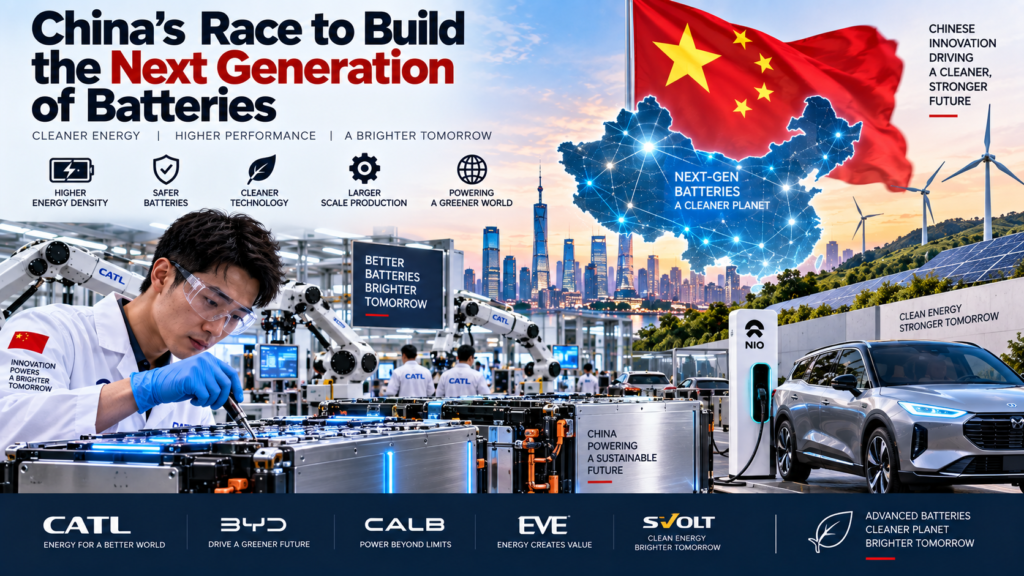
Three Technologies Competing for the Future
The race to build the next generation of batteries is not a single race. It is three races running at the same time, each with different trade offs and different timelines.
Sodium-Ion Batteries: The Cost Killer
The first technology is sodium-ion. Sodium is roughly one thousand times more abundant in the earth’s crust than lithium, and it is far cheaper to obtain. A sodium-ion battery uses sodium salts as the main electrode material instead of lithium, which removes the most expensive and supply constrained input from the battery.
The cost data is compelling. A 2025 study published in the journal Next Energy used process based cost modeling to compare lithium-ion and sodium-ion batteries. The study found that sodium-ion batteries based on certain cathode chemistries cost between 54 and 62 dollars per kilowatt hour, compared with higher costs for lithium iron phosphate and nickel manganese cobalt lithium-ion cells. A separate report from the International Renewable Energy Agency placed sodium-ion battery costs at 90 to 125 dollars per kilowatt hour, approaching the 75 to 105 dollar range for lithium-ion.
CATL, the Chinese battery giant, became the first company in the industry to announce mass production plans for sodium-ion batteries. The company unveiled its Naxtra brand in April 2025 and began mass production in December of that year. The Naxtra batteries for passenger vehicles have an energy density of 175 watt hours per kilogram, which is almost the same as lithium iron phosphate batteries. They support fast charging, enable hybrid electric and pure electric vehicles to achieve ranges of 200 and 500 kilometers respectively, and can maintain full power even at temperatures as low as minus 40 degrees Celsius. The 24 volt start stop batteries for heavy duty trucks have a service life of over eight years, which can reduce total lifecycle costs by 61 percent compared with traditional lead acid batteries.
The safety profile is another advantage. CATL’s sodium-ion batteries had no fire and no explosion incidents during testing, even under extreme conditions such as multi directional compression, needle penetration, electric drill piercing, and battery saw cutting.
For Nigerian users, the most important property may be the cold weather performance. Nigeria does not have cold weather, but the fact that the battery can operate at minus 40 degrees without losing power means it is robust. A battery that works in a freezer will almost certainly work in the heat and humidity of Lagos.
Solid-State Batteries: The Energy Density Leap
The second technology is solid-state. A solid-state battery replaces the liquid electrolyte in a conventional lithium-ion battery with a solid material. That change allows for higher energy density, faster charging, and improved safety, because the solid electrolyte is less flammable than the liquid one.
The progress in solid-state batteries has been rapid. In May 2026, Ganfeng Lithium announced that its 10 ampere hour lithium metal solid-state battery with an energy density of 500 watt hours per kilogram had entered small batch production. The company described it as the world’s first solid-state product to achieve that energy density at that cell size. Ganfeng’s 400 watt hour per kilogram solid-state battery has exceeded 1,100 charge cycles and completed engineering validation. The company is pursuing two parallel solid-state routes based on silicon carbon and lithium metal anodes.
Other companies are moving quickly. Eve Energy rolled out two all-solid-state batteries in March 2026, one for consumer electronics and one for automotive applications. A production facility with an annual capacity of 100 gigawatt hours was scheduled to be operational by December 2026. Dongfeng Motor is advancing production plans for an oxide polymer cell scheduled for integration in the second half of 2026. Changan plans to start trial installations of 400 watt hour per kilogram solid-state batteries during 2026.
The Chinese government is supporting the push. China’s first national standard for vehicle solid-state batteries took effect in 2026, paired with a consumption tax exemption. The Ministry of Industry and Information Technology is directing research funding toward three next generation battery chemistries with energy densities that could reach more than twice that of current lithium-ion batteries. A project to build a pilot production line for square solid-state power batteries was launched in Suzhou in August 2026, with a first phase capacity of 0.2 gigawatt hours and a goal of achieving mass production within two years.
But solid-state batteries are not yet ready for mass market. The head of CATL publicly cautioned in June 2026 that solid-state batteries are still years away from mass market adoption. The technology faces challenges in materials, manufacturing processes, equipment, and cost. The current focus is on semi-solid and hybrid batteries that offer improvements over liquid lithium-ion without the full complexity of all-solid-state designs.
Blade Battery and the Evolution of Lithium-Ion
The third technology is not a new chemistry. It is an evolution of lithium-ion itself, and it is already in production.
BYD’s Blade Battery, first launched in 2020, uses lithium iron phosphate chemistry in a long, flat cell format that can be integrated directly into the battery pack without modules. The design increases volume utilization and improves safety. The first generation achieved a weight energy density of 180 watt hours per kilogram, with a lifespan exceeding one million kilometers and more than 3,000 charge cycles. The cell passed a 46 tonne truck crush test and a nail penetration test without catching fire.
In March 2026, BYD launched the second generation Blade Battery alongside a new flash charging network. The company claims the combination can recharge the battery from 10 to 70 percent in five minutes and from 10 to 97 percent in nine minutes. Two cell formats are offered. One features an energy density of 160 watt hours per kilogram with a maximum discharge rate of 16C and an 8C charge rate, suitable for high power applications. The other delivers up to 210 watt hours per kilogram with an 8C discharge rate and a 3C charge rate, catering to vehicles that prioritize range and efficiency.
The Blade Battery matters for Nigeria because it is already in production and already available in vehicles that are sold in African markets. BYD entered Nigeria in 2025 through LOXEA Nigeria, a subsidiary of CFAO Mobility, and the company’s vehicles use Blade Battery technology. When you buy a BYD in Lagos, you are buying a battery that has been tested for safety and durability in conditions far more extreme than anything you will encounter on Nigerian roads.
The Supply Chain That Makes It Possible
The technologies are impressive, but they would not exist without the supply chain behind them. China’s advantage in batteries is not just about chemistry. It is about the entire industrial ecosystem.
China holds 63 percent of the key enterprises in the global humanoid robot component supply chain, but its dominance in battery components is even more complete. The country produces 97 percent of the world’s lithium iron phosphate cathode material. It dominates the processing of lithium, cobalt, nickel, and graphite, the raw materials that feed battery factories. A battery factory in China can source cells, modules, battery management systems, and thermal management components from suppliers within a few hours drive.
That proximity translates into speed. The Shenzhen ecosystem, which I have written about before in the context of electronics, applies equally to batteries. A company can design a new battery pack, source the components, build a prototype, and test it in weeks rather than months. That iteration speed is almost impossible to match anywhere else in the world.
For Nigeria, this supply chain dominance has a practical implication. Almost every battery that enters the Nigerian market, whether in a phone, an inverter, a solar system, or an electric vehicle, contains Chinese components or is assembled in a Chinese factory. That is not a temporary situation. It is a structural feature of the global battery industry.
What This Means for Africa and Nigeria
The battery race is not happening in a vacuum. It has direct implications for African consumers, businesses, and governments.
Cheaper Energy Storage
The most immediate benefit for Nigerian households and businesses is cheaper energy storage. The cost of lithium iron phosphate batteries has fallen dramatically over the past decade, and sodium-ion batteries promise to push costs even lower. A 2025 report from BloombergNEF found that China supplied 95 percent of South Africa’s imported batteries in 2025. The same supply chain serves Nigeria.
For a Nigerian family that relies on an inverter and battery system for backup power, the cost of that system is falling. A battery pack that would have cost two million naira five years ago may now cost significantly less, not because of any change in Nigerian policy, but because Chinese factories are producing at a scale that has never existed before. When sodium-ion batteries enter mass production, that cost will fall further.
The Battery Belt in Africa
The second implication is the emergence of what some analysts are calling the battery belt in Africa. Morocco is building Africa’s first battery gigafactory, a 5.6 billion dollar project backed by China’s Gotion High Tech. Production is set to begin in 2026 in Kenitra, with capacity enough for hundreds of thousands of cars. A joint venture called COBCO, involving Chinese and Moroccan partners, began producing lithium-ion battery components in Jorf Lasfar in 2025.
Egypt signed a contract with CATL to build a battery systems plant with an initial annual capacity of 1 gigawatt hour, expanding to 5 gigawatt hours in a second phase. South Africa is positioning itself as a battery manufacturing hub, with Chinese investment flowing into local assembly and component production.
These factories are not just about supplying African markets. They are about building industrial capability on the continent. When a battery gigafactory is built in Morocco, it creates jobs for engineers, technicians, and factory workers. It builds a local supply chain for components and materials. It reduces the cost of electric vehicles, solar systems, and energy storage for the entire region.
Direct Exports to Nigerian Homes
The third implication is already visible. Chinese battery manufacturers are exporting directly to Nigerian households and businesses.
Since 2025, a company called Jiyuan Wanyang Lithium Battery has exported 3,347 units of household energy storage batteries, with a total value of 19.339 million yuan. More than 70 percent of those exports went to Africa, covering Nigeria, Kenya, Ghana, and other countries. These batteries have provided clean and stable power to more than ten thousand local households.
The product is designed specifically for African conditions. It is a small household energy storage battery that is compatible with both grid electricity and solar panel charging. It can meet basic needs like lighting and phone charging, and it can also run small appliances like fans. The service life is more than five years.
That is the battery revolution in its most practical form. It is not a laboratory breakthrough or a government policy. It is a box on a shelf in a Lagos market that gives a family light at night and the ability to charge their phones, regardless of whether the grid is working.
The Problems That Remain
It would be dishonest to write about the battery race without acknowledging the problems.
The first problem is overcapacity. Chinese battery companies have built manufacturing capacity that is roughly four times current global demand. That overcapacity is driving prices down, which is good for consumers. But it is also driving consolidation and financial stress in the industry. Some companies will not survive. The ones that do will be the ones with the strongest technology and the deepest pockets.
The second problem is recycling. The world is producing batteries at a rate that will eventually create a mountain of battery waste. China is ahead of most countries in addressing this. The country recycled more than 400,000 tonnes of used power batteries in 2025, a 32.9 percent increase from the previous year, with leading companies achieving recovery rates for lithium, cobalt, and nickel that are among the most advanced in the world. By 2030, the volume of retired power batteries in China is expected to exceed one million tonnes. China has published 22 national standards covering battery recycling, including general requirements, management specifications, dismantling, residual energy testing, and regeneration. But the problem is still growing faster than the solutions.
For Nigeria, recycling is a particular challenge. Nigeria does not have a formal battery recycling industry. Batteries that reach the end of their life are often dumped or burned, releasing toxic chemicals into the environment. As more batteries enter Nigerian households and businesses, the need for proper disposal and recycling will grow.
The third problem is dependence. Nigeria imports almost all its batteries. That means the country is vulnerable to supply chain disruptions, currency fluctuations, and changes in Chinese export policy. The solution is not to build a battery industry from scratch, which would take decades and enormous capital. The solution is to move up the value chain in areas where Nigeria has a comparative advantage, such as assembly, distribution, servicing, and recycling.
Three Steps You Can Take Today
If you are a Nigerian business owner, technician, or someone looking to enter the battery space, here are three specific things you can do this week.
Learn to Identify Battery Chemistry
The first step is to understand what you are buying. Not all batteries are the same, and the differences matter. A lithium iron phosphate battery, often called LFP, has a longer cycle life and better safety than a nickel manganese cobalt battery, but lower energy density. A sodium-ion battery is cheaper and works better in cold weather, but has lower energy density than lithium-ion. A solid-state battery has the highest energy density and fastest charging, but is not yet widely available.
When you buy a battery for a solar system or an inverter, ask the supplier what chemistry it uses. Ask for the cycle life, the energy density, and the operating temperature range. A battery that is cheap but only lasts two years is more expensive than a battery that costs more but lasts ten. Write down the specifications and compare them before you buy.
Explore the Servicing and Installation Business
The second step is to look at the services around batteries. Most Nigerian businesses that sell batteries focus on import and distribution. But the real value is in installation, maintenance, and repair. A technician who can diagnose a failing battery, replace a faulty cell, or install a solar and battery system correctly is in high demand.
If you are a technician, invest in training. Learn how to test battery health, how to balance cells, and how to install battery management systems. If you are a business owner, consider adding a service arm to your import business. A customer who buys a battery from you and knows you can service it is more likely to come back.
Think About Recycling Before You Need To
The third step is to think about the end of the battery’s life before you sell it. Nigeria does not have a formal battery recycling system, but that will change. The businesses that prepare for it now will have an advantage.
If you are an importer, ask your supplier about take back programmes. If you are a distributor, consider partnering with a recycler or a collection service. If you are a technician, learn how to safely discharge and dismantle a battery for recycling. The battery boom is coming. The battery waste boom is coming too. The businesses that handle both will be the ones that last.
Conclusion
China’s race to build the next generation of batteries is not a distant story about laboratories and patents. It is a story that is already affecting what Nigerian households pay for backup power, what Nigerian drivers will pay for electric vehicles, and what Nigerian businesses can offer in the growing market for energy storage. Sodium-ion batteries promise to cut costs. Solid-state batteries promise to increase energy density and charging speed. The Blade Battery and its successors are already in production and already in vehicles that are sold in Nigerian markets. Chinese companies hold more than 70 percent of the global battery market and produce more than 80 percent of the world’s lithium-ion batteries.
The three most important takeaways for Nigerian readers are these. First, the cost of batteries will continue to fall, driven by Chinese manufacturing scale and new chemistries. That is good news for anyone who needs backup power or is considering an electric vehicle. Second, the battery supply chain is global, but the manufacturing is concentrated in China. Nigeria will import batteries for the foreseeable future, and the opportunity is in distribution, servicing, and recycling, not in manufacturing cells. Third, the next generation of batteries is already arriving. Sodium-ion is in mass production. Solid-state is in pilot production. The technology you buy today will be obsolete in five years, but the need for reliable, affordable energy storage will only grow.
If you take one step today, let it be this. Look at the battery in your inverter, your phone, or your solar system. Find out what chemistry it uses and how old it is. Then write down one question you have about it. Why does it lose capacity? How long should it last? Where will it go when it dies? Find the answer. That is how you start understanding the technology that is powering your life. The battery race is not something that is happening to you. It is something you are already part of.
For a deeper look at how Chinese electric vehicles are reaching African markets, you can read our article on the future of Chinese EVs in Africa. If you want to understand how Chinese technology is changing agriculture in Nigeria, our guide on drones, satellites, and mechanization in African farming covers the tools that are already in use.