
I held a chip in my hand last year in Shenzhen that should not exist. It was a Huawei Kirin 9030, fabricated by SMIC on a 5 nanometer class process, and it was made without the extreme ultraviolet lithography machines that every industry expert said were essential. The engineer who showed it to me smiled and said something I have not forgotten. “They told us we could not do this. So we did it anyway.” That moment captures the story of Chinese semiconductors better than any quarterly report. The fight for global relevance in semiconductors is not just a business competition. It is a race run under sanctions, against the grain of the global supply chain, and with the full weight of a national industrial policy behind it.
This article is for Nigerian importers, technicians, policymakers, and anyone trying to understand where the chips inside their phones, cars, and solar inverters actually come from and how that supply is changing. I have spent years working with importers and watching Chinese technology move through Nigerian markets. What I have learned is that semiconductors are the foundation under everything. The phone in your pocket, the inverter on your wall, the car you drive, and the solar panel on your roof all depend on chips. Understanding what is happening in Chinese semiconductors is understanding the future of the products you buy, sell, and repair.
In this piece, I will show you the numbers behind China’s semiconductor surge, profile the companies leading the charge, explain the strategies they are using to overcome export controls, examine the real challenges that remain, look at what this means for Africa and Nigeria specifically, and give you three concrete steps you can take to position yourself for what is coming.
The Numbers Behind the Surge
Start with the revenue, because the revenue tells you how far this has come. Chinese semiconductor firms reported record revenue in 2025, driven by AI demand, a global memory chip shortage, and US export restrictions that paradoxically accelerated the domestic industry’s growth. SMIC, China’s largest chip manufacturer, reported revenue of 9.3 billion dollars in 2025, a 16 percent increase from the previous year. Analysts project that revenue could top 11 billion dollars in 2026, according to LSEG estimates. SMIC’s net profit surged 39 percent in 2025, and its monthly production capacity exceeded one million wafers.
Hua Hong, another major Chinese foundry, reported fourth-quarter revenue of 659.9 million dollars and forecast sales of between 650 million and 660 million dollars for the following quarter. Moore Threads, a company aiming to rival Nvidia in graphics processing units, guided that 2025 revenue would be between 1.45 billion and 1.52 billion yuan, a 231 to 247 percent year-on-year increase.
The AI chip segment is where the growth is most dramatic. Cambricon Technologies reported first-half 2026 net profit of 2.31 billion yuan, up 122.61 percent year over year, as Beijing’s push for domestic AI chips accelerated. Huawei is projected to capture 62 percent of China’s domestic AI accelerator market in 2026, followed by Cambricon at 14 percent, according to Morgan Stanley. Nvidia’s share of the Chinese AI accelerator market has effectively collapsed to near zero.
The self-sufficiency numbers are equally striking. Goldman Sachs reported in August 2026 that China’s semiconductor integrated circuit self-sufficiency rate by unit count reached 70 percent as of June 2026, nearly doubling from 38 percent in 2010. The country’s advanced process gap, the shortfall in 7 nanometer and below capacity, is projected to shrink from 92 percent in 2025 to 34 percent by 2035.
These are not projections. They are numbers that have already been reported. The chips are being made, the revenue is being booked, and the self-sufficiency rate is climbing faster than almost anyone predicted.
The Companies Fighting for Relevance
The Chinese semiconductor industry is not a single company or a single strategy. It is a collection of companies, each fighting for relevance in a different part of the value chain.
SMIC: The Foundry That Refuses to Stop
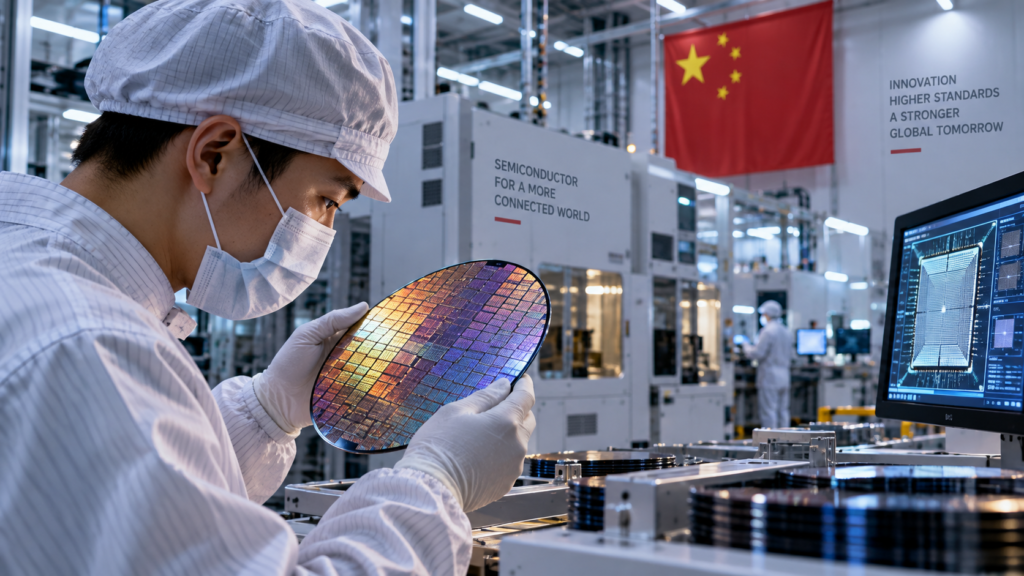
SMIC is the anchor of China’s semiconductor ambitions. It is the country’s largest contract chipmaker, and it has become the test case for whether advanced chip manufacturing is possible without access to the most advanced tools.
In 2026, SMIC achieved volume production of its N+3 node, a 5 nanometer class process. The Huawei Kirin 9030 system on chip, which powers the Mate 80 series, was confirmed by TechInsights to have been manufactured on this node. This is China’s most advanced semiconductor node produced without any extreme ultraviolet lithography tools, relying entirely on deep ultraviolet lithography with multi-patterning.
The technical achievement is remarkable. SemiAnalysis, a respected semiconductor analysis firm, published a teardown report showing that the Kirin 9030’s minimum metal pitch is 32.5 nanometers, which is actually about 10 percent tighter than Intel’s latest 18A process at 36 nanometers. SMIC achieved this using DUV immersion lithography combined with self-aligned quadruple patterning and design-technology co-optimization.
But the report also made clear that metal pitch is only one measure of process capability. The transistor density of SMIC’s N+3 is approximately 113.4 million transistors per square millimeter, which is slightly higher than TSMC’s N6 at 107.7 million but still significantly behind Intel’s 18A high-density libraries. The overall performance of the Kirin 9030 is roughly equivalent to Android flagship chips from three years ago. And critically, the aggressive scaling comes at a cost. Yield challenges are significant, and the Kirin 9030 is likely produced at an operating loss, with a substantial portion of dies being discarded or downgraded.
SMIC is also making progress on the equipment side. The company has been testing an immersion DUV lithography scanner developed by Shanghai Yuliangsheng Technology since September 2025. A state-backed manufacturer in Shanghai has reportedly started mass-producing immersion DUV lithography machines, with the first systems expected to be delivered to SMIC, Hua Hong, and memory maker CXMT later in 2026. Production is targeting around five machines in 2026 and about 20 in 2027. However, key components are still sourced from Japan, and the system is expected to trail ASML in performance and reliability.
Huawei: The AI Chip Champion
Huawei is the most consequential Chinese semiconductor company, and it is not a foundry. It is a chip designer, a systems company, and increasingly the anchor customer for SMIC’s most advanced capacity.
Huawei’s Ascend AI chip line has become the default alternative to Nvidia in China. The company is sharply ramping up production of its 910C Ascend chips, targeting about 600,000 units in 2026, roughly double the previous year’s level. Overall output across the Ascend family is planned to reach up to 1.6 million dies. Huawei expects AI chip revenue to reach approximately 12 billion dollars in 2026, up from 7.5 billion dollars in 2025.
The performance gap with Nvidia has narrowed significantly. Morgan Stanley data shows that Huawei’s Ascend 950 cards and Cambricon’s Siyuan 690 can outperform Nvidia’s H20, the most powerful chip Nvidia is currently permitted to sell to China, by 50 to 150 percent as measured in tokens per second. That is a significant reversal from just a few years ago, when Chinese AI chips were considered generations behind.
Huawei’s strategy is not to build a better general-purpose GPU. It is to build domain-specific architectures optimized for AI workloads. The Ascend series uses neural processing units designed for the specific computational patterns of large language models and other AI tasks. That specialization gives it an efficiency advantage over general-purpose hardware, even if the peak theoretical performance is lower.
Cambricon: The Pure-Play AI Chip Company
Cambricon Technologies is the closest thing China has to a pure-play AI chip company. It designs AI accelerators and licenses IP, and it has benefited enormously from Beijing’s push to get local firms to use homegrown components.
The numbers tell the story. Cambricon’s first-half 2026 net profit hit 2.31 billion yuan, up 122.61 percent year over year. Chinese firms plan to spend 46 percent of their AI accelerator budgets on locally made chips over the next 12 months, up from 30 percent currently, according to a Bloomberg Intelligence survey of technology executives. China’s AI chip self-sufficiency is projected to reach 70 percent by the end of the decade, up from 42 percent in 2025, according to Morgan Stanley estimates.
Cambricon is building domain-specific architectures with its Siyuan 590 and 690 series. These are not trying to be general-purpose GPUs. They are designed to do one thing extremely well, which is run AI inference and training workloads efficiently. In a market where the best Nvidia hardware is unavailable, the economics of custom silicon become far more compelling.
CXMT: The Memory Challenger
ChangXin Memory Technologies, known as CXMT, is China’s most important memory chip company. It is the closest thing China has to a domestic DRAM supplier, and its growth has been extraordinary.
CXMT’s revenue jumped 156 percent in 2025, and its global DRAM market share is projected to rise from 9 percent in 2025 to 12 percent by 2027. The company is expanding capacity through 2026 to 2028 and is a critical supplier to Huawei and other Chinese technology companies.
Memory chips are a key component for AI data centers and consumer electronics. The global memory market has been in short supply, and Chinese memory makers have benefited. But CXMT faces the same lithography constraints as SMIC. If more restrictions are imposed on lithography equipment, that would be the biggest challenge for Chinese memory makers, according to industry analysts.
The Equipment Makers: Naura, AMEC, and Hwatsing
Behind the chipmakers are the equipment companies that supply the tools. Naura Technology Group, Advanced Micro-Fabrication Equipment, and Hwatsing Technology are the leading Chinese semiconductor equipment firms, and they are expanding aggressively.
China’s semiconductor equipment localization rate increased from 8 percent in 2021 to 23.2 percent in 2025 and is projected to reach 39 percent by 2030, according to industry data. But the numbers vary depending on the source. The China Semiconductor Industry Association reported that the proportion of domestically produced semiconductor manufacturing equipment used in China rose from 25 percent in 2024 to 35 percent in 2025, exceeding the government’s 30 percent target. Some new production lines have reportedly achieved localization rates above 50 percent.
The equipment makers are now expanding from front-end manufacturing into back-end packaging. Naura launched two types of 12-inch hybrid bonding equipment for wafer-to-wafer and die-to-wafer bonding. AMEC is expanding from TSV etching into dicing and deposition, with a goal to cover more than 70 percent of the equipment portfolio required for advanced packaging over the next five years. Hwatsing, whose core business is chemical mechanical polishing equipment, is extending its technical scope to advanced packaging, including wafer grinding and edge processing.
This expansion into back-end packaging is a direct response to export controls. As interconnecting multiple chips to boost total computing capacity becomes vital, the scope of equipment localization is naturally expanding into back-end processes. China is pursuing a strategy to offset individual chip performance limits through advanced packaging, according to a researcher at the Korea Institute for International Economic Policy.
The Strategies for Overcoming Export Controls
The Chinese semiconductor industry is not just surviving under export controls. It is adapting, and the adaptations are revealing.
Strategy One: Multi-Patterning Instead of EUV
The most visible strategy is the use of deep ultraviolet lithography with multi-patterning to achieve feature sizes that would normally require extreme ultraviolet lithography. SMIC’s N+3 node is the clearest example. By using DUV immersion lithography combined with self-aligned quadruple patterning, SMIC can achieve 5 nanometer class features without EUV.
The trade-off is yield and cost. Multi-patterning requires more process steps, more masks, and tighter overlay control. The result is lower yields and higher per-chip costs. SMIC’s N+3 node encounters significant yield challenges, particularly due to the aggressively scaled metal pitch. The Kirin 9030 is likely produced at an operating loss.
But the strategic logic is clear. Even at a loss, having the capability matters. It means China can produce advanced chips for its most important customers, particularly Huawei, without depending on foreign fabs. And as the process matures, yields will improve and costs will fall.
Strategy Two: Custom Silicon Instead of General-Purpose GPUs
The second strategy is architectural. Instead of trying to build a general-purpose GPU that can compete with Nvidia’s best, Chinese companies are building application-specific integrated circuits designed for specific AI workloads.
Huawei’s Ascend series uses neural processing units. Cambricon’s Siyuan series uses domain-specific architectures. Alibaba’s T-Head unit launched the Zhenwu M890 parallel processing unit, claiming three times the performance of its predecessor. These are not Nvidia clones. They are different architectures optimized for different tasks.
The result could be an ecosystem that looks structurally different from the Western model. General-purpose GPUs are flexible and programmable, making them ideal for the fast-moving research phase of AI development where model architectures change constantly. ASICs sacrifice that flexibility for raw efficiency, delivering faster performance at lower power consumption for specific AI tasks. In a market where the best Nvidia hardware is unavailable, the economics of custom silicon become far more compelling.
Strategy Three: Advanced Packaging Instead of Shrinking Transistors
The third strategy is to use advanced packaging to compensate for the inability to shrink transistors. If you cannot make a single chip faster, you can stack multiple chips together and connect them with high-bandwidth interconnects.
This is where the equipment companies come in. Hybrid bonding, through-silicon via, and panel-level packaging are all technologies that allow multiple chips to be stacked and interconnected into a single package. Naura’s hybrid bonding equipment, AMEC’s TSV etching and deposition tools, and Hwatsing’s wafer grinding equipment are all part of this strategy.
The logic is straightforward. If you cannot build a better single chip, build a system of chips that together deliver the performance you need. Chinese companies are showcasing server racks capable of integrating tens of thousands of chips, compensating for lower single-chip performance with scale. Purchasing decisions are increasingly driven by deployment economics rather than absolute peak silicon performance, according to Morgan Stanley analysts.
Strategy Four: Domestic Equipment and Materials
The fourth strategy is to build a domestic supply chain for the tools and materials that make chips. This is the longest and hardest strategy, but it is also the most important for long-term independence.
China’s semiconductor equipment localization rate has risen from 8 percent in 2021 to 23.2 percent in 2025, with some sources reporting 35 percent. New production lines are required to source at least 50 percent of their equipment domestically. The government has intervened in capacity allocation to prioritize Huawei and other national champions.
The progress is real, but the gap remains. Immersion DUV lithography is the most advanced lithography system currently available to Chinese chipmakers, and the domestic version still trails ASML in performance and reliability. EUV lithography remains out of reach, though China is reportedly developing a domestic EUV machine at the prototype stage.
The Challenges That Remain
It would be dishonest to write about Chinese semiconductors without acknowledging the real challenges.
The first challenge is lithography. This is the single biggest bottleneck. Without EUV, Chinese chipmakers are limited to DUV multi-patterning, which is more expensive, slower, and lower yield. The domestic immersion DUV machines are a step forward, but they are comparable to ASML designs from around 2008 and cannot match the latest ASML systems.
The second challenge is yield and cost. SMIC’s N+3 node encounters significant yield challenges. The Kirin 9030 is likely produced at an operating loss. Building advanced chips without EUV is expensive, and that cost is borne either by the company or by the government. The question is how long that can be sustained.
The third challenge is the software ecosystem. Advanced chips need design tools, development environments, and software libraries. China’s electronic design automation industry is developing, but it still lags behind the American and European incumbents. The software gap is not as visible as the hardware gap, but it is just as important for the long-term health of the industry.
The fourth challenge is the internal structure of the industry. Chinese industry leaders have publicly acknowledged that the semiconductor sector still suffers from problems of being small, scattered, weak, and homogenized, with severe internal competition. There are too many small companies competing for the same resources, and it is difficult to consolidate them through market mechanisms because of the fragmented ownership structure.
The fifth challenge is talent. Semiconductor manufacturing is complex and requires highly skilled engineers. China has been training more engineers, but the demand for experienced semiconductor talent far exceeds the supply. Building a world-class semiconductor industry takes decades of accumulated expertise, and China is trying to compress that timeline.
What This Means for Africa and Nigeria
You might be reading this and wondering what any of it has to do with Nigeria. The fabs are in China. The lithography machines are in the Netherlands. The design tools are in the United States. What does this mean for a Nigerian importer, a Nigerian technician, or a Nigerian policymaker?
The answer is that the semiconductor supply chain is global, and Nigeria is at the end of it. Almost every semiconductor device that enters Nigeria comes from China. According to trade data, Nigeria imported 186 million dollars worth of semiconductor devices from China in 2024, far more than from any other country. The Nigeria image sensor module market is structurally import-dependent, with zero domestic semiconductor fabrication and an estimated 95 to 100 percent of all advanced modules shipped directly from overseas suppliers, primarily in China.
That dependency means that what happens in Chinese semiconductors affects what Nigerians can buy and how much they pay. When Chinese chipmakers ramp up production, prices fall. When export controls disrupt supply, prices rise. When a new Chinese chip reaches the market, it enables new products, like the Transsion phones that dominate the Nigerian market, which are powered by Chinese-designed processors from companies like Unisoc.
But the relationship is not just about imports. There is a growing opportunity for African countries to participate in the semiconductor value chain in ways that go beyond simply buying finished chips.
Morocco has attracted China’s Ningbo Boway Alloy Material to build the country’s first electronic chip factory in the Nador region, covering nearly 188,000 square meters. This is part of a broader trend of Chinese chip companies looking to Africa as a manufacturing base to access the African Continental Free Trade Area and European markets.
A 2026 analysis argued that countries like Morocco, Tunisia, Kenya, and Ghana can attract Chinese chip companies using the AfCFTA as a platform for regional market access. The African Union could establish a collective fund to take minority stakes in joint ventures, following the model that worked for Chinese industrial development. The analysis noted that China is building an open, inclusive technology ecosystem designed to serve broad global markets, especially in the Global South, led by Huawei, SMIC, and a broad supplier network focused on cost-effective, reliable solutions.
For Nigeria specifically, the opportunity is not in building a semiconductor fab. That would require billions of dollars in investment, decades of talent development, and infrastructure that Nigeria does not currently have. The opportunity is in the layers around the chip. Assembly, testing, packaging, distribution, repair, and integration are all parts of the value chain where Nigeria can participate.
The Nigerian phone market is a case in point. Transsion, the company behind Tecno, Infinix, and itel, sells millions of phones in Nigeria every year. Those phones contain chips designed by Unisoc and other Chinese companies. There is no reason why the assembly, testing, and packaging of those devices could not be done in Nigeria, creating jobs and building technical skills. The government’s emphasis on local assembly and the AfCFTA framework create a policy environment where this could happen.
Three Steps You Can Take Today
If you are a Nigerian business owner, technician, or someone who wants to position yourself for what is coming in semiconductors, here are three specific things you can do this week.
Learn What Chips Are in the Products You Sell
The first step is to understand what you are selling. Not all chips are the same. A phone processor is different from a memory chip, which is different from a power management chip, which is different from an image sensor. The brand name on the phone does not tell you who made the chip inside.
Take apart one of the products you sell, or look up its specifications online. Find out what processor it uses, what memory it has, and what other chips are on the board. Write down the brand names. Then research those brands. Who makes them? Where are they made? What are their strengths and weaknesses? This knowledge will make you a better buyer and a more credible seller.
Look for Opportunities in the Chip Supply Chain
The second step is to look at the layers around the chip. Nigeria is not going to make advanced semiconductors anytime soon. But Nigeria can assemble, test, package, distribute, repair, and integrate devices that contain semiconductors. These are the parts of the value chain where Nigeria has a comparative advantage.
If you are an importer, look at the logistics of getting chips and finished devices into Nigeria. If you are a technician, look at the repair and maintenance of devices that contain chips. If you are a business owner, look at the assembly and packaging of finished products. The chip is the input. The value is added in what you do with it.
Talk to Your Suppliers About Sourcing
The third step is to talk to your Chinese suppliers about where their chips come from. Ask them what processor is in the phone, what memory is in the inverter, what microcontroller is in the solar charge controller. Ask them what alternatives they have if the primary supplier is disrupted. Ask them how the US export controls have affected their supply chain.
The answers will tell you something about the resilience of your own business. If your supplier depends on a single chip source that is vulnerable to sanctions, your supply chain is vulnerable. If your supplier has diversified across multiple chip sources, your supply chain is more resilient. Understanding your suppliers’ chip strategies is understanding the hidden risk in your own business.
Conclusion
Chinese semiconductor companies are fighting for global relevance, and they are making progress faster than almost anyone predicted. SMIC has achieved 5 nanometer class production without EUV lithography. Huawei is producing 600,000 Ascend AI chips a year. Cambricon’s profit doubled in six months. China’s chip self-sufficiency rate has reached 70 percent by unit count. The country is building a domestic equipment industry, from Naura’s hybrid bonding tools to Shanghai Yuliangsheng’s immersion DUV lithography machines.
The three most important takeaways for Nigerian readers are these. First, the semiconductor supply chain is global, and Nigeria is at the end of it. Almost every chip that enters Nigeria comes from China, and the health of that supply chain affects what you can buy and what you pay. Second, China’s semiconductor strategy is not just about making chips. It is about building an entire ecosystem, from design tools to manufacturing equipment to advanced packaging, and that ecosystem is becoming an alternative to the Western-dominated supply chain. Third, the opportunity for Nigeria is not in making chips but in the layers around them. Assembly, testing, packaging, distribution, repair, and integration are all parts of the value chain where Nigeria can participate.
If you take one step today, let it be this. Pick up the phone in your pocket or the inverter in your office and find out what chip is inside it. Look up the manufacturer. Find out where it was made. That one step will tell you more about the global semiconductor supply chain than any report. The chips are in everything you use. The only question is whether you understand where they come from.
For a deeper look at how Chinese electric vehicles are reaching African markets, you can read our article on the future of Chinese EVs in Africa. If you want to understand how Chinese technology is changing agriculture in Nigeria, our guide on drones, satellites, and mechanization in African farming covers the tools that are already in use.