
I was in a meeting with a Nigerian importer in Lagos last year when he pulled out his phone and showed me something that stopped me cold. He had ordered a custom sample of a product from a supplier in Shenzhen, paid for it through a platform I had never used, and received it in Lagos within twelve days. No agent. No bank transfer headache. No back and forth over WhatsApp. Just a direct line from a factory floor in China to a market stall in Lagos. That moment changed how I understood what Chinese e-commerce actually is. The Chinese e-commerce strategy for global expansion is not just about selling things online. It is about rebuilding the entire relationship between factory and customer, and the rest of the world is still catching up.
I have spent years working with importers and watching products move from Chinese factories to Nigerian markets. What I have seen in the last two years is a shift that is bigger than anything that came before. Chinese brands are not just using e-commerce to sell. They are using it to skip entire layers of the distribution chain, to test products in real time, and to build brand loyalty in markets where they have no physical presence. For Nigerian entrepreneurs, importers, and anyone trying to understand where global trade is going, this is the most important shift of the decade.
The Scale of Chinese Cross-Border E-Commerce
Start with the numbers, because they tell the story better than any description. China’s cross-border e-commerce market reached an estimated 38,133 billion yuan in 2025, according to the China Commercial Industry Research Institute. Analysts at the same institute project that the market will grow to 44,349 billion yuan in 2026, a growth rate of 16.3 percent. That is faster than China’s overall goods trade, which means e-commerce is becoming a larger share of how China sells to the world every year.
The global picture is even more striking. A report from MarkWide Research, cited by industry analysts, estimated the global cross-border e-commerce market at 1.84 trillion dollars in 2026, with projections to reach 7.39 trillion dollars by 2035. That is a compound annual growth rate of 16.70 percent. Coherent Market Insights gave a slightly more conservative estimate of 1.74 trillion dollars for 2026, but the direction is the same. Cross-border e-commerce is growing faster than almost any other segment of global trade.
Chinese platforms are capturing a disproportionate share of that growth. Temu grew from near zero to 22 billion dollars in United States gross merchandise value in just three years, according to data from Marketplace Pulse and Digital Commerce 360. Shein captured 9 percent of global cross-border e-commerce. Amazon still leads with roughly 25 percent of the global cross-border market, but the gap has narrowed dramatically. As recently as 2022, Temu had less than 1 percent of that market. By 2026, it held 24 percent.
These numbers matter for Nigerian readers because they describe a shift in how goods move around the world. The old model was a Chinese factory selling to a Chinese exporter, who sold to a Nigerian importer, who sold to a wholesaler, who sold to a retailer, who sold to you. Each layer added cost and time. The new model is a Chinese factory selling directly to you through a platform, with a logistics partner handling delivery. The layers are disappearing.
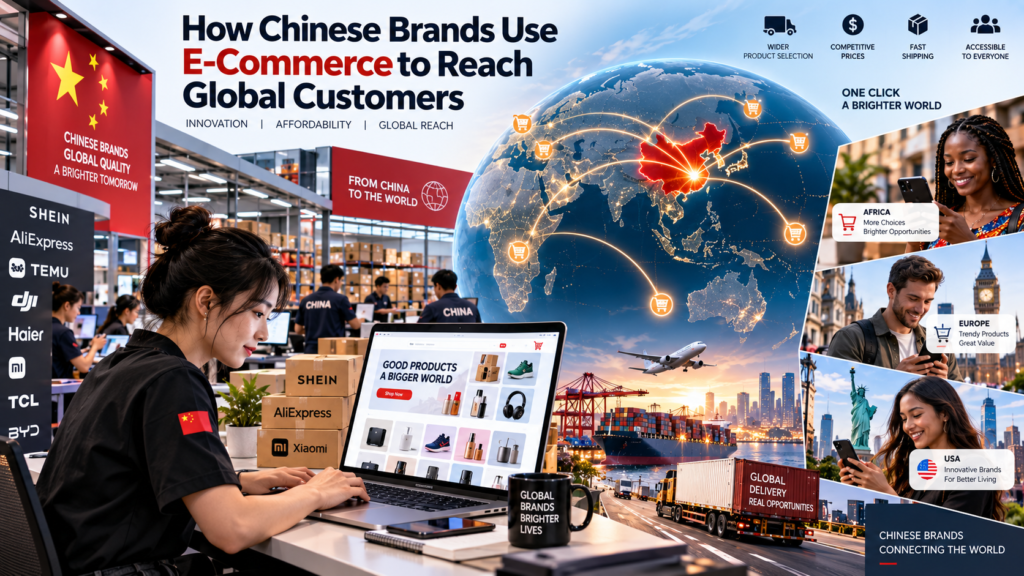
Platform Strategies: How They Actually Reach Customers
The scale is impressive, but the strategy is what makes it work. Chinese e-commerce platforms have taken four distinct approaches to reaching global customers, and each one teaches something different.
AliExpress: The Brand Incubator
AliExpress, the cross-border platform owned by Alibaba Group, has positioned itself as a brand incubator rather than just a marketplace. In April 2026, the company announced a goal to help 2,000 Chinese brands double their overseas scale within the year. The strategy is not to sell more goods. It is to help Chinese companies build brands that customers recognize and trust.
The results are already visible. During the 2026 mid-year shopping festival known as 6.18, AliExpress reported that brand gross merchandise value penetration reached 40 percent. Xiaomi led the smartphone category, while categories like 3D printing, portable energy storage, and smart car accessories saw explosive growth. The platform also built a network of over 10,000 influencers across 14 countries, conducting more than 100 livestreams to help over 60 Chinese brands reach global audiences.
The platform’s internal benchmark is telling. AliExpress aims to achieve 80 percent of Amazon’s fulfillment experience at half the cost. That is not a small ambition. It is a direct challenge to the assumption that fast delivery and reliable service require the kind of massive infrastructure that Amazon spent decades building.
Temu: The Discovery Engine
Temu, owned by PDD Holdings, took a different route. The platform is built for discovery, not search. A survey of shopper behavior found that 45 percent of Temu users browse without a specific item in mind, compared to 23 percent on Amazon. That difference shapes everything about how the platform operates.
Temu’s success comes from a combination of aggressive pricing, gamified shopping experiences, and a supply chain that connects directly to Chinese factories. The platform grew to 22 billion dollars in United States gross merchandise value by early 2026. It entered Nigeria in late 2024 and quickly became one of the country’s most downloaded shopping apps.
But Temu’s model has a weakness. High logistics costs and unreliable customs clearance have forced the platform to scale back operations in some markets. The company’s reliance on low-cost shipping and efficient last-mile delivery is difficult to sustain in countries where those things are not guaranteed. For Nigerian consumers, this means Temu’s prices may stay low, but delivery times may be longer and less predictable than in markets with better infrastructure.
Shein: The Supply Chain Disruptor
Shein did not build its business on marketing or platform design. It built it on a supply chain model that nobody else has been able to replicate at scale. The company’s Large-scale Automated Test and Reorder system, known as LATR, changes the fundamental logic of fashion production.
Instead of forecasting demand and producing large batches, Shein produces small test batches of 100 to 200 units per new design. It watches how customers respond in real time. If a design sells, it restocks within five days. If it does not sell, it stops production and moves on. This model depends on a network of about 7,500 active suppliers in 2025, most of them small and medium factories. No single supplier accounts for more than 6 percent of total purchases.
The financial results speak for themselves. Shein reported over 41.8 billion dollars in revenue in 2025, serving 273 million active consumers globally. The company listed on the Hong Kong Stock Exchange in September 2026, raising approximately 13.2 billion Hong Kong dollars in net proceeds. It is now one of the five largest apparel companies in the world by retail sales.
What makes Shein relevant for Nigerian readers is not just the scale. It is the model. Shein built its advantage by connecting directly to small factories and giving them digital tools to manage orders, production, and quality control. A Nigerian clothing manufacturer could apply the same principle at a smaller scale, using WhatsApp and simple inventory software to test designs with real customers before committing to large production runs.
TikTok Shop: Content as Commerce
The fourth approach is the one that is growing fastest. TikTok Shop combines social media, livestreaming, and e-commerce into a single experience. For Chinese brands trying to reach global customers, it is a direct line from factory to consumer, with content doing the work that advertising used to do.
The numbers from Southeast Asia show how powerful this model has become. TikTok Shop’s gross merchandise value in the region grew by 125 percent year on year in 2025. During the 6.6 shopping festival in the first half of 2025, gross merchandise value grew by 123 percent. During the 11.11 festival, it grew by 230 percent. During 12.12, it grew by 270 percent. TikTok has over 460 million monthly active users in Southeast Asia alone, providing a massive audience for content-driven commerce.
The model is spreading. A Chinese tissue brand called Sipiao used TikTok Shop to generate 34,000 orders in a single day during a shopping festival. The company’s monthly sales in Southeast Asia grew from 3 million dollars to 5 million dollars, with 90 percent of that revenue coming through TikTok Shop. Chinese beauty brands like Proya, Florasis, and INTO YOU are using the same playbook, combining livestreaming, influencer partnerships, and short video content to reach young consumers across the region.
The Infrastructure That Makes It Possible
The strategies are clever, but they would not work without infrastructure. Three pieces of infrastructure are particularly important, and each one has lessons for Nigerian businesses.
Overseas Warehouses and Local Fulfillment
The first piece is overseas warehousing. Instead of shipping every order from China, Chinese platforms are building warehouses in target markets. This cuts delivery times from weeks to days, reduces shipping costs, and makes returns easier to manage.
JD.com’s European retail platform Joybuy operates over 60 warehouses and delivery stations across Europe. In more than 30 cities, the platform offers same-day delivery. In the United Kingdom, its first smart warehouse in Milton Keynes handles over 20,000 orders per day. This is not just about speed. It is about building the kind of reliability that makes customers willing to buy again.
For Nigerian importers, the lesson is direct. If you are selling online, the bottleneck is usually delivery. Building or partnering with a local fulfillment operation, even a small one, can transform your customer experience. A product that arrives in two days feels different from a product that arrives in two weeks, even if the product is identical.
Digital Supply Chain Tools
The second piece of infrastructure is digital supply chain management. Chinese platforms do not just connect factories to customers. They give factories the digital tools to manage orders, track production, and respond to demand changes in real time.
Shein provides its suppliers with free cloud-based software for order management, production planning, quality control, and shipping. The company also offers customized production tools and regular supplier training. A factory that once relied on Excel spreadsheets and paper records can now see real-time demand data and adjust production accordingly. Payment terms have also improved. Standard suppliers are paid within 30 days, and high-quality factories can receive payment within 7 days. In the old export model, factories often waited 3 to 6 months to be paid.
For Nigerian manufacturers, this is one of the most practical lessons in the Chinese e-commerce playbook. You do not need a sophisticated enterprise resource planning system to benefit from digital tools. You need a way to see what is selling, what is not, and how much inventory you have at any given moment. A simple spreadsheet that is updated daily can be the beginning of a digital supply chain.
AI and Data-Driven Decision Making
The third piece is artificial intelligence. Chinese e-commerce platforms are using AI not just for recommendations, but for the entire business chain. AI is being used to predict demand, optimize inventory, automate customer service, and even design products.
Transsion, the company behind Tecno and Infinix, built an AI-powered customer service system that handles over 92 percent of customer problems without human intervention, with user satisfaction above 88 percent. That system processes queries in multiple languages and operates around the clock. For a company selling in dozens of African markets, that capability is not a luxury. It is a necessity.
A white paper from Amazon Global Selling’s Asia-Pacific Innovation Center found that AI penetration in cross-border e-commerce is increasing across the entire business chain. AI is being used to optimize listings, translate product descriptions, manage advertising spend, and predict which products will sell in which markets. Platforms that invest in these tools give their sellers an advantage that smaller competitors cannot match.
How This Plays Out in Africa and Nigeria
The global trends matter, but what matters most for Nigerian readers is how these strategies are playing out here. And the picture is complex.
Temu entered Nigeria in late 2024 and quickly became one of the country’s most downloaded shopping apps. Shein has been gaining ground across African markets, with the two platforms capturing a combined 3.6 percent share of South Africa’s clothing market. Jumia, the African e-commerce platform, reported a 39 percent increase in first-quarter revenue to 50.6 million dollars in 2026, driven in part by a surge in products from Chinese vendors. The volume of products sold by international sellers on Jumia rose 87 percent year on year.
But the Chinese e-commerce model in Africa faces real obstacles. Logistics costs are high. Customs clearance is unpredictable. Payment systems are fragmented. Last-mile delivery in many Nigerian cities is slower and more expensive than in markets like Southeast Asia. Temu’s decision to scale back operations in Nigeria reflects these realities.
There is also regulatory pressure. Nigerian manufacturers have complained that platforms like Shein and Temu benefit from the de minimis rule, which allows small shipments to enter the country without import duties. If Nigeria changes its import rules, the cost structure for these platforms could shift significantly. South Africa has already taken steps to close this loophole, and Nigeria may follow.
The opportunity for Nigerian businesses is not to compete with Temu or Shein on price. It is to learn from their playbook and apply it to local markets. A Nigerian fashion brand could use the Shein model of small batch testing to reduce inventory risk. A Nigerian electronics retailer could use TikTok Shop to reach customers through content rather than paid advertising. A Nigerian manufacturer could use digital supply chain tools to respond faster to demand changes. The tools are available. The question is whether Nigerian businesses will use them.
What Nigerian Entrepreneurs Can Learn
The Chinese e-commerce playbook offers several clear lessons for Nigerian entrepreneurs, importers, and business owners.
Sell Direct and Cut the Middlemen
The first lesson is to sell direct whenever possible. Chinese brands succeed on platforms like TikTok Shop and Temu because they sell directly to consumers, bypassing the layers of distributors, wholesalers, and retailers that traditionally stood between factory and customer. Every layer you remove is a cost you can either keep as profit or pass on to the customer as savings.
For Nigerian businesses, this does not mean abandoning retail partners. It means building a direct channel as well. A WhatsApp group for your best customers. A simple website with a payment link. An Instagram page where people can order directly. These are low-cost ways to build a direct relationship with the people who buy your products.
Test Small, Learn Fast, Scale What Works
The second lesson is to adopt the Shein approach to product testing. Do not produce a thousand units of a new design and hope it sells. Produce a hundred. Watch what happens. If it sells, make more. If it does not, you have lost a small amount of money instead of a large one.
This approach requires you to be close to your customer, so you can see how they respond. It requires you to be willing to change quickly. And it requires you to accept that some experiments will fail. But it is a much safer way to grow than betting everything on a single product launch.
Use Content to Sell, Not Just Ads
The third lesson is to use content as a sales tool. TikTok Shop’s success in Southeast Asia shows that short videos and livestreams can generate sales more effectively than traditional advertising, especially for products that need to be demonstrated or explained. A Nigerian furniture maker could post videos showing how a piece is assembled. A Nigerian food producer could livestream a cooking demonstration using their product. A Nigerian fashion brand could use short videos to show how clothes look on different body types.
Content works because it builds trust. A customer who watches a video of a real person using a product feels more confident buying it than a customer who only sees a static advertisement. That trust is what drives repeat purchases, and repeat purchases are what build a brand.
The Risks and the Reality
It would be dishonest to write about the Chinese e-commerce playbook without acknowledging the risks and challenges.
The first risk is logistics. Chinese platforms have built sophisticated fulfillment networks, but those networks are expensive and complex. In markets with poor infrastructure, the cost of delivering a low-priced item can exceed the profit margin. Temu’s scaling back in Nigeria is a reminder that even the best platform strategy can be undone by logistics.
The second risk is regulation. The de minimis rule, which allows small shipments to enter countries without import duties, is under pressure in many markets. If Nigeria changes its import rules, the economics of cross-border e-commerce could change overnight. Platforms and sellers that depend on low-cost shipping will need to adapt.
The third risk is competition. The Chinese e-commerce market is intensely competitive, and that competition is spreading globally. Temu, Shein, AliExpress, and TikTok Shop are all fighting for the same customers. As competition intensifies, margins shrink. Some platforms will not survive. Sellers who depend on a single platform are exposed to that risk.
For Nigerian entrepreneurs, these risks mean that the Chinese playbook is not a guaranteed formula. It is a set of principles that must be adapted to local conditions. The principles are sound. The execution must be local.
Three Steps You Can Take Today
If you want to apply the lessons from Chinese e-commerce to your own Nigerian business, here are three specific things you can do this week.
Audit Your Sales Channels
Take a piece of paper and write down every channel through which you currently sell. Retailers. Distributors. Your own website. Social media. WhatsApp. Then ask one question for each channel. How much does this channel cost me, and how much control do I have over the customer experience?
Identify the channel where you have the most direct relationship with the customer and the lowest cost per sale. That is your starting point. Invest more in that channel before you try to build a new one.
Create a Direct Ordering Option
If you do not have a way for customers to order directly from you, create one this week. It does not need to be complicated. A WhatsApp Business account with a catalog and a payment link is enough to start. A simple Google Form that collects orders and payment confirmations. An Instagram page where people can send a direct message to order.
The goal is to build a channel you control. If a platform changes its rules or a distributor drops your product, you still have a way to reach your customers.
Test One Product with a Small Batch
Pick one product from your lineup that you have been thinking about updating or expanding. Make a small batch of a new version, a new size, or a new color. Sell it to your existing customers. Watch what happens. If they love it, make more. If they do not, you have learned something valuable at a low cost.
This is the Shein model applied at a small scale. It is not about copying Shein’s technology or scale. It is about adopting the mindset of testing before committing. That mindset is what allowed Shein to grow from a small online store to one of the largest apparel companies in the world.
Conclusion
Chinese brands use e-commerce to reach global customers by building platforms that sell direct, using supply chains that test and adapt in real time, and investing in the infrastructure that makes fast delivery possible. The scale of this shift is enormous. China’s cross-border e-commerce market is projected to reach 44,349 billion yuan in 2026. Temu grew to 22 billion dollars in United States gross merchandise value in three years. Shein built a supply chain that restocks in five days.
The three most important takeaways for Nigerian readers are these. First, selling direct cuts costs and builds relationships. Every layer you remove between your product and your customer is a layer that is not adding value. Second, testing small and learning fast is safer than betting big and hoping. The Shein model of small batch production is a principle that any business can apply, regardless of size. Third, content is commerce. Short videos and livestreams are not just marketing. They are sales channels that build trust and drive repeat purchases.
If you take one step today, let it be this. Look at your business and identify one product that you could test with a small batch. Then find one way to sell it directly to your customers, without a middleman. It could be a WhatsApp message to your best buyers. It could be a post on your Instagram page. It could be a simple order form on your website. The Chinese e-commerce revolution started with factories selling directly to customers. You can start the same way, at whatever scale you have right now.
For a deeper look at how Chinese brands compete on price, technology, and design, you can read our article on their competitive strategies. If you want to understand how Chinese companies are building their African market strategy, our guide on their playbook for the continent covers the details.