
I remember the first time I held a Transsion phone in a Lagos market. The seller told me the battery would last three days on a single charge. I laughed. Then I bought it, and he was right. That moment taught me something about how Chinese brands operate. They do not win by being the cheapest. They win by knowing exactly what a customer in a specific place needs, and then building a product that delivers it at a price that feels like a steal. The competitive strategy of Chinese brands is not one thing. It is three things working together: price, technology, and design. And understanding how those three pieces fit is essential for any Nigerian entrepreneur, importer, or business owner who wants to compete in the same markets.
I have spent years working with importers and manufacturers in Nigeria, watching Chinese products move from the margins to the center of our markets. I have seen brands like Tecno and Infinix become household names. I have watched BYD cars appear on Lagos roads. I have studied how these companies price their products, invest in technology, and use design to win trust. In this article, I will break down each of those three competitive dimensions with real numbers, real examples, and specific lessons you can apply to your own business. By the end, you will have a clear picture of how Chinese brands compete, and three concrete steps you can take this week to apply those lessons to your own venture.
The Price Advantage: More Than Just Cheap
The first thing people notice about Chinese brands is the price. But the price advantage is not as simple as being the cheapest. It is a system that allows Chinese companies to deliver more value at every price point than their competitors.
How Chinese Brands Actually Price
Let me give you a concrete example. BYD, China’s largest electric vehicle manufacturer, shocked the global auto industry in 2025 when it slashed the price of 22 electric and hybrid models. Its cheapest model, the Seagull, dropped to 55,800 yuan, which is about 7,700 dollars at the time of writing. That is cheaper than most petrol cars of a similar size. In Nigeria, the Seagull is priced at a range starting at 31 million naira through Mandillas, which is still steep by local standards but far below what a comparable electric vehicle from a European brand would cost.
The Seagull story is not about dumping. It is about a company that has spent years building its own battery supply chain, its own semiconductor production, and its own manufacturing ecosystem. BYD makes its own batteries. It makes its own chips. It controls more of its supply chain than almost any other carmaker in the world. That control is what allows it to price aggressively without losing money on every unit.
This is the first lesson for Nigerian entrepreneurs. Price advantage does not come from cutting corners. It comes from controlling your costs. If you can make or source your key inputs cheaper than your competitors, you can price more aggressively and still make a profit.
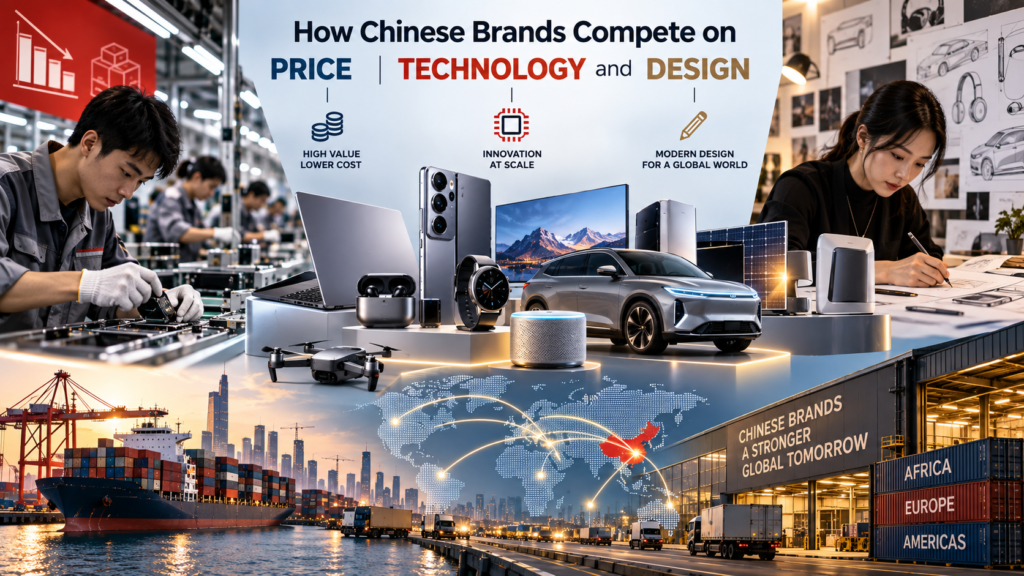
The Value-for-Money Formula
Chinese brands do not just compete on price. They compete on value for money. That means giving the customer more features, better performance, or longer durability at the same price point as competitors.
Look at Transsion in Africa. Its phones are priced below 150 dollars for more than 85 percent of its shipments. But they come with features that matter to African users. Long battery life because power supply is unreliable. Dual SIM or quad SIM support because network quality varies. Cameras optimized for darker skin tones. These are not expensive features to add, but they make the product feel like it is worth more than the price tag suggests.
A Chinese home appliance brand like Midea follows the same formula. The company has been expanding into Africa aggressively, building factories in Egypt for washing machines and refrigerators. By manufacturing locally, Midea reduces import duties and shipping costs, which allows it to sell appliances at prices that local consumers can actually afford. The product is not the cheapest on the market, but it offers a combination of price and quality that is hard to beat.
The Competition Between Chinese Brands
Here is something that many people miss. The biggest threat to a Chinese brand is often another Chinese brand. In Africa, Transsion holds a commanding 48 percent share of the smartphone market, but its lead is under pressure from Xiaomi, Honor, and Oppo, all of which are also Chinese. Xiaomi grew by 32 percent in the same period. Honor grew by 161 percent.
This competition is good news for African consumers in the short term. When Chinese brands fight each other, prices come down and features improve. But it also means that brands have to work harder to maintain their margins. Transsion’s gross margin fell from 21.5 percent in the first half of 2024 to 20.1 percent in the first half of 2025 because of rising component costs and intense competition. The company responded by pushing into higher-end phones and expanding into new product categories like home appliances and electric two-wheelers.
The lesson for Nigerian businesses is this. Do not try to compete with Chinese brands on price alone. You will lose. Instead, find a niche where you can control your costs and deliver value that a mass-market Chinese brand cannot. That might be customization. It might be local service. It might be a product designed for a specific Nigerian use case that no Chinese factory is thinking about.
The Technology Edge: Investing in the Future
The second competitive dimension is technology. Chinese brands do not just sell products. They invest heavily in the research and development that makes those products better.
The Scale of R&D Investment
The numbers are staggering. In 2025, Chinese listed companies spent a combined 1.94 trillion yuan on research and development, which is about 270 billion dollars. That was the fourth consecutive year of growth. BYD alone spent 63.4 billion yuan on R&D in 2025, making it the top spender among Chinese listed companies.
That kind of investment buys real capability. Huawei’s global smartwatch market share rose to 17 percent in 2025, a direct result of years of investment in health monitoring, battery technology, and design. Xiaomi, which many people still think of as a budget phone brand, now holds over 45,000 global patents and ranks ninth in the world for PCT international patent applications.
What the Technology Investment Buys
For consumers, all this R&D translates into products that do more and last longer. Transsion increased its R&D expenditure by 15 percent in the first half of 2025, reaching 1.36 billion yuan. That money went into camera algorithms for darker skin tones, AI-powered customer service systems, and new product categories like electric two-wheelers.
The camera optimization is a good example. International phone brands had been selling phones in Africa for years without optimizing their cameras for African users. Transsion collected 3D imaging data from African users and built algorithms that could capture facial bone structure, provide intelligent fill light, and add beauty features for dark skin. That is not a marketing gimmick. It is a technology investment that made the product genuinely better for a specific group of users.
Xiaomi has taken a different technology path. The company has built an ecosystem of connected devices that work together. Its phones connect to its smart home appliances, its wearables, and its electric vehicles. In 2025, Xiaomi’s global smartphone shipments ranked in the top three worldwide, with a 13.3 percent market share, a position it has held for 22 consecutive quarters. The ecosystem is the moat. Once a customer buys into one Xiaomi product, they are more likely to buy the next one.
The Nigerian Angle on Technology
For Nigerian entrepreneurs, the technology lesson is not about building your own semiconductor factory. It is about investing in the technology that makes your product better for your specific customer. A Nigerian food processing company might invest in better packaging technology that extends shelf life in Nigerian heat. A Nigerian furniture maker might invest in better kiln drying technology so that wood does not crack in Nigerian humidity. A Nigerian fintech company might invest in better fraud detection technology for Nigerian payment patterns.
The Chinese brands that succeed in Africa do not bring their global technology unchanged. They adapt it. They localize it. They invest in solving the specific problems of the specific market they are entering. That is the lesson.
The Design Advantage: Winning Hearts, Not Just Wallets
The third competitive dimension is design. This is the one that people underestimate the most, and it is the one that has changed the most in the last decade.
From Copying to Leading
For a long time, Chinese design meant copying. Chinese companies would take a successful Western product, reverse engineer it, and sell it cheaper. That phase is over. Today, Chinese companies are winning the most prestigious design awards in the world.
At the iF Design Awards, one of the three most important design competitions globally, Chinese products won 1,319 awards in 2024. At the Red Dot Design Awards, another global heavyweight, China won 1,213 awards. China has held the top position at both competitions since 2020. At the Turin Auto Show in 2026, Chinese automakers won multiple awards, with Geely, Chery, and GWM taking home Best Technological Innovation awards in their categories, and BYD’s Yangwang U9 winning China Performance Car of the Year.
Design as a Product Strategy
The design advantage is not just about winning awards. It is about using design to solve problems and create products that people actually want to use.
Anker, the charging accessories brand, built its global business on a design philosophy it calls the shallow sea strategy. The idea is that consumer electronics has huge deep sea categories like smartphones, but it also has many small, shallow categories that individually seem minor but together add up to serious money. Anker picked narrow categories like charging cables and power banks, became the best in the world at them, and then expanded. Today, Anker serves over 200 million customers in more than 180 countries.
Huawei’s MateBook Fold, a foldable laptop, won a 2025 iF Design Award. The judges noted that the product achieved an excellent balance between technological innovation and user experience, setting a new standard for foldable computing devices. That is design as a competitive advantage. It is not about making a product look pretty. It is about making a product work better.
Design for African Conditions
The most relevant design lesson for Nigerian entrepreneurs is this. Chinese brands that succeed in Africa design for African conditions, not for a global template.
Transsion designed its phones with features that matter to African users. Long battery life. Dual SIM. Cameras tuned for darker skin tones. These are design decisions, not just engineering decisions. They come from paying attention to how people actually live.
Midea designed its home appliances for African markets by building factories in Egypt and adapting products to local conditions. Haier expanded in Kenya through partnerships with supermarket chains like Carrefour and Naivas, and it tailored its products to local preferences. These are not just distribution decisions. They are design decisions. The product is different because the market is different.
The Design Opportunity for Nigerian Brands
Nigerian designers and manufacturers have a real opportunity here. The Chinese design revolution shows that a country can move from copying to leading in a single generation. It requires investment in design education, a connection between design and manufacturing, and a willingness to design for local conditions rather than global templates.
A Nigerian furniture maker who designs for Nigerian homes, with furniture that handles humidity and dust and multi-purpose living spaces, is doing exactly what Chinese brands did when they started designing for Chinese homes. A Nigerian clothing brand that designs for Nigerian body types and Nigerian weather is following the same path. The playbook is not complicated. It just requires focus.
How the Three Dimensions Work Together
The real power of the Chinese competitive strategy is that price, technology, and design reinforce each other.
Technology investment lowers costs. When you develop your own battery technology, you do not have to buy batteries from someone else. When you build your own manufacturing ecosystem, you control more of the cost structure. That is how BYD can price the Seagull at 7,700 dollars and still make money.
Design increases perceived value. When a product looks good, feels good, and solves a real problem, customers are willing to pay more for it. That higher perceived value gives the company room to invest more in technology and design, which creates a virtuous cycle.
Price brings customers in the door. When a customer buys a Transsion phone because it is affordable, they experience the long battery life and the optimized camera. That experience builds trust. The next time they buy a phone, they are more likely to buy the same brand, even if it costs slightly more.
This is the system that Chinese brands have built. It is not one advantage. It is three advantages working together.
What Nigerian Businesses Can Learn
If you run a Nigerian business, the Chinese competitive strategy offers clear lessons.
Control Your Costs Before You Cut Your Prices
The first lesson is to focus on cost control, not price cutting. A price cut without a cost advantage is just a way to lose money faster. Chinese brands price aggressively because they have spent years building efficient supply chains and manufacturing ecosystems. Nigerian businesses should do the same, even at a smaller scale. Look at your supply chain and find the points where you are paying too much. Can you source raw materials more directly? Can you negotiate better terms with suppliers? Can you reduce waste in your production process?
Invest in Technology That Solves Real Problems
The second lesson is to invest in technology, but only in technology that solves a real problem for your customer. Transsion did not invest in camera technology because cameras are cool. It invested because African users wanted to take better photos of themselves, and the existing cameras were not doing that. A Nigerian business should invest in technology that solves a Nigerian problem. That might be a better delivery tracking system. It might be a more durable packaging material. It might be a payment system that works without reliable internet. The technology matters only if it makes the product better for the customer.
Design for Your Customer, Not for a Global Template
The third lesson is to take design seriously. Design is not decoration. It is the process of understanding what your customer needs and building a product that delivers it. A Nigerian fashion brand that designs for Nigerian body types and Nigerian weather is using design as a competitive advantage. A Nigerian tech company that designs software for the way Nigerians actually use their phones is doing the same thing. Design is where you differentiate yourself from the mass-market products that Chinese factories can produce at a lower cost than you ever could.
The Risks and the Reality
It would be dishonest to write about the Chinese competitive strategy without acknowledging the risks and the challenges.
The first risk is that the price advantage is eroding. Component costs are rising. Memory prices, which are a key input for smartphones, increased by more than 80 percent quarter on quarter in early 2026. The average selling price of a smartphone in Africa rose by 11 percent in the final quarter of 2025. Chinese brands are not immune to these cost pressures. As costs rise, the price advantage shrinks.
The second risk is that competition is intensifying. Chinese brands are now competing with each other in Africa, not just with Western brands. Transsion, Xiaomi, Honor, and Oppo are all fighting for the same customers. That competition is good for consumers, but it puts pressure on margins. Brands that cannot differentiate themselves will struggle.
The third risk is policy. The United States and the European Union have both imposed tariffs on Chinese goods. BYD faces a 27.4 percent combined tariff in Europe, and other Chinese carmakers face even higher rates. These tariffs do not directly affect African markets, but they change the global landscape. Chinese brands may redirect their exports to Africa as they face barriers in Western markets, which could intensify competition on the continent.
For Nigerian businesses, these risks mean that the Chinese playbook is not a guaranteed formula for success. It is a set of principles that must be adapted to local conditions. The principles are sound. The execution must be local.
Three Steps You Can Take Today
If you want to apply the Chinese competitive strategy to your own Nigerian business, here are three specific things you can do this week.
Audit Your Cost Structure
Take your best-selling product and break down the cost of every component and every step in your production or procurement process. Identify the three biggest cost items. Then ask yourself one question for each. Can I source this more cheaply without sacrificing quality? Can I negotiate a better price with my supplier? Can I reduce waste at this stage?
Write down your answers. Pick one cost item and make a plan to reduce it by 10 percent within the next three months. That is how you build a price advantage.
Study Your Customer’s Real Problem
Talk to five of your best customers. Ask them what they wish your product did better. Do not ask them what features they want. Ask them what problem they have that your product does not solve. Listen carefully. The answer might surprise you.
Then look at your product and ask one question. Can I change something, either in the product itself or in how I deliver it, to solve that problem? That is how you build a technology and design advantage.
Find Your Design Differentiator
Look at your product or service and ask one question. What about this is designed specifically for Nigerian conditions? If you cannot answer that question, you have just found your biggest opportunity.
It might be packaging that survives Nigerian heat. It might be a service model that works around Nigerian traffic. It might be a payment plan that fits Nigerian income patterns. Whatever it is, it needs to be something that a Chinese factory cannot easily copy because they do not live here.
Conclusion
Chinese brands compete on price, technology, and design. But the real advantage is that those three things work together. Technology investment lowers costs, which allows for aggressive pricing. Design increases perceived value, which supports higher margins. Price brings customers in the door, and the experience of using a well-designed, well-built product keeps them coming back.
The three most important takeaways for Nigerian readers are these. First, price advantage comes from cost control, not from cutting corners. Control your costs before you cut your prices. Second, technology investment should solve real problems for real customers, not chase trends. Third, design is a competitive weapon. Use it to differentiate yourself from the mass-market products that Chinese factories can produce more cheaply than you ever could.
If you take one step today, let it be this. Look at your product or service and ask one question. What is one thing about it that is designed specifically for the Nigerian market? If you cannot think of anything, you have just found your starting point. Write it down. Fix it this month. That is how you start competing in a market where Chinese brands have shown what is possible.
For a deeper look at how Chinese brands are competing in African markets today, you can read our article on the future of Chinese brands in Africa. If you are interested in how Chinese companies moved from local factories to global brands, our guide on the Chinese playbook covers the strategies they used.