
I walked through Computer Village in Ikeja last month and counted the brand names painted on the shop fronts. Tecno. Infinix. itel. Xiaomi. Oppo. Ten years ago, most of those names did not exist in Nigeria. Today, they are the first names that come to mind when a first-time buyer walks into a phone shop. That shift happened faster than anyone predicted, and it raises a question that more Nigerian business owners should be asking. Which Chinese brands are next?
This article is for Nigerian importers, retailers, distributors, and anyone who wants to understand where the Chinese brand wave in Africa is heading. I have spent years working with importers and watching Chinese products move through Nigerian markets, from Lagos to Onitsha to Kano. I have seen brands arrive quietly and become unavoidable within a few years. I have also seen brands arrive with big budgets and disappear. In this piece, I will identify the Chinese brands most likely to become household names in Africa over the next five to ten years, explain the specific reasons behind each pick, and give you three practical steps you can take to position yourself for what is coming.
What Makes a Brand a Household Name in Africa
Before naming candidates, it helps to be clear about what we are measuring. A household name in Africa is not just a brand with high sales. It is a brand that ordinary people mention without prompting. It is a brand that a market trader in Onitsha knows by name, that a family in Kano considers when making a purchase, that a young person in Nairobi or Accra recognises on sight.
Three factors separate brands that become household names from brands that stay niche. The first is distribution depth. A brand that is only available in major cities or through premium retail channels will never become a household name. It needs to be in the markets, the small shops, the roadside kiosks.
The second factor is product relevance. The product has to solve a problem that ordinary people actually have. Not a problem that a marketing team in Shanghai imagines, but a problem that a Nigerian family faces every day. Power supply. Network reliability. Affordability. Durability in heat and dust.
The third factor is trust. Trust is built through after-sales service, warranty support, and consistent quality. A brand that disappears when the product breaks will not build the loyalty needed to become a household name. Trust is the slowest factor to build and the easiest to lose.
With those three factors in mind, here are the brands most likely to cross that line.
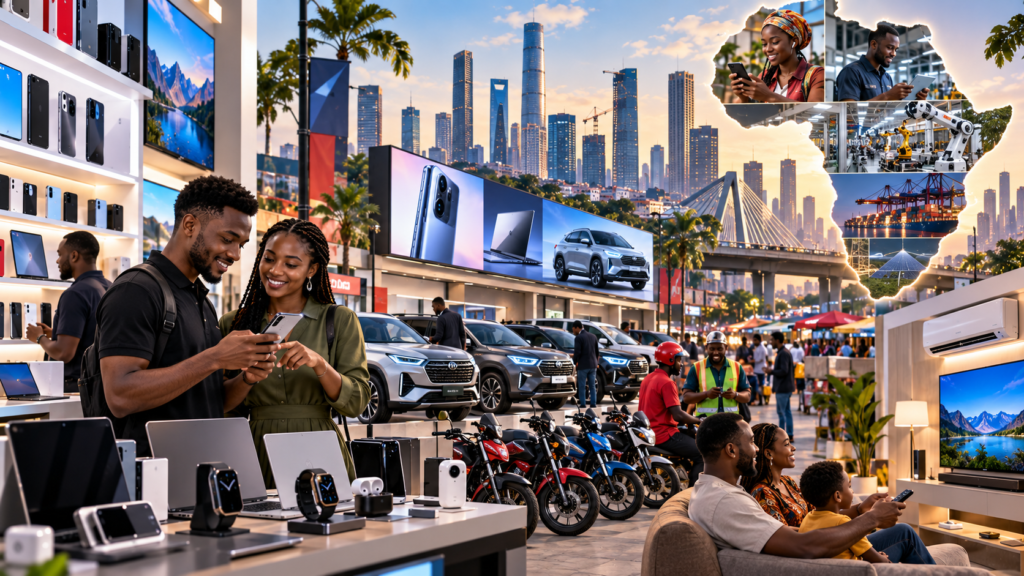
Smartphone Brands: The Battle for the Next Billion Users
The African smartphone market shipped 84.4 million units in 2025, up 13 percent from the previous year, according to Omdia. Smartphones now make up roughly 55 percent of total mobile phone shipments on the continent, which means feature phones are still a significant part of the market. That shift from feature phones to smartphones is the single biggest opportunity for Chinese brands in Africa, and several are fighting hard for it.
Xiaomi: The Ecosystem Play
Xiaomi shipped 10.7 million smartphones in Africa in 2025 and held 13 percent market share, up from 11 percent the previous year. That growth of 27 percent was one of the strongest among the top five brands. The company has been expanding aggressively, launching its Redmi Note 15 series in Kenya in early 2026 and planning to expand into 15 new African markets while opening a flagship store in Morocco.
What makes Xiaomi a strong candidate for household name status is not just its phones. It is the ecosystem. Xiaomi sells smart cameras, robot vacuums, smart mops, air purifiers, air fryers, and a growing range of connected devices. In South Africa, where Xiaomi holds 9 percent market share and is growing at 5 percent annually, the company is expanding its AI Internet of Things product range through local distributors. Once a customer buys a Xiaomi phone, they are more likely to buy a Xiaomi smart home product. Once they buy the smart home product, they are more likely to stay within the ecosystem when they upgrade their phone.
The challenge for Xiaomi is premium positioning. In South Africa, the company is focusing on expanding partnerships with MTN, Telkom, Vodacom, and Cell C to offer premium devices on contract. Most South Africans cannot afford to buy high-end flagships outright, so operator partnerships are essential for moving expensive inventory. If Xiaomi can crack the operator channel, it can move from a value brand to a mainstream brand. If it cannot, it may stay stuck in the value tier where margins are thin.
Honor: The Fastest Growing Brand in Africa
Honor grew its African smartphone shipments by 144 percent in 2025, reaching 3.5 million units and 4 percent market share. That is the fastest growth rate of any major brand on the continent. The company has been expanding into new markets, using its X series and mid-range products to gain traction, and strengthening partnerships with local operators to build brand awareness and distribution.
Honor’s growth is impressive, but the question is whether it can sustain it. The brand is still small in absolute terms, and it faces intense competition from Transsion, Xiaomi, and Samsung. To become a household name, Honor will need to build the kind of distribution depth and after-sales network that Transsion spent years developing. That is not something that happens overnight.
Oppo and Realme: The Youth-Focused Challenger
Oppo shipped 3.4 million smartphones in Africa in 2025, holding 4 percent market share with 8 percent growth. In the fourth quarter of 2025, Oppo’s share rose to 4 percent with 26 percent year-on-year growth, which suggests strong momentum heading into 2026. Realme, which sits under Oppo’s umbrella, is targeting younger consumers with performance-driven devices.
Oppo’s strategy in South Africa gives a clue to its broader approach. The company said South Africa has been a key contributor to its growth across the continent, with 17 percent market share growth in its African markets in the first quarter of 2025. If Oppo can replicate that performance in Nigeria and Kenya, it has a real shot at household name status. The challenge is that the youth segment is crowded and brand loyalty is weak. Young buyers switch brands quickly if a competitor offers better specs at the same price.
Home Appliance Brands: The Quiet Revolution
The smartphone market gets most of the attention, but the home appliance market may be where the next household names emerge. Appliance penetration rates in Africa remain low, which means there is enormous room for growth. Chinese manufacturers are investing heavily in local production to capture that growth.
Midea: Building Factories, Not Just Brands
Midea Group became the official sponsor of the Africa Cup of Nations 2025, which was held in Morocco. That sponsorship was not just a marketing play. It signalled that Midea is investing for the long term. The company’s newly built washing machine and refrigerator factories in Egypt were expected to start production in August and November 2025 respectively. Midea has established factories in Egypt and plans to expand its investment there, viewing the country as a strategic hub between Africa and the Middle East.
Midea’s advantage is its manufacturing base. By producing locally, the company reduces import duties and shipping costs, which allows it to sell appliances at prices local consumers can afford. In Nigeria, Midea air conditioners are already among the go-to brands for many buyers, alongside Hisense, Gree, TCL, and Chigo. If Midea continues to invest in local production and expands its distribution network beyond major cities, it could become the default appliance brand for millions of African households.
Haier: From Nigeria to the Continent
Haier is already a household name in Nigeria through Haier Thermocool, which has been one of the biggest electronics names in the country for years. But Haier is not stopping at Nigeria. In Egypt, the company’s ecological park phase one has already started production, manufacturing over 200,000 air conditioning units, and its local market share has risen to third place. Phase two is under construction, and when fully operational, total capacity is expected to exceed 1.5 million units.
Haier’s approach is different from Midea’s. The company is building a multi-brand portfolio. It acquired Sanyo’s appliance business, then Candy in Italy, and built a portfolio that positions it higher than budget competitors like Aqua and alongside premium names like Samsung and LG in markets like Vietnam. If Haier brings that multi-brand strategy to Africa, it could capture multiple price segments at once.
Hisense: The South African Leader
Hisense holds 15 percent of the South African washing machine market and has established factories in South Africa. The company has been consolidating its leadership through affordability and service. For Nigerian consumers, Hisense is already a familiar name in televisions and air conditioners. If the company decides to expand aggressively into West Africa the way it has in Southern Africa, it could become a household name across the continent.
Automotive Brands: The Next Frontier
The automotive market is where the biggest shift is happening, and it is happening faster than most people expected. Chinese car brands held 42.7 percent of Egypt’s passenger car market in the first half of 2026, up from just about 10 percent in 2020. In South Africa, Chinese brands’ share of the passenger car market climbed from 11.2 percent a year earlier to nearly 20 percent. These are not marginal gains. They are structural changes.
BYD: The Electric Vehicle Pioneer
BYD entered the Nigerian market in April 2025 through LOXEA Nigeria, a subsidiary of CFAO Mobility. The company introduced the BYD Atto 3 and BYD Dolphin, making LOXEA the pioneer in bringing an electric vehicle brand to Nigeria. BYD also partnered with Stanbic IBTC Bank to promote electric vehicle financing, which addresses one of the biggest barriers to EV adoption in Nigeria: the upfront cost.
BYD’s global scale gives it an advantage that smaller competitors cannot match. The company makes its own batteries, its own semiconductors, and controls more of its supply chain than almost any other carmaker in the world. That control allows it to price aggressively. In Egypt, BYD partnered with the Mansour Group to enter the market, establishing Egypt’s first BYD technology centre in Sheikh Zayed and launching the Seagull, Song Plus EV, and Song Plus DM-i.
The question for BYD in Africa is infrastructure. Electric vehicles need charging stations, and charging infrastructure in Nigeria is still limited. BYD and its partners will need to invest in charging networks, not just vehicles, if they want to become a household name. The company’s partnership with Stanbic IBTC on financing is a step in the right direction, but it is only one piece of the puzzle.
Changan: Building the Dealer Network
Changan Automobile is expanding aggressively across Africa. In South Africa, the company plans to expand its dealership network from 25 to more than 40 by the end of 2026, following the launch of its new 2026 Uni-S SUV. It inaugurated a flagship store in Durban in May 2026 and opened its first showroom in Ethiopia in July 2026. The company also showcased its new energy lineup at the Luanda International Fair in Angola in 2026.
Changan’s strategy is to use South Africa as a regional hub and expand into nearby markets like Namibia and Zambia. The company already covers more than two thirds of vehicle segments in South Africa, which means it has products for a wide range of buyers. If Changan can replicate this playbook in Nigeria and Kenya, it has a strong chance of becoming a household name.
Chery: The Nigerian Bet
Chery has been making a serious push into Nigeria through its distributor Carloha. The company has been allotted land at the Lekki Free Zone to commence construction of an auto plant, with construction expected to start in the first quarter of 2026. Carloha has set new standards for service and trust in the Nigerian automotive industry with a six-year warranty and service programme.
Chery’s decision to build a plant in Nigeria is significant. Local assembly reduces costs, creates jobs, and signals long-term commitment to the market. If Chery can deliver on its warranty promise and build a reputation for reliability, it could become the first Chinese car brand that Nigerian families trust by name.
GWM Haval: The South African Success Story
Great Wall Motor’s Haval sub-brand has been one of the biggest success stories in South Africa. Haval sales surged 45 percent to over 12,000 units in 2025. The Haval Jolion was the second best-selling Chinese vehicle in South Africa for the year, with 13,607 units sold. The company is also planning to introduce more plug-in hybrid models following the success of the H6 GT PHEV.
Haval’s success in South Africa shows that Chinese car brands can compete with established Japanese and European brands on quality and features, not just price. If Haval expands into West Africa with the same product lineup and service standards, it could become a household name across the continent.
E-Commerce Platforms: The New Household Names
The e-commerce space is where the battle for household name status is most intense, and the stakes are highest.
Temu: The Fastest Growing Shopping App in Nigeria
Temu entered Nigeria in late 2024 and quickly became one of the country’s most downloaded shopping apps. The platform gained traction through aggressive advertising, deep discounts, and promises of delivery within two weeks. Its parent company, PDD Holdings, built its business on a group-buying model that offers extreme discounts, referral incentives, and gamification to drive viral growth.
Temu’s challenge is logistics. High logistics costs and unreliable customs clearance have forced the platform to scale back operations in Nigeria. The company’s model depends on low-cost shipping and efficient last-mile delivery, both of which are difficult in Nigeria. If Temu can solve the logistics problem, it has the marketing engine and the supply chain to become a household name. If it cannot, it may remain a niche platform for urban, price-sensitive shoppers.
Shein: The Fashion Disruptor
Shein has been expanding in Africa using influencer-driven marketing to reach consumers in South Africa, Kenya, and Ghana. The company uses data analytics to predict fashion trends and a highly responsive supply chain to deliver low-cost apparel quickly. Its model of producing small test batches of 100 to 200 units per design and restocking within five days if a design sells has given it a speed advantage that traditional retailers cannot match.
Shein’s challenge is regulatory. Nigerian manufacturers have complained that international e-commerce giants like Shein and Temu are using the de minimis rule to gain an unfair competitive advantage. If Nigeria changes its import rules, Shein’s cost structure could be affected. But for now, the brand is gaining ground among young, fashion-conscious consumers in major cities.
What These Brands Have in Common
If you look at the brands on this list, a pattern emerges. The ones most likely to become household names share three characteristics.
First, they invest in local production or local assembly. Midea and Haier are building factories in Egypt. BYD entered Nigeria through a local distributor and partnered with a local bank. Chery is building a plant in Lekki. Changan is expanding its dealer network. These are not just export operations. They are commitments to the local market.
Second, they invest in distribution depth. Transsion succeeded because it built relationships with small shops and market traders across Africa. The brands on this list are following the same playbook. Xiaomi is expanding into 15 new African markets. Oppo is growing its operator partnerships. Haval is expanding its dealer network. Distribution depth is what turns a brand from a city brand into a household name.
Third, they invest in after-sales service. Transsion’s Carlcare network has over 2,000 service points globally. Chery offers a six-year warranty in Nigeria. BYD partnered with Stanbic IBTC on financing to make ownership easier. Service is what builds trust, and trust is what makes a brand a household name.
The Risks and the Reality
It would be dishonest to write about these brands without acknowledging the risks. The first risk is component costs. Memory prices increased by more than 80 percent quarter on quarter in early 2026, and the average selling price of a smartphone in Africa rose by 11 percent in the final quarter of 2025. As costs rise, the price advantage that Chinese brands rely on shrinks. Brands that cannot differentiate themselves on design, service, or technology will struggle.
The second risk is competition between Chinese brands. Transsion, Xiaomi, Honor, and Oppo are all fighting for the same customers. That competition is good for consumers in the short term, but it puts pressure on margins. Some brands will not survive. The ones that do will be the ones that build the deepest distribution, the best service, and the strongest brand loyalty.
The third risk is policy. The United States and the European Union have both imposed tariffs on Chinese goods. These tariffs do not directly affect African markets, but they change the global landscape. Chinese brands may redirect their exports to Africa as they face barriers in Western markets, which could intensify competition on the continent.
Three Steps You Can Take Today
If you are a Nigerian business owner, importer, or distributor, here are three specific things you can do this week to position yourself for the brands that are coming.
Identify the Next Brand Before It Arrives
Look at the brands on this list and research which ones are actively looking for distribution partners in Nigeria. Changan, Chery, and BYD are all expanding. If you have distribution experience, retail space, or logistics capability, there is an opportunity to become a partner before the brand becomes a household name. Early partners get better terms, stronger relationships, and a first-mover advantage.
Build Relationships with Chinese Suppliers in Growing Categories
If you import products, look at the categories where Chinese brands are gaining ground. Home appliances, electric vehicles, consumer electronics, and fast-moving consumer goods. Find suppliers in those categories and build relationships before demand spikes. The importers who succeed are the ones who are already connected to the supply chain when a product becomes popular.
Study the Distribution Playbook
The brands that become household names do not rely on a single channel. They build distribution depth across markets, small shops, and online platforms. Study how Transsion built its network. Study how Xiaomi is expanding its operator partnerships. Then apply those lessons to your own business. If you can reach customers that other distributors cannot, you become valuable to the brands that are trying to reach them.
Conclusion
The Chinese brands most likely to become household names in Africa are not necessarily the biggest ones today. They are the ones that are investing in local production, building distribution depth, and committing to after-sales service. Xiaomi, Honor, Oppo, Midea, Haier, Hisense, BYD, Changan, Chery, Haval, Temu, and Shein all have the product, the capital, and the ambition. Whether they become household names depends on whether they can execute in African conditions.
The three most important takeaways for Nigerian readers are these. First, the brands that become household names are the ones that invest in local distribution and local service, not just marketing. Second, the categories to watch are smartphones, home appliances, electric vehicles, e-commerce, and fast-moving consumer goods. These are the areas where Chinese brands are gaining the most ground. Third, the opportunity for Nigerian businesses is to position themselves as partners, distributors, or suppliers before these brands become household names. The early movers capture the most value.
If you take one step today, let it be this. Pick one brand from this list that operates in your sector or your region. Spend 30 minutes researching its African expansion plans. Find out who its current distributors are, which markets it is targeting next, and what it looks for in partners. Write down one thing you could offer that brand. That is how you start positioning yourself for the next wave of household names before they arrive.
For a deeper look at how Chinese brands compete on price, technology, and design, you can read our article on the competitive strategies behind their success. If you want to understand how Chinese companies moved from local factories to global brands, our guide on the Chinese playbook covers the strategies they used.