
In 2005, a Chinese company most people outside Asia had never heard of bought IBM’s personal computer division for 1.75 billion dollars. Lenovo was Asia’s biggest PC maker at the time, but globally it ranked ninth with just 2.3 percent market share. Within a decade, it stood at number one, commanding 20 percent of the global market. That single deal, mocked by some as a snake swallowing an elephant, became the template for a generation of Chinese companies. It showed that a factory could become a brand, and a local player could become a global force.
I have watched this playbook unfold from the Nigerian side. I have imported Chinese products for years, sat across tables from suppliers in Guangzhou and Yiwu, and watched brands like Tecno and Xiaomi go from unknown to unavoidable in Nigerian markets. What struck me is that the Chinese companies that made the leap from factory to global brand did not all follow the same path. Lenovo bought its way in. Anker built its way in, one charging cable at a time. Shein rewired an entire supply chain. The Chinese playbook for building global brands is not one strategy. It is a set of strategies, each suited to a different starting point.
This article breaks that playbook down for Nigerian entrepreneurs, manufacturers, and business owners who want to understand how Chinese companies made the transition and what lessons apply here. I will cover the four main routes to global branding, the capabilities that made them work, and the three specific steps you can take in your own business, whether you are making furniture in Aba, packaging food in Lagos, or running a small factory anywhere in Nigeria.
The Four Routes from Factory to Brand
Chinese companies did not all become global brands the same way. The route they chose depended on what they had and what they lacked. Here are the four paths, with real examples of each.
Route One: Build from Scratch with a Narrow Focus
This is the Anker path. Anker started in 2011 as a charging accessories brand. It did not have a famous parent company. It did not buy an established name. It started with power banks and charging cables and built a global brand one product category at a time.
The company’s founder, Yang Meng, described the early days simply. Fourteen years ago, they started with portable chargers and power banks. The products were small and plain, and the promise was straightforward: reliable charging whenever and wherever you need it. Today, Anker serves over 200 million customers in more than 180 countries, and its charging business generates less than 10 percent of total revenue because the company has expanded into smart home, audio, and robotics.
What made Anker work was focus. The company did not try to be everything to everyone. It picked narrow categories that were in the growth phase of their product life cycle and had room for real innovation. Anker calls this the “shallow sea” strategy. The idea is that consumer electronics has huge deep sea categories like smartphones, but it also has many small, shallow categories that individually seem minor but together add up to serious money.
Anker’s internal rules are worth writing down. First principle: find the user’s most fundamental need. Seek the ultimate: build a product that genuinely leads the industry and is different from everything else, even if that means taking big risks. These two rules explain why Anker kept growing while many other accessory brands stayed small. They did not chase trends. They chased the underlying need.
Route Two: Buy a Global Brand and Learn from It
This is the Lenovo path, and it is the fastest route if you have capital. Lenovo was already Asia’s biggest PC maker, but it had no global brand recognition. Buying IBM’s PC division gave it three things at once. It acquired the ThinkPad brand, a five year license to use IBM branding, and a global sales network spanning more than 160 countries. The deal closed in May 2005 and immediately made Lenovo the world’s third largest PC maker.
The acquisition worked because Lenovo did not just buy the brand and leave it alone. It learned from it. Lenovo inherited IBM’s international management team, its intellectual property, and its distribution relationships. Over time, it absorbed those capabilities and applied them to its own operations. By 2014, Lenovo had become the world’s number one PC maker, a position it has largely held since.
Haier followed a similar route in home appliances. The company acquired Sanyo’s appliance business, then Candy in Italy, and built a portfolio of brands that positioned it higher than budget competitors like Aqua and alongside premium names like Samsung and LG in markets like Vietnam. Haier invested two billion dollars in acquisitions over six years, and by 2024 its global revenue exceeded forty billion dollars.
The lesson here is that buying a brand is not just about the logo. It is about buying the capability to operate as a global company. If you acquire a brand but do not learn how it works, you have bought a name, not a business.
Route Three: Rewire the Supply Chain and Sell Direct
This is the Shein path, and it is the most disruptive. Shein did not start with a famous brand or a big acquisition. It started with a supply chain model that nobody else had built at scale.
The company created a system it calls Large scale Automated Test and Reorder, or LATR. The idea is simple but hard to execute. Instead of predicting what will sell and producing large batches, Shein produces small test batches of 100 to 200 units per new design. It watches how customers respond in real time. If a design sells, it restocks within five days. If it does not sell, it stops production and moves on.
To make this work, Shein built a network of about 7,500 active suppliers in 2025, most of them small and medium sized factories. No single supplier accounts for more than 6 percent of total purchases, which means the company is not dependent on any one partner. Shein also gives its suppliers cloud based software for order management, production, quality control, and shipping, so even small workshops can operate digitally and efficiently.
The result is a company that generated 41.8 billion dollars in net revenue in 2025, with 273 million active users worldwide and over one billion orders placed. Shein did not become a global brand by having the best designs. It became a global brand by having the fastest and most flexible supply chain in fashion.
Route Four: Mass Customization from an OEM Base
This is the Dayang path, and it is less famous but just as instructive. Dayang Group started in 1979 as a small workshop with 85 rural women. It became one of the first Chinese manufacturers to integrate into global value chains through original equipment manufacturing, or OEM. That means it made clothes that other companies sold under their own brand names.
Over decades, Dayang built production capacity of eleven million garments per year and became the world’s leading made to measure garment manufacturer. Then it made a shift. Instead of just producing for other brands, it built its own network of over 1,000 custom storefronts across four continents and more than thirty countries. It moved from mass production for others to mass customization for its own customers.
The Dayang story shows that you do not have to abandon manufacturing to build a brand. You can use your manufacturing expertise as the foundation. The factory becomes the advantage, not the limitation.
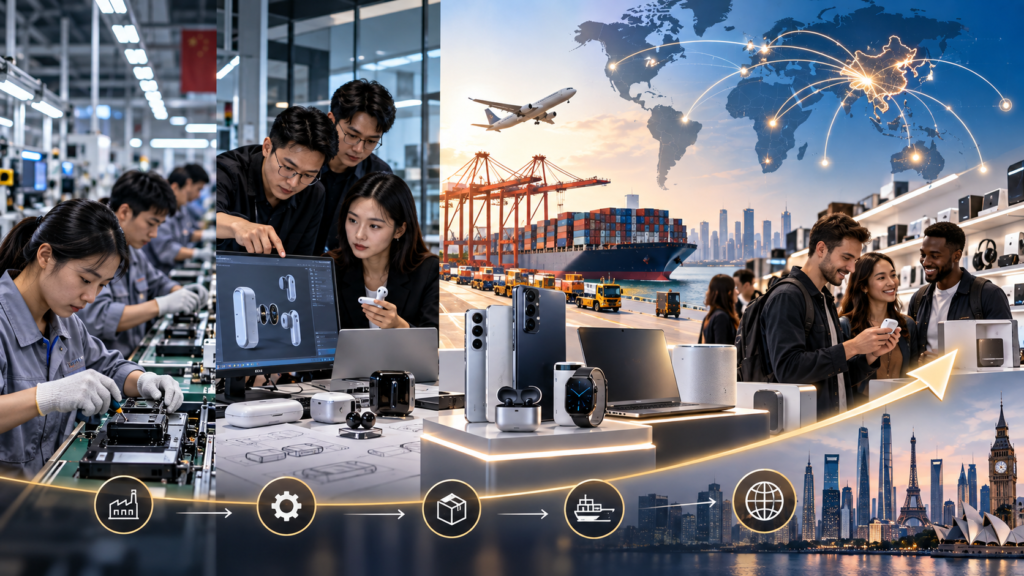
The Capabilities That Made the Playbook Work
The four routes are different, but they share a set of underlying capabilities. Without these, none of the routes work. With them, any of the routes becomes possible.
Localization That Goes Beyond Translation
Chinese brands that succeeded globally did not just translate their products. They rebuilt them for local conditions.
Transsion, the company behind Tecno, Infinix, and itel, built its African business on a simple insight. Its data showed that inconsistent electricity was the primary pain point for Nigerian phone users. Not camera quality. Not screen resolution. Power. That insight shaped both the product and the marketing. Battery life was sold not as a feature but as a lifestyle enabler.
The camera optimization for darker skin tones came from the same approach. Transsion built a 3D imaging database based on diverse skin tones and lighting conditions across Africa, then adjusted its algorithms accordingly. It also invested in speech recognition and natural language processing for less commonly served languages, launching a mobile AI assistant designed specifically for African users.
This is localization at the product level, not the marketing level. The company changed what the product did, not just how it was advertised.
Speed as a Competitive Weapon
The second shared capability is speed. Chinese companies that became global brands did not wait for perfect conditions. They tested, learned, and shipped.
Shein restocks in five days. Midea, the home appliance giant, developed a split air conditioner specifically for the European market that does not require professional installation. The product shipped over 200,000 units in Europe in one year, and Midea coordinated overtime production and rail freight to cut delivery time from 45 days by sea to 15 to 25 days by rail. Haier developed an air conditioner for European old buildings that does not require drilling into walls, cutting installation time by half.
None of these products would exist if the companies had waited for a global strategy to be approved in headquarters. They saw a specific problem in a specific market and moved fast to solve it.
Scale That Spreads Risk
The third capability is scale. Chinese manufacturers have access to supply chains, component suppliers, and production capacity that most companies in smaller markets cannot match. When Xiaomi enters a new market, it draws on the same component suppliers and manufacturing partners that serve its operations in Asia, Europe, and Latin America. That gives it a cost advantage that is difficult to overcome.
But scale also spreads risk. When one market slows down, Chinese brands can shift focus to another. When the Moroccan phone market declined in 2025, Chinese brands did not retreat. They increased focus on Egypt, Nigeria, and South Africa, where growth was stronger. That flexibility is a competitive advantage that smaller players simply do not have.
Design as a Core Investment, Not a Decoration
The fourth capability is design. Chinese companies that became global brands invested in design as a core part of the product, not as something added at the end.
Anker’s product philosophy is built around two principles that are essentially design principles. First principle means understanding the user’s most fundamental need. Seek the ultimate means building something that genuinely leads the industry, not just something that looks nice. The company’s IFA 2026 showcase included a 3D texture UV printer, a solar storage system, and security cameras, all built around the same philosophy of solving a real problem in a way that is different from everyone else.
Midea’s PortaSplit air conditioner is a design solution to a design problem. European apartments often cannot have traditional split units because drilling external walls is restricted or banned. The PortaSplit does not need installation, so it fits the building, not the other way around. That is design thinking applied to manufacturing.
What the Playbook Means for Nigerian Businesses
You might be reading this and thinking that these stories are impressive but distant. China has scale, capital, and decades of industrial policy that Nigeria does not have. All of that is true. But the playbook is not about copying the scale. It is about copying the thinking.
Start with a Narrow Focus
Anker did not start by trying to build a global technology conglomerate. It started with charging cables. It picked one narrow category, became the best in the world at it, and then expanded.
Nigerian manufacturers often try to do too much at once. A furniture maker wants to make chairs, tables, beds, and wardrobes all at the same time. A food processor wants to package rice, beans, spices, and flour under one brand. The result is a business that is mediocre at everything instead of excellent at one thing.
Pick one product. Make it better than anyone else in Nigeria. Then use that reputation to expand. That is the Anker way.
Build for Nigerian Conditions, Not Global Templates
Transsion did not succeed in Africa by taking a phone designed for China and hoping it worked here. It succeeded by building for Nigerian conditions. Long battery life because power is unreliable. Dual SIM because network quality varies. Cameras tuned for darker skin tones because the default settings were wrong.
Nigerian businesses should do the same. If you make refrigerators, design them for Nigerian power fluctuations and Nigerian kitchen sizes. If you make clothing, design for Nigerian weather and Nigerian body types. If you package food, design for Nigerian storage conditions and Nigerian distribution realities. A product built for Nigerian conditions will beat a generic imported product every time, even if the imported product is cheaper.
Use Your Factory as a Brand Asset
Dayang started as an OEM, making clothes for other brands. It did not abandon manufacturing when it built its own brand. It used its manufacturing expertise as the foundation. The factory became proof that the brand could deliver quality at scale.
Nigerian manufacturers who make products for other companies should think the same way. Your production capability is not a limitation. It is a credential. When you launch your own brand, you can tell customers that you have been making products for years, that you know how to control quality, and that you can deliver at volume. That is a trust signal that a startup without a factory cannot match.
Three Steps You Can Take Today
If you run a Nigerian business and you want to apply the Chinese playbook, here are three specific things you can do this week.
Audit Your Product for Local Fit
Take your best selling product and ask three questions. Does it solve a problem that is specific to Nigerian conditions? Does it have a feature that a Chinese or Western competitor would not think to include because they do not live here? Is there anything about the product that assumes conditions that do not exist in Nigeria, like stable power or cold chain logistics or wide roads?
Write down the answers. If you find a gap, that gap is your opportunity.
Pick One Narrow Category and Own It
Look at your product line and identify the one item where you have the strongest advantage. It might be the item with the highest margins. It might be the item customers ask for by name. It might be the item that is hardest for competitors to copy.
Then focus. Make that one product the best in Nigeria. Improve the design, the packaging, the warranty, the delivery. Become known for that one thing before you try to become known for everything.
Start a Small Test Batch Before You Scale
Shein does not produce thousands of units of a new design and hope it sells. It produces 100 to 200 units, tests the market, and only scales what works.
You can do the same. If you have a new product idea, do not invest your entire savings in a full production run. Make a small batch. Sell it to real customers. Watch what they say. If they love it, scale. If they do not, you have lost a small amount of money instead of a large one.
The Risks and the Reality
It would be dishonest to write about the Chinese playbook without talking about the risks and the costs. The transition from factory to global brand is not easy, and not every company that tries it succeeds.
The first risk is capital. Building a brand requires spending on design, marketing, distribution, and after sales support before you see the returns. Many Chinese companies spent years losing money on branding before they became profitable. Nigerian businesses with limited access to capital may find this difficult, especially when interest rates are high and foreign exchange is volatile.
The second risk is competition. The global brand space is crowded. Chinese companies succeeded partly because they entered categories where Western brands had become complacent. That window is closing. New Chinese brands now compete not just with Western brands but with each other. A Nigerian brand entering the same categories will face the same intense competition.
The third risk is policy. Global brand building depends on stable trade rules, reliable logistics, and access to foreign markets. All of these can be disrupted by policy changes. Nigeria’s own import and export policies have shifted repeatedly in recent years, and each shift creates uncertainty for businesses trying to plan long term.
None of these risks mean the playbook is not worth following. They mean it must be followed with clear eyes. The companies that succeed are the ones that understand the risks and plan for them.
Conclusion
The Chinese playbook for building global brands is not a secret formula. It is a set of choices that companies made over decades. Lenovo chose to buy a global brand and learn from it. Anker chose to build from scratch with a narrow focus. Shein chose to rewire its supply chain and sell direct. Dayang chose to use its manufacturing base as the foundation for mass customization.
What all four have in common is a willingness to invest in capabilities that take years to build. Design. Localization. Speed. Supply chain integration. These are not quick wins. They are the kind of investments that compound over time.
The three most important takeaways for Nigerian readers are these. First, the route to global branding is not one road but four, and the right one depends on what you already have. Second, localization is not a marketing tactic. It is a product strategy that starts with understanding the specific conditions of your market. Third, the factory is not a limitation. It is the foundation. Companies that build brands on top of real manufacturing capability have an advantage that companies without factories do not.
If you take one step today, let it be this. Write down one product you make or sell. Then write down one thing about that product that is designed specifically for Nigerian conditions. If you cannot think of anything, you have just found your next product improvement. Start there, and you are already following the Chinese playbook.
For a deeper look at how to source products from China for your Nigerian business, you can read our guide on working with Chinese manufacturers. If you want to understand how Chinese brands are competing in African markets today, our article on the future of Chinese brands in Africa covers the current landscape.