
For those of you who don’t know what computer village is, it is one of the biggest technology and gadget market in Lagos, Nigeria. I remembered the last time I walked into a phone shop in Ikeja last month and watched a young man ask for a Tecno phone by name. Not “the Chinese one.” Not “the cheap one.” He asked for Tecno, then compared it to Infinix and Xiaomi before making his choice. Ten years ago, that conversation would have been different. The buyer would have asked for Samsung or Nokia, and the seller would have offered a Chinese alternative as a budget compromise. That shift is the story of this article. A generation of Chinese technology brands has moved from the margins to the center of African consumer consciousness. They are no longer unknown. They are now the reference point against which other brands are measured.
This article is for Nigerian importers, retailers, distributors, and anyone trying to understand which Chinese tech brands matter and why. I have spent years working with importers and watching Chinese products move through Nigerian markets, from Computer Village in Lagos to Onitsha main market to Kano. In this piece, I will profile the Chinese technology brands that have crossed the line from obscure to unavoidable, explain the specific strategies that got them there, and give you three practical steps to position yourself for what comes next.
The Shift from Unknown to Unavoidable
Before profiling individual brands, it helps to understand the scale of the shift. Chinese technology brands are no longer a niche segment. They are the mainstream.
At IFA 2026, the world’s largest consumer electronics trade show in Berlin, more than 1,900 brands exhibited. Chinese companies from the mainland numbered 932, and including Hong Kong, Macau, and Taiwan, the total exceeded 1,000. That is roughly half of all exhibitors at a show with a hundred year history. German media reported that China was becoming the center of the exhibition. The chief executive of IFA was asked publicly whether there were too many Chinese companies.
The numbers tell the same story across categories. Chinese brands are no longer competing for a seat at the table. They are setting the agenda. The sections below profile the brands that have made that transition in the eyes of African consumers.
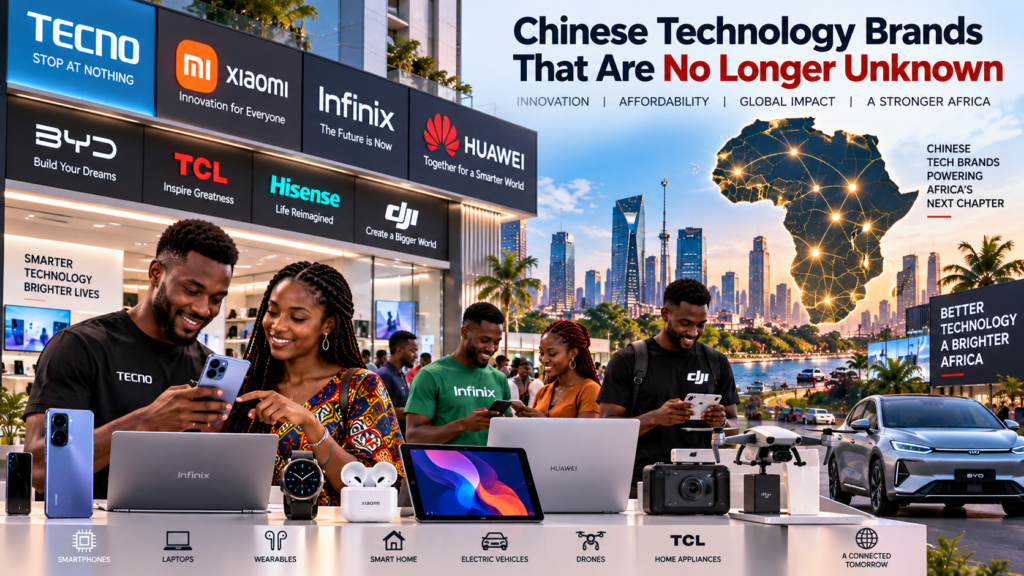
This article is for Nigerian importers, retailers, distributors, and anyone trying to understand which Chinese tech brands matter and why. I have spent years working with importers and watching Chinese products move through Nigerian markets, from Computer Village in Lagos to Onitsha main market to Kano. In this piece, I will profile the Chinese technology brands that have crossed the line from obscure to unavoidable, explain the specific strategies that got them there, and give you three practical steps to position yourself for what comes next.
The Shift from Unknown to Unavoidable
Before profiling individual brands, it helps to understand the scale of the shift. Chinese technology brands are no longer a niche segment. They are the mainstream.
At IFA 2026, the world’s largest consumer electronics trade show in Berlin, more than 1,900 brands exhibited. Chinese companies from the mainland numbered 932, and including Hong Kong, Macau, and Taiwan, the total exceeded 1,000. That is roughly half of all exhibitors at a show with a hundred year history. German media reported that China was becoming the center of the exhibition. The chief executive of IFA was asked publicly whether there were too many Chinese companies.
The numbers tell the same story across categories. Chinese brands are no longer competing for a seat at the table. They are setting the agenda. The sections below profile the brands that have made that transition in the eyes of African consumers.
Tecno, Infinix, and itel: The Transsion Empire
If you ask a Nigerian phone buyer to name a Chinese brand, they will almost certainly name one of these three. Tecno, Infinix, and itel are all owned by Transsion Holdings, a company that has built its entire business around understanding the African consumer.
Transsion held 47 percent of the African smartphone market in the first quarter of 2026, shipping 9.3 million units during the quarter. That is nearly one out of every two smartphones sold on the continent. In Nigeria specifically, Transsion brands are the default choice for first-time smartphone buyers and for consumers upgrading from feature phones.
The company succeeded because it built for African conditions before anyone else did. When Transsion entered Africa, international brands were selling phones designed for global markets. They did not account for the fact that power supply in many African countries is unreliable. Transsion developed low cost high voltage fast charging and wide temperature range battery technology specifically for African conditions. They did not optimize cameras for darker skin tones. Transsion built a 3D imaging database from African users and developed algorithms that could capture facial bone structure, provide intelligent fill light, and add beauty features for dark skin. The company’s co-founder noted that traditional face detection and beauty algorithms often failed in dark skin scenarios, leaving a gap that Transsion filled.
The result is a brand that African consumers describe as feeling like a local brand, not a foreign one. A Kenyan finance worker told reporters that Tecno felt like a brand that belonged to her community, not an imported product. That perception is the strongest asset a consumer brand can have.
itel, the most affordable of the three brands, has expanded beyond phones into the renewable energy sector. In 2026, itel Energy launched a lineup of portable and scalable solar solutions in Lagos, including the itel Power Go with a 130W inverter and 320Wh battery capacity, and commercial energy storage systems for businesses. The products were designed specifically for Nigerian realities: frequent blackouts, limited living space in urban homes, and the need for budget friendly alternatives amid rising energy prices. The West Africa director for itel Energy explained that affordability and portability were key considerations because most Nigerian homes do not have excess space.
Xiaomi: The Ecosystem Challenger
Xiaomi entered the African market later than Transsion, but it has grown faster than almost any competitor. The company shipped 1.8 million smartphones in Africa in the first quarter of 2026, holding 9 percent market share. That represented a 28 percent decline from the previous year, but the decline was driven by memory price increases that disproportionately affected the entry level segment where Xiaomi competes, not by a loss of consumer interest.
What makes Xiaomi a brand to watch is not its phone business alone. It is the ecosystem. Xiaomi sells smart cameras, robot vacuums, smart mops, air purifiers, air fryers, and a growing range of connected devices. Once a customer buys a Xiaomi phone, they are more likely to buy a Xiaomi smart home product. Once they buy the smart home product, they are more likely to stay within the ecosystem when they upgrade their phone.
In Nigeria, Xiaomi has been positioning its Redmi sub-brand as the value leader. The upcoming Redmi 17 was designed with a 7,500mAh battery and 45W turbo charging, positioning it for students and young professionals who rely on their phones throughout the day. That is a direct response to the same power reliability challenge that Transsion addressed years earlier. Xiaomi is not inventing a new problem. It is solving a known problem with better specifications.
Huawei: The Comeback Brand
Huawei is the most consequential Chinese technology brand that many African consumers still do not fully understand. The company’s history is well known. It was the world’s largest smartphone maker before United States sanctions cut off its access to advanced chips and Google services. Many analysts predicted the company would fade from the consumer market.
That prediction was wrong. Huawei’s HarmonyOS operating system became the world’s third largest mobile operating system, holding 5 percent of global smartphone shipments in the second quarter of 2026. In China, HarmonyOS took 24 percent of smartphone sales in the same quarter, ahead of Apple’s iOS at 18 percent. The company said more than 100,000 native HarmonyOS applications have been developed, and total apps accessible on HarmonyOS smartphones exceed 400,000.
Huawei’s rotating chairman announced plans to pilot HarmonyOS in selected overseas markets before deciding on a broader consumer rollout. He said the goal was to provide the world with a second option. That language matters. Huawei is not positioning itself as a budget alternative to Android. It is positioning itself as a sovereign alternative, a platform that governments and companies can adopt without depending on American technology.
For African consumers and businesses, Huawei’s significance is not just about phones. The company is a major supplier of telecommunications infrastructure, cloud services, and enterprise technology across the continent. Its consumer brand recognition, even after years of sanctions, remains strong in Nigeria and other African markets where Huawei devices were widely used before the Google services restriction.
DJI: The Undisputed Drone Leader
DJI is not a household name in the way that Tecno is. But in the drone market, it is close to a monopoly. The company held 74.1 percent of China’s online drone retail market in the first quarter of 2026, with retail sales of 560 million yuan out of a total market of 750 million yuan. By April 2026, its share had risen to 81.6 percent, with the second place brand holding just 3.8 percent. In the United States, despite a Federal Communications Commission ban, DJI drones make up 97.1 percent of contractor drone fleets.
DJI’s dominance is built on product quality and continuous innovation. The company’s Mini series dominates sales charts, and its Neo series has strengthened its position in outdoor dynamic tracking. The industry has shifted from drones as flying toys to drones as professional intelligent imaging devices, and DJI has led that shift.
For Nigerian entrepreneurs, DJI matters in sectors like agriculture, real estate, construction, and security. Drone surveying, crop monitoring, and site inspection are growing applications in Nigeria, and DJI is the default tool for most of them. The brand is not unknown to professionals in those fields. It is the standard.
Anker Innovations: The Charging and Smart Home Powerhouse
Anker is a case study in how a company can build a global brand from a narrow starting point. The company began with charging cables and power banks. Today it serves over 200 million customers in more than 180 countries, and its charging business generates less than 10 percent of total revenue because it has expanded into smart home, audio, and robotics.
The financial results show the scale of the business. For the half year ended June 30, 2026, Anker reported revenue of 16.6 billion yuan, up from 12.9 billion yuan in the same period a year earlier. Net income rose to 1.7 billion yuan from 1.2 billion yuan. Analysts covering the company project full year 2026 revenue of 38.8 billion yuan. The company employs over 6,300 people and distributes its products in domestic and overseas markets.
Anker’s success comes from a product philosophy the company calls the shallow sea strategy. The idea is that consumer electronics has huge deep sea categories like smartphones, but it also has many small, shallow categories that individually seem minor but together add up to serious money. Anker picks narrow categories where there is room for genuine innovation, becomes the best in the world at them, and then expands.
For Nigerian consumers, Anker is best known for its charging products. But the company’s expansion into energy storage is relevant to the Nigerian market. Reliable power storage is a daily need for millions of Nigerian households and businesses, and Anker’s expertise in battery technology positions it well for that market.
TikTok and ByteDance: The Platform That Changed Everything
TikTok is not a hardware brand, but it is arguably the most influential Chinese technology product in the world. The platform surpassed 2 billion monthly active users globally in the first quarter of 2026, with downloads growing 7 percent quarter on quarter. It is owned by ByteDance, a Chinese company that has built one of the most powerful recommendation algorithms in the history of consumer technology.
For Nigerian businesses, TikTok is not just a social media platform. It is a commerce channel. TikTok Shop has become a major sales channel in Southeast Asia, and the model is spreading. Nigerian entrepreneurs are already using TikTok to reach customers directly, bypassing traditional retail channels. A fashion brand can post a video showing how clothes look on different body types. A food producer can livestream a cooking demonstration. A furniture maker can show how a piece is assembled. The content itself is the advertisement, and the platform’s algorithm puts it in front of people who are likely to buy.
ByteDance also owns CapCut, the video editing tool that has become standard for mobile content creation. CapCut reported 9 percent revenue growth in the first quarter of 2026. For Nigerian content creators and small businesses, CapCut is often the first editing tool they learn, and that familiarity builds a relationship with the ByteDance ecosystem.
TCL and Hisense: The Television and Appliance Giants
The television market is where Chinese brands have made some of their most visible gains in African homes. TCL and Hisense are the two names most Nigerian consumers recognize, and both are expanding aggressively.
TCL deepened its presence in Nigeria in 2026 with the launch of a range of AI enabled consumer electronics, including SQD Mini LED televisions, smart air conditioners, smart refrigerators, and washing machines. The company’s international television business revenue grew 29.6 percent to 25.4 billion Hong Kong dollars in the first half of 2026, surpassing its domestic revenue.
Hisense has been manufacturing in South Africa for years and has become one of the leading appliance brands on the continent. At IFA 2026, Hisense announced it would become the official global partner of the UEFA European Championship for 2028, its fourth consecutive sponsorship of the tournament. That kind of sponsorship is not just marketing. It is a signal of long term commitment to the European and global markets, and it builds brand recognition that carries over into African markets as well.
The appliance sector is where Chinese brands are investing most heavily in local manufacturing. Midea established a South African subsidiary in 2026 with a washing machine manufacturing plant scheduled to begin production within the year. Haier’s Egypt ecological park phase two is planned for production by the end of 2026. As these factories come online, prices will fall, and Chinese appliance brands will become even more dominant in African households.
The Electric Vehicle Brands: BYD, Geely, and Changan
The automotive sector is the newest frontier for Chinese technology brands in Africa, and the brands entering the market are already becoming known.
BYD entered Nigeria in 2025 through LOXEA Nigeria, a subsidiary of CFAO Mobility. The company introduced the Atto 3 and Dolphin models and partnered with Stanbic IBTC Bank to promote electric vehicle financing. Geely Galaxy, the premium new energy vehicle brand under Geely Auto Group, entered Nigeria in June 2026 through a partnership with TIM Motors, with a launch event in Lagos themed “Powering the Future”. Changan Automobile opened its first showroom in Ethiopia in July 2026 and is expanding its dealer network in South Africa from 25 to more than 40 by the end of 2026.
These brands are not yet household names in Nigeria. Electric vehicle adoption is still in its early stages, and charging infrastructure remains limited. But the brands are building recognition through dealer networks, financing partnerships, and high visibility launches. For Nigerian consumers who follow the automotive market, BYD and Geely are no longer unknown. They are the names that come up when someone asks about electric cars.
The Common Thread: Localization, Speed, and Service
If you look across all these brands, a pattern emerges. The ones that have moved from unknown to unavoidable share three characteristics.
The first is localization. Transsion built cameras for dark skin and batteries for unreliable power. itel built solar products for Nigerian homes with limited space. TCL built AI enabled appliances for Nigerian conditions. These are not global products with a local sticker. They are products designed for local conditions from the beginning.
The second is speed. Chinese brands move faster than their competitors. They test, learn, and ship. Shein restocks in five days. Xiaomi launches new models with specifications that directly address known consumer pain points. The ability to iterate quickly is a competitive advantage that compounds over time.
The third is service. Transsion’s Carlcare network operates over 2,000 service points globally, with deep coverage in African markets. Anker’s global distribution network ensures that replacement parts and accessories are widely available. Service is what builds trust, and trust is what makes a brand a household name.
What Nigerian Businesses Should Take From This
The rise of Chinese technology brands in Africa is not just a story about China. It is a story about how brands are built. Nigerian entrepreneurs can learn from it.
Build for the Customer Who Actually Exists
The most important lesson is to build for the customer who is actually there. Transsion did not succeed by building the best phone in the world. It succeeded by building the best phone for a specific group of people with specific needs. Nigerian businesses often try to serve everyone and end up serving no one. Pick a customer. Understand their specific problem. Build for them.
Invest in Service, Not Just Sales
The second lesson is that service is not a cost center. It is a competitive advantage. Transsion’s Carlcare network is expensive to operate, but it is one of the reasons the brand has maintained its market leadership for years. Nigerian businesses that invest in after sales support, warranty service, and customer care will build the kind of loyalty that survives competition.
Use Content to Build Trust
The third lesson is that content is commerce. TikTok and CapCut have shown that short video content is not just entertainment. It is a sales channel. Nigerian entrepreneurs who learn to tell their story through video will reach customers that traditional advertising cannot reach. A furniture maker who posts assembly videos builds trust with buyers who worry about quality. A food producer who livestreams cooking demonstrations builds confidence in the product. Content is how you earn attention in a crowded market.
The Risks and the Reality
It would be dishonest to write about the rise of Chinese technology brands without acknowledging the risks.
The first risk is component costs. Memory prices increased by more than 80 percent quarter on quarter in early 2026, and the average selling price of a smartphone in Africa rose 11 percent in the final quarter of 2025. As costs rise, the price advantage that Chinese brands rely on shrinks. Brands that cannot differentiate themselves on design, service, or technology will struggle.
The second risk is competition between Chinese brands. Transsion, Xiaomi, Honor, and Oppo are all fighting for the same customers. Honor grew 101 percent year on year in the first quarter of 2026, the fastest growth of any brand in Africa. That competition is good for consumers in the short term, but it puts pressure on margins. Some brands will not survive.
The third risk is regulatory. As Chinese e-commerce platforms and technology brands gain market share, African governments may introduce regulations to protect local industries. Nigeria has already seen complaints from local manufacturers about the de minimis rule. If import rules change, the cost structure for Chinese brands could shift.
Three Steps You Can Take Today
If you are a Nigerian business owner, importer, or distributor, here are three specific things you can do this week to respond to the rise of Chinese technology brands.
Audit Your Product Line for Brand Competition
Take a piece of paper and list every product you sell. For each one, ask a simple question. If a Chinese brand entered this category tomorrow with a product at a similar price point, would my customers switch? If the answer is yes, you have a vulnerability. If the answer is no, you have an advantage. Write down the products where you are most vulnerable, and start thinking about how to differentiate.
Study One Brand and Apply Its Principles
Pick one Chinese brand from this article. Spend 30 minutes researching how it operates. Not what it sells, but how it thinks. How does it reach customers? How does it handle service? How does it adapt its product to local conditions? Write down one principle you can apply to your own business. Then apply it this month. The goal is not to copy the brand. The goal is to learn from its approach.
Talk to Your Customers About What They Actually Want
The Chinese brands that have succeeded in Africa succeeded by listening to customers. Talk to five of your best customers this week. Ask them one question. What is one thing you wish my product or service did better? Listen carefully. The answer might surprise you. Then act on it. That is how you build a business that earns attention, not just competes for it.
Conclusion
Chinese technology brands are no longer unknown in Africa. Transsion holds nearly half the smartphone market. Xiaomi is building an ecosystem that spans phones, appliances, and smart home devices. Huawei has returned with HarmonyOS as the world’s third largest mobile operating system. DJI dominates the drone market. Anker has built a global charging and smart home business. TikTok has over 2 billion users. TCL and Hisense are in millions of African homes. BYD and Geely are building the electric vehicle market.
The three most important takeaways for Nigerian readers are these. First, the brands that succeed are the ones that localize their products for African conditions, not the ones that simply export finished goods. Second, service is a competitive advantage. The brands that invest in after sales support build the loyalty that survives competition. Third, content is commerce. Short video platforms like TikTok are not just marketing channels. They are sales channels that build trust.
If you take one step today, let it be this. Look at your business and ask one question. What is one thing that a Chinese technology brand does better than you? It might be price. It might be distribution. It might be service. Whatever it is, write it down. Then spend 30 minutes thinking about how you can close that gap. Not by copying the brand, but by doing something it cannot do. That is how you compete in a market where Chinese technology brands are no longer unknown. They are the standard.
For a deeper look at how Chinese brands compete on price, technology, and design, you can read our article on the competitive strategies behind their success. If you want to understand how Chinese companies are building their African market strategy, our guide on their playbook for the continent covers the details.