
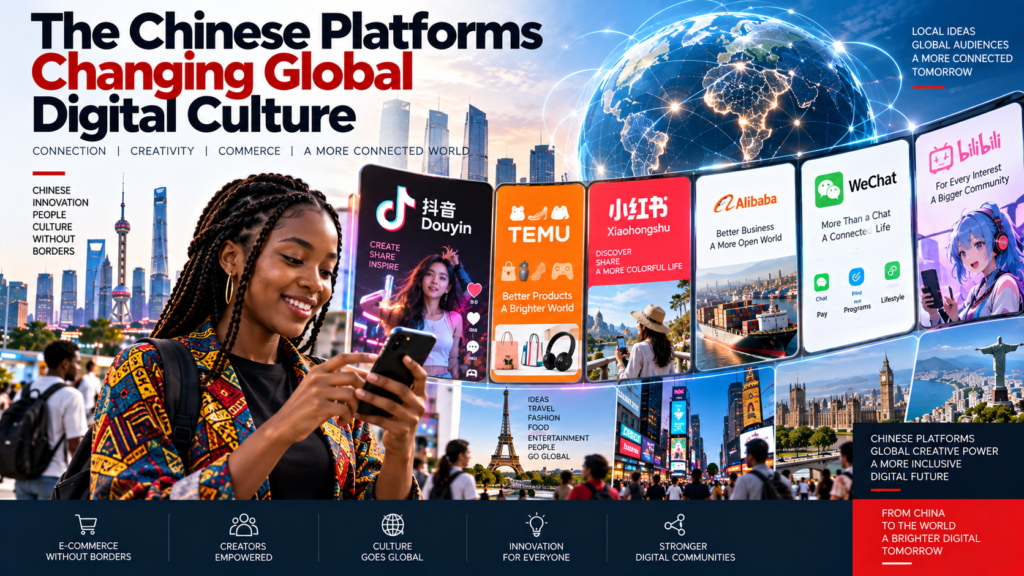
I watched a Nigerian teenager in Lagos last week do something that would have been impossible ten years ago. She opened TikTok, learned a dance move that originated in Seoul, added a sound that was trending in Brazil, and posted a video that within hours was viewed by people in Manila, Nairobi, and Berlin. She did not think about any of that. She just wanted to join in. That is the quiet revolution happening right now. Chinese digital platforms have built the infrastructure that allows a girl in Lagos to participate in a global culture in real time, and the Chinese platforms changing global digital culture are not just distributing content. They are rewriting the rules of how culture moves, who creates it, and who gets to participate.
This article is for Nigerian entrepreneurs, content creators, marketers, and anyone trying to understand where digital culture is heading. I have spent years watching how Chinese technology products move through African markets, but the platform story is different. It is not about hardware. It is about the invisible architecture that shapes what billions of people see, share, and imitate every day. In this piece, I will show you the scale of these platforms, explain the specific mechanisms they use to shape culture, examine what is happening in Nigeria and Africa, name the real concerns that are emerging, and give you three practical steps to position yourself in this new landscape.
The Scale of the Platform Shift
Start with the numbers, because they tell you how far this has gone. TikTok surpassed 2 billion monthly active users globally in the first quarter of 2026, with downloads growing 7 percent quarter on quarter, according to Sensor Tower data. That places it alongside Facebook, WhatsApp, Instagram, and YouTube as one of the five most used platforms on earth. ByteDance’s video editing tool CapCut, which sits alongside TikTok in the same ecosystem, saw revenue growth of 9 percent in the same period.
The e-commerce platforms tell a similar story. Temu, owned by PDD Holdings, reached 366 million unique visitors and 1.34 billion monthly visits in early 2026, making it the second most visited e-commerce site globally after Amazon. Goldman Sachs projected that Temu’s gross merchandise value would exceed 100 billion dollars in 2026. Shein served approximately 160 markets with 281 million active customers as of March 2026, generating 41.8 billion dollars in net revenue in 2025, surpassing Adidas and H&M in annual revenue.
But the category that may be most culturally significant is one that most people outside Asia have never heard of. Short drama apps, which deliver serialized fiction in episodes of one to two minutes, saw global downloads exceed 850 million in the first quarter of 2026, a year on year increase of 140 percent. Five of the six short drama apps in the global top 40 download rankings were launched by Chinese companies. FreeReels ranked 8th with over 100 million downloads. ReelShort, DramaBox, NetShort, and ByteDance’s Melolo all placed in the top 40. DramaBox and ReelShort each generated nearly 140 million dollars in in-app purchase revenue in a single quarter.
These are not marginal products. They are reshaping how hundreds of millions of people spend their time, what they talk about, and what they imitate.
How Chinese Platforms Shape Culture Differently
The Chinese platforms that have achieved global scale did not succeed by copying Western models. They succeeded by building different mechanisms for content discovery, creation, and distribution. Understanding those mechanisms is essential for anyone who wants to compete or participate in this new landscape.
Algorithm-Driven Discovery Over Social Graphs
Facebook and Instagram are built on social graphs. You see content from people you know, or from accounts you have chosen to follow. TikTok is built on something different. Its algorithm studies how you interact with content, not who you know, and serves you videos based on predicted interest rather than social connection.
The result is that a creator with zero followers can reach millions of people if the algorithm decides their content is engaging. A Nigerian dancer with no industry connections can go viral alongside a professional studio in Los Angeles. The barrier to entry is not who you know. It is whether your content holds attention.
This shift has profound implications for cultural production. When discovery is algorithmic rather than social, cultural trends can emerge from anywhere. A dance move that starts in a small town can become a global challenge in days. A sound that was recorded on a phone in a bedroom can become the soundtrack for millions of videos. The gatekeepers who once controlled what became popular, record labels, television networks, and advertising agencies, have lost much of their power.
Platform-Native Cultural Forms
The second mechanism is the creation of cultural forms that exist only on these platforms. The best example is the hand dance, or gesture dance, that has become a global phenomenon on TikTok and Douyin.
A 2026 analysis in the Chinese newspaper Wenhui Bao described how hand dances, built on simple, repeatable hand movements and facial expressions, have become a new global social language. The form is platform-native. It was designed for short video, for vertical screens, for the specific constraints and possibilities of the medium. It requires no formal training, no special equipment, and no shared spoken language. A person in Lagos can learn a hand dance from a video created in Shanghai and perform it identically within minutes.
The analysis noted that a hand dance set to a remixed version of the Yunnan folk song Midu Mountain Song reached over 4 billion views on Douyin and over 2 billion views on TikTok under the hashtag MiduEchoing. The song originated in a specific region of China, but it became a global trend because the hand dance made it accessible to anyone, regardless of language or cultural background. The body, as the analysis put it, bypasses complex encoding and decoding processes and concentrates emotion and information in the rise and fall of a limb.
This is a fundamentally different model of cultural export than anything that came before. Traditional cultural export required translation, adaptation, and marketing. Platform-native forms require none of those things. They spread because they are easy to imitate, and they are easy to imitate because they were designed for a platform where imitation is the primary form of engagement.
Short Drama and the New Storytelling
The third mechanism is the short drama format. These are not short films in the traditional sense. They are serialized narratives, often with dramatic plot twists, cliffhangers, and emotional highs, delivered in episodes of one to two minutes. The format was pioneered in China, where it became a massive industry, and it is now spreading globally through apps like DramaBox, ReelShort, and FreeReels.
The short drama format is significant because it changes the economics of storytelling. Traditional television and film production requires large budgets, long production cycles, and distribution deals. A short drama can be produced quickly, distributed directly through an app, and monetized through in-app purchases. A creator with a compelling story and a small budget can reach a global audience without going through traditional gatekeepers.
For Nigerian creators, this is an opportunity that is only beginning to be recognized. Nollywood has already demonstrated that Nigerian stories can travel. The short drama format offers a new channel for that storytelling, one that does not require the same investment or the same distribution relationships.
What Is Happening in Nigeria and Africa
The global platform shift is not something happening elsewhere. It is happening here, and the pace is accelerating.
TikTok in Nigeria
Nigeria’s TikTok user base now exceeds 37 million active accounts, more than double the figure recorded in 2025, according to data cited by Voice of Nigeria. Data from GeoPoll’s 2026 survey showed that 66 percent of young Nigerians use TikTok regularly, with 71 percent accessing the platform daily.
The platform has become a cultural engine in Nigeria, particularly in music. TikTok dance challenges and viral sound trends are now a leading determinant of hit songs. Music promoters and artists structure their release plans around the platform. A Lagos-based music promoter told reporters that every serious artist dropping a song now asks one question. Will this work on TikTok? If the answer is no, they go back and rework it.
The success of CKay’s Love Nwantiti is the clearest example. The song moved from moderate streaming numbers to global chart dominance on the strength of a TikTok challenge wave. That pattern has since been repeated by dozens of Nigerian artists. The platform’s algorithm rewards high engagement within short periods, meaning a well-timed dance challenge can push a song to millions of new listeners in days, outpacing traditional radio promotion.
Temu in Nigeria
Temu entered Nigeria in November 2024 and rapidly gained popularity through aggressive advertising, deep discounts, and a mobile-first shopping model. Within months, it became one of the most downloaded shopping applications in the country, attracting an estimated 12.7 million Nigerian users. Nigeria’s National Data Protection Commission opened a formal investigation into Temu’s data processing activities in early 2026, citing concerns about online surveillance, accountability gaps, data minimisation, transparency, duty of care, and cross-border transfer of personal data.
The investigation is significant because it signals that African regulators are beginning to assert authority over global platforms. The scale of Temu’s Nigerian user base, 12.7 million people, makes the country a significant market for the platform. But it also makes the data protection concerns more serious. The NDPC has previously imposed a 766 million naira fine on MultiChoice for data protection violations, indicating that penalties are no longer theoretical.
For Nigerian consumers, the question is not whether to use these platforms. It is whether the platforms are accountable to Nigerian law and Nigerian users. The investigation is a test of whether global platforms can be held to local standards.
Shein and the Fast Fashion Wave
Shein has been gaining ground across African markets, with Shein and Temu together capturing 37 percent of the clothing e-commerce market in South Africa. Nigerian manufacturers have complained that these platforms benefit from the de minimis rule, which allows small shipments to enter the country without import duties. If Nigeria changes its import rules, the cost structure for these platforms could shift significantly.
But the cultural impact of Shein is not just about price. The platform has introduced millions of African consumers to fast fashion at a scale that was previously unavailable. The Shein model, producing small test batches of 100 to 200 units per design and restocking within five days if a design sells, has created a feedback loop between consumer behavior and production that traditional retailers cannot match. African consumers are not just buying clothes. They are participating in a global fashion system that responds to their preferences in real time.
The Three Waves of Chinese Cultural Export
To understand where this is heading, it helps to see the pattern. Chinese platforms have moved through three distinct waves of cultural export, and each one has reached deeper into global culture than the last.
The first wave was content export. Chinese films, television shows, and music were translated and distributed to overseas audiences. This was a one-way flow. China produced, the world consumed. The cultural impact was limited by language barriers and distribution constraints.
The second wave was platform export. TikTok, Temu, and Shein are not content. They are infrastructure. They allow users to create and distribute their own content, and they monetize that activity through advertising, commerce, and in-app purchases. The cultural impact is deeper because the platforms are not just delivering Chinese culture. They are shaping how culture is created and shared globally. A Nigerian creator on TikTok is not consuming Chinese content. They are using Chinese infrastructure to reach a global audience.
The third wave is format export. The short drama format, the hand dance, the livestream commerce model, these are cultural forms that originated in China and are now being adapted and recreated around the world. They are not Chinese content in the traditional sense. They are templates for cultural production that anyone can use. When a Nigerian creator makes a short drama, they are not copying a Chinese show. They are using a format that was refined in China and applying it to Nigerian stories.
This third wave is the most significant because it is the hardest to resist. You can ban a platform. You can regulate a company. But you cannot easily stop a format. Once a way of telling stories or engaging audiences has been proven to work, it spreads. The short drama format is already being used by creators in Southeast Asia, Latin America, and increasingly Africa. The hand dance is already a global phenomenon.
What Nigerian Creators and Businesses Should Do
The platform shift is not something that Nigerian creators and businesses can ignore. It is the environment in which they now operate. Here are three specific steps to position yourself in this new landscape.
Build for Algorithmic Discovery, Not Just Followers
The first step is to understand that on Chinese platforms, discovery is driven by the algorithm, not by follower count. A creator with 500 followers can reach more people than a creator with 50,000 if the algorithm decides the content is engaging. This means you should focus on creating content that holds attention, not on building a follower base for its own sake.
The practical implication is to study what works on the platform. What are the first three seconds of a viral video? What kind of hooks keep people watching? What sounds are trending? What formats are being repeated? The algorithm rewards content that generates engagement, so your goal is to create content that people want to watch to the end, comment on, and share.
Use Platform-Native Formats
The second step is to use formats that are native to the platform. Do not try to repurpose a television advertisement or a YouTube video for TikTok. The platform has its own grammar. Short videos have a different pacing, a different visual style, and a different relationship with the viewer. Hand dances, challenges, duets, and short dramas are all formats that were designed for the platform. Learn them, adapt them, and use them to tell Nigerian stories.
The hand dance phenomenon is instructive. The Midu Mountain Song hand dance reached billions of views because it was simple, repeatable, and visually engaging. A Nigerian creator could apply the same principles to a Nigerian folk song or a Nigerian dance move. The format is not Chinese. It is platform-native. The content can be anything.
Think About Commerce and Culture Together
The third step is to recognize that on these platforms, commerce and culture are not separate. TikTok Shop, Temu, and Shein have shown that content can drive purchases directly. A creator who demonstrates a product can generate sales without a traditional advertising campaign. A business that tells a compelling story can build a customer base without a retail presence.
For Nigerian entrepreneurs, this means thinking about content as a sales channel, not just a marketing expense. A fashion brand that posts videos showing how clothes look on different body types is not just advertising. It is selling. A food producer that livestreams a cooking demonstration is not just promoting. It is converting viewers into customers. The line between content and commerce has blurred, and the businesses that understand this will have an advantage.
The Risks and the Real Concerns
It would be dishonest to write about the Chinese platforms changing global digital culture without acknowledging the risks and concerns.
The first concern is data sovereignty. Temu’s investigation in Nigeria is a reminder that global platforms collect vast amounts of data from users in countries where data protection laws are still developing. The NDPC’s investigation identified cross-border transfer of personal data as one of its priority review areas. For Nigerian users, the question is whether their data is protected by Nigerian law and whether they have recourse if it is misused.
The second concern is cultural homogenization. When a handful of platforms control what billions of people see, there is a risk that cultural diversity will be flattened. If the algorithm rewards certain formats, certain sounds, and certain visual styles, creators around the world will gravitate toward those formats. The result could be a global culture that is less diverse, not more.
But the counterargument is also strong. The hand dance phenomenon shows that platforms can amplify local culture, not just homogenize it. The Midu Mountain Song was a regional folk song from Yunnan. It became a global trend because the platform allowed it to spread. The algorithm did not erase its local character. It amplified it. The question is whether that pattern will continue or whether the pressure to conform to platform norms will overwhelm local distinctiveness.
The third concern is regulatory. As Chinese platforms gain market share in Africa, governments are beginning to assert authority. Nigeria’s investigation into Temu is one example. South Africa has taken steps to close the de minimis loophole that benefits Shein and Temu. If regulations change, the cost structure for these platforms could shift, and the user experience could change. Nigerian businesses that depend on these platforms should be prepared for regulatory shifts.
Three Steps You Can Take Today
If you are a Nigerian creator, entrepreneur, or business owner who wants to position yourself in this new landscape, here are three specific things you can do this week.
Study One Platform and Learn Its Grammar
Pick one platform, whether it is TikTok, Temu, or a short drama app, and spend one hour studying how content works on it. Not what the platform is for, but how the content is structured. What are the first three seconds of a viral video? What kind of products sell best on Temu? What makes a short drama episode engaging? Write down three observations. Then think about how you could apply those observations to your own content or business.
Create One Piece of Platform-Native Content
Do not repurpose something you already have. Create something specifically for the platform. It could be a 15 second video. It could be a product demonstration. It could be a short drama episode. The goal is to learn by doing, not by watching. Post it. See what happens. The algorithm will tell you more in a day than any guide can tell you in a week.
Talk to Your Customers About What They Watch
Ask five of your customers what platforms they use and what content they engage with. Do not ask them what they buy. Ask them what they watch. The answers will tell you where attention is going. If your customers are spending hours on TikTok, that is where your marketing should be. If they are browsing Temu, that is where your product should be discoverable. Attention is the currency of the platform economy, and you need to know where your customers are spending theirs.
Conclusion
The Chinese platforms changing global digital culture are not just tools. They are infrastructure. TikTok, Temu, Shein, and the short drama apps have built systems that shape how billions of people discover content, make purchases, and participate in cultural trends. The scale is enormous. TikTok has 2 billion monthly users. Temu is the second most visited e-commerce site in the world. Short drama downloads grew 140 percent in a single quarter. In Nigeria, TikTok has over 37 million users, and Temu has 12.7 million.
The three most important takeaways for Nigerian readers are these. First, the platforms have shifted power from gatekeepers to algorithms. A creator with no industry connections can reach a global audience if their content holds attention. Second, platform-native formats are the new cultural language. Hand dances, short dramas, and livestream commerce are not passing trends. They are the grammar of the platform economy. Third, commerce and culture are now inseparable. Content sells, and selling requires content.
If you take one step today, let it be this. Pick one platform and create one piece of content specifically for it. Not a repurposed advertisement. Not a generic post. Something that was designed for the platform, using its formats and its grammar. Post it. Watch what happens. The algorithm will teach you more in 24 hours than any article can. That is how you start participating in the culture that is being built, rather than just consuming it.
For a deeper look at how Chinese brands compete on price, technology, and design, you can read our article on the competitive strategies behind their success. If you want to understand which Chinese technology brands are already household names in Africa, our guide on the brands that are no longer unknown covers the landscape.