
I was at a trade fair in Lagos last year when a Chinese supplier pulled out a small device and told me it was a translator that could handle Yoruba, Igbo, and Hausa in real time. I did not believe him until he used it. That moment stayed with me because it showed something that most people outside the tech world are only beginning to grasp. China is not just selling finished products anymore. It is building the core technologies that will define the next twenty years of global industry. The next Chinese technology revolution is not a single breakthrough. It is a set of breakthroughs happening at the same time, in fields that most Nigerians have never heard of, and it will change what is available in our markets, what jobs are created, and what opportunities exist for African entrepreneurs.
This article is for Nigerian business owners, importers, students, and anyone who wants to understand where technology is heading next. I have spent years working with importers and watching Chinese products move through Nigerian markets. What I have learned is that the products we see today are always the tail end of a revolution that started years earlier. The smartphone wave that transformed African markets started with semiconductor investments in the 2000s. The electric vehicle wave that is coming to Nigeria now started with battery research in the 2010s. The next wave is being built right now, in laboratories and factories across China, and it covers six technologies that will reshape everything.
The Five-Year Plan That Sets the Direction
To understand where China is going, you need to understand the plan that guides it. Every five years, the Chinese government sets out a national strategy that coordinates investment across government, universities, and private companies. The current plan covers 2026 to 2030, and it names specific technologies as priorities.
According to China’s Ministry of Industry and Information Technology, the country will turn frontier technologies into new growth engines by putting emerging and future industries at the center of its industrial agenda. Integrated circuits, aerospace, biomedicine, the low altitude economy, new energy storage, and intelligent robots will be developed into emerging pillar industries. The plan also names future growth points that are not yet commercial but are being prepared for the next cycle. These include quantum technology, biomanufacturing, hydrogen and nuclear fusion energy, brain computer interfaces, embodied intelligence, and 6G communications.
The language matters. When the Chinese government names a technology as a future growth point, it means funding is being allocated, universities are being directed to train people in that field, and state-owned enterprises are being asked to build supply chains around it. This is not a suggestion. It is a directive, and the entire system moves to execute it.
For Nigerian readers, this is important because it tells you where the next wave of Chinese products will come from. The phones and appliances we buy today were the future growth points of five years ago. The technologies on this list are what we will be buying in 2030.
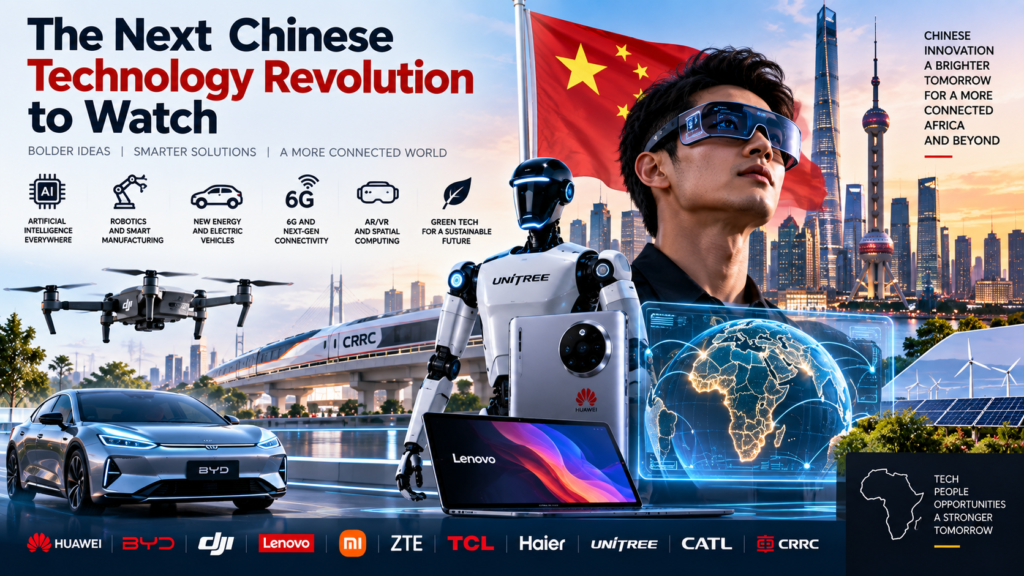
Artificial Intelligence: The Engine Behind Everything
Artificial intelligence is the first technology on the list, and it is the one that connects all the others. China’s core AI industry was worth over 1.2 trillion yuan in 2025, with more than 6,200 companies operating in the sector, according to China’s Ministry of Industry and Information Technology as cited by the Nigerian Guardian newspaper. Chinese companies such as DeepSeek, Alibaba, Tencent, Baidu, Zhipu AI, and Moonshot AI have developed large language models that compete with the best in the world. More importantly for Africa, several of these companies have embraced open source development, making powerful AI models available at lower cost.
The cost difference is significant. Research from UBS in 2026 found that the training cost for leading Chinese large language models is only about one tenth of what American companies spend. That matters for African developers because it means they can build applications on top of these models without the massive budgets that were previously required. A Nigerian developer building a crop disease detection tool for farmers in Kaduna does not need to train a model from scratch. They can use an open source Chinese model and adapt it to local conditions.
China has also been exporting its AI capabilities to Africa through practical tools. At the 2026 World Artificial Intelligence Conference in Shanghai, China unveiled an intelligent weather warning system called Mazu, named after the Chinese goddess of the sea. The system provides early warning for extreme weather events, and a version for Djibouti was delivered with forecast resolution improved from 9 kilometers to 3 kilometers. China also signed cooperation agreements with Cote d’Ivoire, Guinea, and Cameroon to deploy Mazu in more African countries. The system is designed for developing countries as a shared, customizable, and sustainable international public good.
For Nigerian entrepreneurs, AI is not an abstract technology. It is a tool that can be used today. A small business can use AI chatbots to handle customer service. A farmer can use AI powered tools to detect crop diseases. A logistics company can use AI to optimize delivery routes. The barrier is no longer cost or access. It is awareness and willingness to learn.
Quantum Computing: The Race for Unimaginable Speed
Quantum computing is the second technology on the list, and it is the one that is hardest to explain in plain language. But the basic idea is simple. Regular computers store information as bits, which can be either zero or one. Quantum computers use quantum bits, or qubits, which can be both at the same time. That allows them to solve certain problems at speeds that regular computers cannot match.
In May 2026, Chinese scientists developed a programmable quantum computing prototype called Jiuzhang 4.0 that set a new world record for optical quantum information technology. The team, led by the University of Science and Technology of China, manipulated and detected quantum states of up to 3,050 photons. That was a significant leap from the 255 photons achieved with the previous prototype. The system can solve the Gaussian boson sampling problem at a speed more than 10 to the 54th times that of the world’s most powerful supercomputer. To put that in perspective, a calculation that would take the fastest supercomputer more than 10 to the 42nd years to complete takes Jiuzhang 4.0 just 25 microseconds. That is shorter than the blink of an eye.
China’s research team achieved this by integrating 1,024 high efficiency squeezed state optical fields into an 8,176 mode hybrid coded circuit. The technology is still experimental, but the pace of progress is what matters. Each generation of the Jiuzhang prototype has been significantly more powerful than the last. Jiuzhang 3.0 handled 255 photons. Jiuzhang 4.0 handles 3,050. That is a twelvefold increase in a single generation.
What does quantum computing mean for Africa? In the short term, not much, because the technology is still in the laboratory. In the medium term, it could transform fields like drug discovery, materials science, and cryptography. A quantum computer could simulate molecular interactions at a level of detail that regular computers cannot, which would speed up the development of new medicines and new materials. For a continent that imports most of its pharmaceuticals, the ability to design drugs locally would be transformative. That is a long term possibility, but it is the direction the technology is heading.
Embodied AI and Robotics: The Machines That Move
The third technology is embodied AI, which is a technical term for artificial intelligence that controls a physical body. Humanoid robots, robotic arms, and autonomous machines are all examples of embodied AI. China has moved faster in this field than almost anyone expected.
China shipped more than 40,000 humanoid robots in the first half of 2026, accounting for 97 percent of global shipments, according to a report released at the 2026 World Robot Conference. The Chinese Institute of Electronics estimates that China’s humanoid robot market could reach about 870 billion yuan, which is roughly 128 billion dollars. Unitree Robotics, a Chinese company, became the first humanoid robot maker to list on China’s A-share market in August 2026. The company shipped over 5,500 humanoid robots in 2025, and its listing was a signal that the sector is moving from research to commercial production.
The World Robot Conference in Beijing showcased more than 400 complete humanoid robot products from Chinese companies. At the same conference, a robot duck called Microduck was demonstrated waddling, carrying objects with its beak, and skating on tiny wheels. It was cute, but it was also a demonstration of a deeper capability. The robot combined mobility, manipulation, and decision making in a single platform. Those are the building blocks of machines that can work in warehouses, factories, farms, and hospitals.
For Nigerian businesses, the robotics revolution will arrive through logistics and manufacturing first. Chinese factories that build robots are also using robots to build products more cheaply. That means the goods we import from China will continue to get cheaper and better. It also means that when Chinese companies build factories in Africa, as they are doing in Egypt and South Africa, those factories will use robots. The jobs that are created will be in maintaining and operating the robots, not in manual assembly.
Brain Computer Interfaces: The Direct Link
The fourth technology is brain computer interfaces, which create a direct communication pathway between the brain and an external device. The technology has moved from science fiction to clinical reality faster than most people realize.
In September 2026, China’s National Medical Products Administration approved the world’s first product standard for brain computer interface medical devices that use artificial intelligence to process brainwave data. The standard sets technical requirements and testing methods for the entire data process, including collection, processing, and output. It takes effect on September 1, 2027. China has now released three medical device standards for brain computer interfaces, which means the regulatory framework is being built ahead of commercial products.
At the 2026 World Artificial Intelligence Conference in Shanghai, a team from Tsinghua University demonstrated a semi-invasive brain computer interface system called Beinao-1. A patient was able to control a game using only their thoughts. The system is moving into clinical verification, and a second version called Beinao-2 is planned for this year. A Shanghai based company called Yansi Naike demonstrated a system that allowed users to play games by thinking.
The applications for Africa are mostly medical in the near term. Brain computer interfaces could help patients with paralysis control prosthetic limbs. They could help people with locked in syndrome communicate. They could help diagnose neurological conditions. These are not applications that will reach Nigerian hospitals next year, but they are applications that will be developed over the next decade, and they will change what is possible in medicine.
6G: The Network That Connects Everything
The fifth technology is 6G, the next generation of mobile communications. China is treating 6G as a top priority during the 2026 to 2030 period. The Ministry of Industry and Information Technology is accelerating research on core 6G technologies, continuing technical trials, and developing standards. The first formal 6G standard version is expected to be frozen in 2029, with global commercial deployment targeted for around 2030.
China has already made significant progress. The country has formed more than 300 key technology reserves in the first phase of 6G technology trials, and its 6G patent applications account for over 40 percent of the global total. In the first half of 2026, China approved 6GHz band frequency licenses for 6G trials and accelerated the second phase of technical testing.
The difference between 5G and 6G is not just speed. It is the integration of communication, sensing, and computing into a single network. At a demonstration in China, a robot dog was able to fetch a package using commands delivered through augmented reality glasses. The robot used the network’s computing power to perceive its environment and make decisions in real time. The network is no longer just a pipe for data. It is a distributed brain.
For Nigeria, the 6G revolution is further away than the others, because 5G coverage is still limited. But the direction matters. Each generation of network technology has enabled new applications that were not possible before. 4G enabled ride hailing and mobile payments. 5G will enable remote surgery and autonomous vehicles. 6G will enable things we cannot yet imagine. The countries that build the infrastructure early will be the ones that capture the economic benefits.
New Energy: The Foundation of Everything Else
The sixth technology is new energy, which includes advanced batteries, hydrogen, and nuclear fusion. This is the foundation on which all the other technologies depend. Electric vehicles need batteries. Data centers need reliable power. Factories need energy that is cheap and clean.
China has been building its new energy supply chain for over a decade, and the results are now visible across Africa. China supplied 98 percent of South Africa’s imported solar equipment, 95 percent of its batteries, and 80 percent of its wind equipment in 2025, according to BloombergNEF. Egypt signed a contract with Contemporary Amperex Technology, the world’s largest battery supplier, to build a battery systems plant with an initial annual capacity of 1 gigawatt hour, expanding to 5 gigawatt hours in a second phase. Morocco secured 100 million euros in financing from the African Development Bank to build Africa’s first integrated battery gigafactory, a project by Chinese battery maker Gotion High-Tech.
These factories are not just about selling batteries. They are about building industrial capability in Africa. When a battery gigafactory is built in Morocco, it creates jobs for engineers, technicians, and factory workers. It builds a local supply chain for components and materials. It reduces the cost of electric vehicles, solar systems, and energy storage for the entire region. That is the pattern that Chinese new energy investment is creating across the continent.
What This Means for Nigerian Entrepreneurs
The six technologies on this list are not equally relevant to Nigeria today. Quantum computing and brain computer interfaces are long term. AI and 6G are medium term. Embodied AI, robotics, and new energy are already arriving.
If you run a business in Nigeria, here is what you should be thinking about.
First, AI is a tool you can use today. You do not need to build an AI company. You need to use AI tools to make your existing business more efficient. A small retailer can use AI to manage inventory. A farmer can use AI to monitor crops. A logistics company can use AI to plan routes. The tools are available, often for free, and the cost of not using them is growing.
Second, new energy is a business opportunity, not just a technology trend. The demand for solar panels, batteries, and inverters in Nigeria is enormous and growing. The supply chain is dominated by Chinese manufacturers, which means there are opportunities for importers, distributors, installers, and maintenance providers. If you are looking for a sector to enter, this is one of the most promising.
Third, robotics and embodied AI will change manufacturing. When Chinese companies build factories in Africa, those factories will use robots. The jobs that are created will be in operating, maintaining, and programming those robots. If you are a young Nigerian considering a career path, robotics and automation are fields that will grow in demand. If you run a manufacturing business, start thinking about how automation can improve your quality and reduce your costs.
The Risks and the Reality
It would be dishonest to write about the next Chinese technology revolution without acknowledging the risks and the challenges.
The first risk is that the benefits of these technologies may not reach ordinary Nigerians quickly. The gap between the technology frontier and everyday life in Nigeria is wide. AI tools are available, but many small business owners do not know how to use them. Electric vehicles are coming, but charging infrastructure is limited. The challenge is not the technology itself. It is the infrastructure, education, and policy environment that determines whether the technology can be adopted.
The second risk is dependence. If Nigeria imports all its AI models, all its batteries, and all its robots from China, the country remains dependent on a foreign supply chain. That is not inherently bad, because global trade is built on specialization. But it does mean that Nigerian businesses need to think about where they can add value. Importing and distributing is one layer. Manufacturing and servicing is a deeper layer. Building original technology is the deepest layer. The further up that ladder you go, the more value you capture.
The third risk is policy. Trade rules, import tariffs, and foreign exchange policies in Nigeria have shifted repeatedly in recent years. Each shift creates uncertainty for businesses trying to plan long term. Chinese companies can hedge against this by operating across multiple countries. A Nigerian entrepreneur usually cannot. That is a structural challenge that requires policy attention, not just business strategy.
Three Steps You Can Take Today
If you are a Nigerian entrepreneur, student, or professional who wants to position yourself for the next Chinese technology revolution, here are three specific things you can do this week.
Learn One AI Tool and Use It in Your Business
Pick one AI tool and spend one hour learning how to use it. It could be a chatbot for customer service. It could be a tool for generating product descriptions. It could be a tool for analyzing sales data. The goal is not to become an expert. The goal is to understand what AI can do, so you can see opportunities where others do not. Write down one way you could use that tool in your business this month.
Research One New Energy Product for Your Market
Look at the demand for solar panels, batteries, or inverters in your area. Find out who is selling them, what they cost, and where the supply comes from. If you are an importer, research Chinese suppliers and compare prices. If you are a technician, find out what training is available for solar installation and battery maintenance. The new energy sector is growing fast, and the people who position themselves early will capture the most value.
Talk to Someone in Manufacturing About Automation
If you know anyone who runs a factory or a workshop, ask them one question. What is the most repetitive task in your production process? That task is a candidate for automation. It might be something simple, like a machine that cuts material to size. It might be something more complex, like a robotic arm that moves products between stages. The goal is not to automate everything at once. The goal is to identify where automation could improve quality or reduce cost, and then find a supplier who can help.
Conclusion
The next Chinese technology revolution is not one thing. It is six things happening at the same time. Artificial intelligence is making machines smarter. Quantum computing is pushing the limits of computation. Embodied AI is putting intelligence into physical bodies. Brain computer interfaces are connecting minds to machines. 6G is building the network that connects everything. New energy is providing the power that makes it all possible.
For Nigerian readers, the three most important takeaways are these. First, AI and new energy are the two technologies that are most immediately relevant to Nigerian businesses. AI tools are available today, and the demand for energy solutions is enormous. Second, the technologies on China’s 2026 to 2030 plan will become the products we buy in 2030. Understanding the plan gives you a preview of what is coming. Third, the opportunity is not just to consume these technologies but to build businesses around them. Importing, distributing, installing, maintaining, and adapting these technologies for Nigerian conditions are all valuable roles.
If you take one step today, let it be this. Pick one technology from this article and spend thirty minutes researching how it is being used in Africa right now. Not in China. In Africa. Find one example of a Nigerian or African business that is using AI, solar energy, or automation. Write down what they are doing and what you could learn from it. That is how you start preparing for the revolution that is already arriving.
For a deeper look at how Chinese brands compete on price, technology, and design, you can read our article on the competitive strategies behind their success. If you want to understand how Chinese companies are building their African market strategy, our guide on their playbook for the continent covers the details.