
I stood at the Apapa port gate in Lagos last year and watched a container truck sit idle for four hours. The driver, a man named Emeka who had been hauling cargo for eleven years, told me the delay was normal. The paperwork was manual. The gate was manual. The crane was slow. He said that in a good week, he made three trips. In a bad week, one. Then he asked me a question that I could not answer at the time. “You travel to China. Is it still like this there?” It is not. Chinese logistics technology has moved so far ahead that the gap between a port in Lagos and a port in Shenzhen is now measured in decades, not years. That gap is closing, but slowly. The transformation of logistics by Chinese technology is the story of how that gap is being closed, and what it means for Nigerian importers, exporters, and businesses that depend on moving goods.
I have spent years working with importers and watching how Chinese products move through Nigerian markets. What I have learned is that logistics is the invisible backbone of every transaction. When it works, nobody notices. When it fails, nothing works. Chinese companies have spent the last decade building the most advanced logistics systems in the world, and they are now exporting those systems to Africa. In this article, I will show you the scale of what has been built, profile the companies leading the transformation, explain how each layer of the logistics chain is being rebuilt, examine what this means for Nigeria specifically, name the real problems that remain, and give you three concrete steps you can take to benefit from what is coming.
The Three Layers of Logistics Transformation
Logistics is not a single business. It is a chain of activities that begins when a product leaves a factory and ends when it reaches a customer. Chinese technology is transforming all three layers of that chain, and each layer matters in a different way.
The first layer is the port. This is where goods enter a country. Ports are the bottlenecks of African trade, and they are where the most dramatic changes are happening. The second layer is the warehouse. This is where goods are stored, sorted, and prepared for distribution. Warehouses are the invisible centers of any logistics network, and they are where automation delivers the largest productivity gains. The third layer is the last mile. This is the final journey from a warehouse to a customer’s door, and it is the most expensive and most difficult part of the chain.
Chinese companies are active in all three layers, but they are moving at different speeds. Port automation is advancing fastest, driven by large government backed projects. Warehouse automation is spreading next, driven by companies like Huawei and Alibaba. Last mile delivery is the most challenging, but it is also where the largest consumer market opportunity lies.
Layer One: The Ports
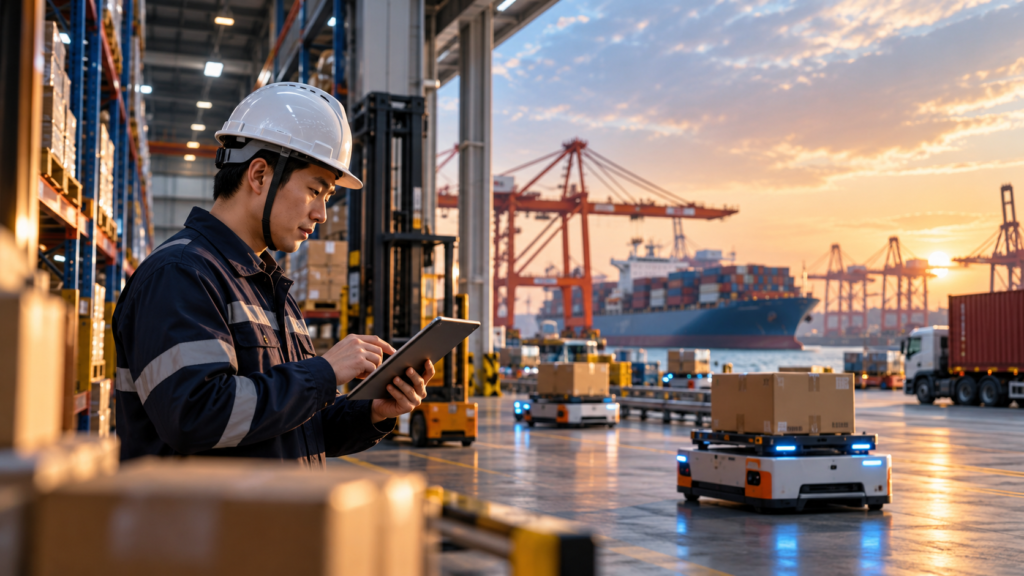
The most dramatic changes are happening at African ports, where Chinese companies are installing automation and artificial intelligence systems that replace manual processes with digital ones.
The Scale of Chinese Port Involvement
The numbers tell the story. According to the Africa Centre for Strategic Studies, a research institution under the United States Department of Defense, Chinese companies not only operate, finance, or hold stakes in about one third of all ports in Africa. They also now control the software, automation, and artificial intelligence tools that those ports depend on. Huawei and other Chinese firms are providing 5G networks, automated gate systems, and equipment software to African ports, gradually replacing older Western systems.
More than 30 African countries have adopted China’s BeiDou satellite navigation system as their primary maritime navigation tool. This is not a small shift. It means that the positioning data that guides ships, cranes, and trucks in African ports is increasingly coming from a Chinese system rather than an American one.
The Simandou Port in Guinea
The first Chinese smart port solution in Africa was deployed in 2026 at the Morebaya port in Guinea’s Simandou region. The system, developed by Yinghai Intelligent Technology, a subsidiary of Shandong Port Group, is an unmanned automatic control system for stacker reclaimers. The port handles 60 million tonnes of iron ore annually, and the system allows the port to operate 24 hours a day, seven days a week, with constant efficiency.
The most important number is this. Once the project is fully operational, the number of workers in high risk positions on the stockyard is expected to decrease by more than 90 percent. That is not just an efficiency gain. It is a safety gain. Port work is dangerous, and automating the most dangerous tasks saves lives.
The Nigeria Pledge
Nigeria is next. In November 2025, the Chinese government pledged strong technical and diplomatic support for Nigeria’s port modernization and automation project. A Chinese vice minister noted that China currently operates 52 fully automated ports, among the highest number globally, and explained that these ports have enhanced trade efficiency, drastically reduced vessel turnaround time, strengthened security through smart surveillance, and minimized human error.
The plan for Nigeria includes automated cargo handling systems, digital gate controls, electronic customs processes, and maritime communication technology. The goal is to move Nigerian ports from their current manual and semi automated state to full digital operations. If implemented, this would be the largest single logistics upgrade in Nigerian history.
The Electric Equipment Arriving Now
While port automation is still being planned for Nigeria, Chinese equipment is already arriving in other parts of Africa. In June 2026, a Chinese manufactured electric reach stacker was officially delivered in Dar es Salaam, Tanzania. The equipment, manufactured by Guangxi LiuGong Machinery, was acquired by Azam Inland Container Depot, a subsidiary of the Bakhresa Group.
The chief executive of the Bakhresa Group said the investment reflects their commitment to operational excellence and sustainable growth, and that by adopting green technology, they are enhancing productivity and safety while reducing emissions and energy consumption. LiuGong has already deployed electric excavators, wheel loaders, and mining trucks in Africa, supporting the region’s shift toward low carbon development.
This is the pattern. Port automation arrives as large government backed projects. Electric equipment arrives through private sector purchases. Both are part of the same transformation, and both are driven by Chinese technology.
Layer Two: The Warehouses
While ports are the most visible part of the logistics chain, warehouses are where the most immediate productivity gains are being realized. Chinese companies are building smart warehouses across Africa, and the results are measurable.
The Huawei Smart Warehouse in Johannesburg
In April 2025, Huawei launched a 14,000 square metre smart warehouse facility in Johannesburg, South Africa. The facility is built on a framework Huawei calls GEM, which stands for Green Power, E-security, and Modern logistics. The warehouse management system automates 60 percent of daily processes and integrates automated guided vehicles and automated forklifts to provide intelligent task allocation and scheduling.
The efficiency numbers are striking. Staff can now complete up to 110 tasks per hour, nearly doubling traditional productivity rates. A unified digital platform coordinates all operations, increasing individual employee output by 37 percent. The picking efficiency is between 60 and 110 line items per hour, thanks to automated guided vehicles capable of moving 600 kilograms and automated forklifts capable of moving one tonne with each move.
The green power component is equally significant. A 150 kilowatt solar power system, equipped with Huawei’s SUN2000 inverters, supplies 90 percent of the warehouse’s daytime electricity needs. For a Nigerian business that struggles with grid reliability, this is a model worth studying. A warehouse that runs on solar power is not just environmentally friendly. It is operationally resilient.
Huawei South Africa’s chief executive noted that the warehouse and logistics market in South Africa was valued at 93 billion dollars in 2024 and is projected to reach 157 billion dollars by 2032. He said this growth represents a transformation toward more agile, responsive, and technologically advanced supply chains. Africa Global Logistics, a company that employs more than 23,000 people across 50 countries, has been a logistics partner with Huawei for 15 years and has integrated Huawei technology into its operations.
The Ethiopian Airlines Cargo Terminal
The second major warehouse project is in Ethiopia. In February 2024, AVIC International Engineering, a subsidiary of the Aviation Industry Corporation of China, completed Ethiopia’s first modern air e-commerce cargo station for Ethiopian Airlines Group in Addis Ababa. The facility uses Chinese standard automated sorting equipment and a Chinese developed warehouse management system. It handles 150,000 tonnes of cargo annually and has significantly improved the efficiency of e-commerce parcel sorting.
This project matters for Nigeria because it shows what is possible. Ethiopia is not a wealthier country than Nigeria. It does not have better infrastructure. But it has made a strategic decision to invest in logistics technology, and it is already seeing the results.
The SANY Parts Hub in South Africa
The third example is smaller but equally instructive. SANY Group, a Chinese engineering machinery manufacturer, operates a parts hub in South Africa that has fully digitized its inbound and outbound parts management using QR code technology. The system boosted efficiency by over 100 percent compared with traditional models.
This is the simplest lesson for Nigerian businesses. You do not need a 14,000 square metre facility to benefit from logistics technology. You need a system that tracks what comes in and what goes out. A QR code scanner and a simple inventory management system can double your efficiency. The technology is not expensive. The willingness to adopt it is.
Layer Three: The Last Mile
The last mile is the most difficult part of the logistics chain, and it is where Chinese companies are innovating most aggressively.
Cainiao’s Africa Parcel Service
In November 2025, Cainiao, the logistics arm of Alibaba Group, launched a dedicated cross border small parcel service covering eight African countries, including Morocco, Ghana, and Nigeria. The company planned to extend the service to South Africa and Egypt by the end of December, giving it coverage of Africa’s leading e-commerce growth markets.
Cainiao said underdeveloped logistics infrastructure remained a bottleneck for trade growth even as Africa’s demand for made in China goods surged. The company said it planned to leverage its network and technology to ensure certainty and reliability in small parcel delivery tailored to local conditions.
The pricing data is striking. In Morocco, Cainiao’s service is priced 10 percent lower than comparable market products, while supporting full track and trace and exception alerts. The company also addressed Africa’s customs clearance challenges by optimizing air routes and reinforcing last mile delivery networks.
This matters for Nigerian consumers and businesses. When a Nigerian buys a product from a Chinese e-commerce platform, the delivery experience depends on the logistics network behind it. Cainiao is building that network, and it is doing so at a cost that makes Chinese e-commerce competitive with local retail.
The Temu and Shein Challenge
But the last mile is also where Chinese platforms are facing their biggest challenges in Nigeria. Temu and Shein, two Chinese shopping apps that have expanded into African markets, have faced significant difficulties with high logistics costs and unreliable customs clearance, forcing them to scale back operations.
Jumia’s chief executive, Francis Dufay, highlighted fragmented logistics as a key challenge for international platforms operating in Nigeria. These issues have led non local platforms like Shein and Temu to reduce their presence. The lesson is that even the most sophisticated logistics technology cannot fully overcome the infrastructure challenges of a market where roads are poor, customs is slow, and last mile delivery is expensive.
The irony is that Cainiao’s expansion is partly a response to this challenge. By building its own parcel network, Cainiao is trying to solve the problem that Temu and Shein encountered. Whether it succeeds will depend on how well it adapts to Nigerian conditions.
Drones and the Future of Delivery
The most futuristic part of last mile logistics is drone delivery, and Africa is already a testing ground. In Rwanda, the government established several drone logistics points as early as 2016. Chinese agricultural drones from companies like DJI and XAG are widely used in South African sugarcane plantations, where they spray more efficiently and use less pesticide than manual methods.
At the 2025 Africa Aviation Summit, China’s first unmanned electric vertical takeoff and landing aircraft, certified by the Civil Aviation Administration of China, completed its first flight in Africa. The aircraft is being prepared for commercial operations in Rwanda. This is not a replacement for trucks and motorcycles. It is a supplement for specific use cases, such as delivering medical supplies to remote areas or urgent packages in congested cities.
The Strategic Dimension
It would be naive to write about Chinese logistics technology in Africa without acknowledging the strategic dimension. The Africa Centre for Strategic Studies report argued that Chinese built digital ecosystems generate vast volumes of commercial and logistics data while encouraging countries to adopt Chinese technical standards, increasing the likelihood that future procurement will remain tied to Chinese vendors. Analysts argue that this effectively turns one time infrastructure investments into sustained commercial and political leverage.
The report also noted that China has built multiple shipping corridors connecting African port clusters to Chinese hub cities like Qingdao and Yantai in Shandong province. These corridors carry about 350 billion dollars in trade annually. The report said Africa is increasingly integrated into a China centered maritime network.
For Nigerian policymakers, this raises a question that cannot be avoided. Do you want your logistics infrastructure built on Chinese standards, or do you want to maintain flexibility to work with multiple vendors? There is no simple answer. Chinese technology is often cheaper, more available, and better suited to local conditions than Western alternatives. But adopting it creates dependencies that are difficult to reverse.
The pragmatic approach is to be clear eyed about the trade offs. Chinese logistics technology can transform Nigerian ports, warehouses, and last mile delivery. It can reduce costs, improve efficiency, and create jobs. But it also creates a relationship that goes beyond a simple commercial transaction. Nigerian businesses and policymakers should engage with their eyes open.
What This Means for Nigerian Businesses
The transformation of logistics is not just a story about ports and warehouses. It is a story about what Nigerian businesses can do differently, and what opportunities are emerging.
The Opportunity in Logistics Services
The first opportunity is in logistics services. As Chinese e-commerce platforms expand in Nigeria, they need local partners. They need warehouses, delivery riders, customs brokers, and last mile couriers. A Nigerian entrepreneur who can provide reliable logistics services is valuable to every Chinese platform entering the market.
The Cainiao expansion is a case in point. Cainiao is building its own network, but it cannot build everything. It will need local partners for warehousing, distribution, and customer service. If you are a logistics provider, position yourself as a partner rather than a competitor.
The Opportunity in Equipment and Maintenance
The second opportunity is in equipment and maintenance. The electric reach stacker delivered in Tanzania is a signal of what is coming to Nigeria. As ports and warehouses upgrade to electric equipment, they will need technicians who can maintain and repair it. They will need spare parts, charging infrastructure, and training.
A Nigerian technician who learns how to service electric forklifts, automated guided vehicles, and smart warehouse systems is a valuable asset. A Nigerian business that stocks spare parts for Chinese logistics equipment is providing a service that every port and warehouse will need.
The Opportunity in Data and Visibility
The third opportunity is in data and visibility. Chinese logistics technology is built on data. Every package is tracked. Every container is monitored. Every warehouse movement is recorded. The companies that can provide visibility into the supply chain are the ones that will win contracts.
A Nigerian technology company that builds a logistics tracking platform for local businesses is providing a service that Chinese platforms need. A customs broker who can integrate with electronic customs systems is more valuable than one who works with paper. The future of logistics is digital, and the businesses that embrace that future will have an advantage.
The Problems That Remain
It would be dishonest to write about the transformation of logistics without acknowledging the problems.
The first problem is infrastructure. No amount of software can fix a road that is impassable during the rainy season. No tracking system can compensate for a port that takes a week to clear a container. Chinese technology can improve the efficiency of existing infrastructure, but it cannot replace the need for investment in roads, rail, and power.
The second problem is skills. Smart warehouses and automated ports require workers with technical skills. Nigeria’s education system is not producing enough graduates with those skills. Huawei’s technical academy in South Africa is a model that could be replicated in Nigeria, but it requires investment and coordination between government, industry, and educational institutions.
The third problem is regulation. Nigeria’s customs processes are complex and often opaque. Electronic customs systems can make them more transparent and efficient, but only if the regulatory framework supports them. The Chinese pledge to support Nigerian port modernization includes electronic customs processes, but the success of that component depends on the willingness of Nigerian agencies to adopt new systems.
The fourth problem is cost. The equipment and systems that Chinese companies are selling are not cheap. A smart warehouse management system costs money. An automated port gate costs money. Electric reach stackers cost money. The businesses and governments that invest in these systems will see returns, but the upfront cost is a barrier.
Three Steps You Can Take Today
If you are a Nigerian business owner, importer, or logistics professional, here are three specific things you can do this week to position yourself for the transformation that is coming.
Audit Your Current Logistics Costs
The first step is to understand where you are losing money. Take a piece of paper and write down every step in your logistics chain, from the moment a product leaves your supplier to the moment it reaches your customer. For each step, write down the cost and the time it takes. Then ask one question. Which step is the biggest bottleneck?
The answer will tell you where to focus. If the bottleneck is at the port, you need a better customs broker or a more efficient clearing process. If the bottleneck is in the warehouse, you need a better inventory management system. If the bottleneck is in last mile delivery, you need a better courier or a different delivery model. The goal is not to fix everything at once. The goal is to fix the thing that is costing you the most.
Visit a Modern Warehouse or Logistics Hub
The second step is to see what good looks like. If you are in Lagos, visit a modern warehouse. If you are in Abuja, visit a logistics hub. If you cannot visit in person, watch videos online. Look at how products are stored, how they are moved, and how they are tracked. Pay attention to the small things. How are labels applied? How are orders picked? How is inventory counted?
The Huawei warehouse in Johannesburg uses automated guided vehicles and QR code scanning. The SANY parts hub uses QR code technology to double efficiency. These are not exotic technologies. They are practical tools that any business can adopt, at a smaller scale, with a smaller budget.
Talk to Your Suppliers About Their Logistics
The third step is to ask your Chinese suppliers how they handle logistics. Ask them what shipping lines they use, how they clear customs, and what tracking systems they have. Ask them if they work with Cainiao or another Chinese logistics provider. Ask them what they recommend for Nigerian importers.
The answers will tell you something about the sophistication of your supply chain. If your supplier is still using paper based systems and manual customs clearance, you are exposed to delays and errors. If your supplier has integrated digital systems, you are more likely to get your goods on time. Understanding your suppliers’ logistics is understanding the hidden risk in your own business.
Conclusion
Chinese technology is transforming logistics in Africa at every layer of the chain. Ports are being automated with artificial intelligence and 5G networks, reducing high risk jobs by more than 90 percent at the Simandou port in Guinea. Warehouses are being digitized with systems like Huawei’s GEM framework, which automates 60 percent of daily processes and increases productivity by 37 percent. Last mile delivery is being rebuilt by companies like Cainiao, which now covers eight African countries and plans to cover all of Africa’s top e-commerce markets.
The three most important takeaways for Nigerian readers are these. First, the transformation is arriving in Nigeria, but it will not arrive all at once. Port automation will come through government projects. Warehouse automation will come through private investment. Last mile delivery will come through partnerships with companies like Cainiao. Second, the opportunity is in the services around the technology. Chinese companies need local partners for warehousing, distribution, customs, maintenance, and data. Nigerian businesses that position themselves as partners will capture the most value. Third, the strategic dimension cannot be ignored. Chinese logistics technology creates dependencies that are difficult to reverse. Nigerian businesses and policymakers should engage with clear eyes and a long term perspective.
If you take one step today, let it be this. Write down the three biggest bottlenecks in your logistics chain. Not the whole chain. Just three. Then pick the one that costs you the most money and the most time. Spend thirty minutes researching how Chinese companies solve that specific problem. Whether it is warehouse management software, automated sorting equipment, or a last mile delivery partnership, the solution exists. The only question is whether you will find it and use it before your competitors do.
For a deeper look at how Chinese brands compete on price, technology, and design, you can read our article on the competitive strategies behind their success. If you want to understand how Chinese technology is changing agriculture in Nigeria, our guide on drones, satellites, and mechanization in African farming covers the tools that are already in use.