
I stood in a rice field outside Kano last year and watched a drone rise into the air. The farmer beside me, a man in his fifties who had spent his whole life working the land with a hoe and a handheld sprayer, watched it with the same expression I imagine his grandfather wore when he first saw a tractor. The drone covered ten hectares in a single day. The farmer told me that manual spraying would have taken him and a team of labourers two to three days for just five hectares, and by the time they finished, the pests had already done their damage. That moment captures why Chinese agricultural technology is not just a curiosity for Nigerian farmers. It is a lifeline.
I have spent years working with importers and watching how Chinese products move through Nigerian markets, from phones to solar panels to vehicles. But agriculture is different. When a Chinese phone fails, you buy another one. When a crop fails, a family goes hungry. That difference matters. In this article, I will show you how Chinese technology is changing farming in Nigeria and across Africa, from drones that spray fields in hours to satellite systems that predict crop yields, from rice seeds that triple harvests to cassava machines that replace backbreaking labour. I will name the companies doing the work, the numbers behind the results, the real problems that remain, and three specific steps you can take if you are a farmer, an agribusiness owner, or someone looking to invest in this space.
The Scale of China-Africa Agricultural Cooperation
Before diving into specific technologies, it helps to understand the framework. In June 2026, the China-Africa Agri-Tech and Industrial Cooperation Forum opened in Nairobi, Kenya, bringing together more than 100 delegates including policymakers, researchers, and industry leaders. The forum focused on deepening agricultural cooperation through innovation, technology transfer, and strategic partnerships. The Chinese Ambassador to Kenya, Guo Haiyan, said at the opening that agricultural modernization has been an essential area for a mutually beneficial partnership, and that combining Africa’s rich agricultural resources and youthful population with China’s development experience, technology, and market opportunities could advance agricultural modernization and strengthen food security.
That framework is now producing concrete results. China has been transferring agricultural technology to Africa through a network of Agricultural Technology Demonstration Centers, or ATDCs. A 2026 study published in an academic journal evaluated the impact of these centers using panel data from 40 African countries between 2000 and 2022. The study found that China’s rice technology transfer significantly increased total rice output, cultivation area, and yield, while also reducing methane emission intensity. The dual benefits of economic and environmental outcomes were highlighted as particularly significant. The study also found that the impact was more pronounced in countries with higher levels of agricultural technology and governance performance, which tells us something important. Technology transfer works best where there is already some capacity to absorb it.
For Nigerian farmers, this means the opportunity is real, but it is not automatic. You have to be ready to learn, adopt, and adapt.
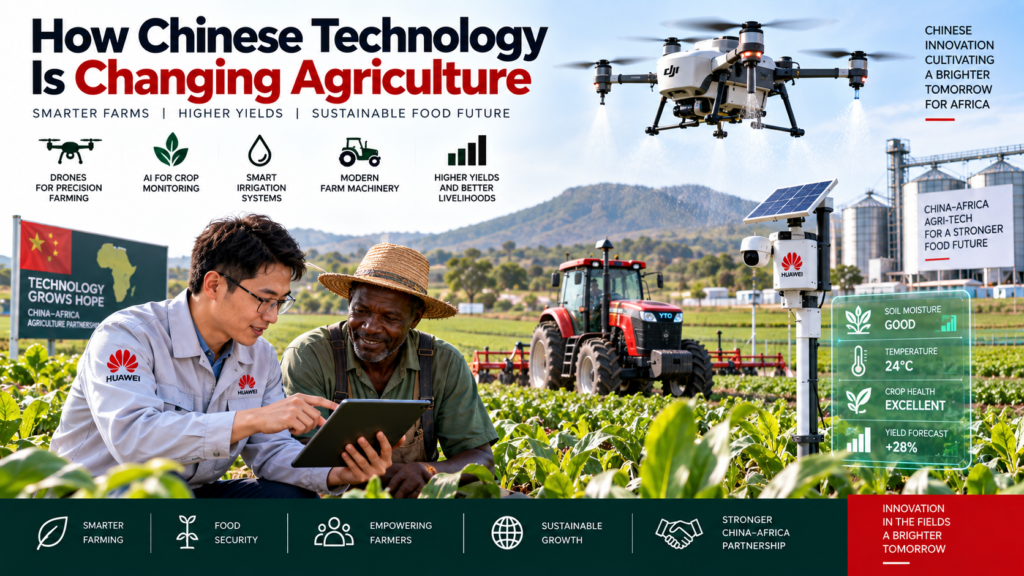
Drones: From Backbreaking Labour to Precision Spraying
The most visible change in Nigerian agriculture right now is happening in the sky. Agricultural drones are transforming how farmers manage pests, apply fertilizers, and monitor crop health, and Chinese manufacturers are leading the charge.
The Smartisan Demonstration in Kano
In November 2025, Smartisan Investment Nigeria Limited, a Chinese agricultural investment company, introduced a drone crop-spraying technology in Kura Local Government Area of Kano State. The company’s representative, Charles Lee, who has lived in Nigeria for 16 years, explained that the drone can replace the labour-intensive manual method of applying fertilizers and agrochemicals. He said the device can do the work of about 40 labourers in a single day, enabling farmers to complete large-scale spraying in just a few hours.
The numbers are striking. Lee explained that delays associated with manual spraying often lead to huge losses during pest outbreaks because many farmers cannot cover their fields within the critical treatment window of two to three days. With the drone, a farmer can spray 10 hectares in one day. When pests strike, damage can reach up to 50 percent if treatment is delayed. The system has already been deployed in China, Kenya, and Mozambique, where it increased farmers’ harvests by 15 to 20 percent annually. The drone atomizes chemicals into ultra-fine particles of about 10 micrometres, ensuring deeper penetration and complete coverage of both sides of leaves. It also reduces chemical usage by up to 40 percent, lowering overall costs for farmers.
The chairman of the Kura Local Government Farmers’ Association, Usman Abdulmalik Kura, described the technology as timely, noting that farmers are grappling with rising production costs and persistent labour shortages. He said many farmers can no longer afford labour for spraying, and pest attacks are becoming more common. But he also added a note of caution. Affordability would determine the technology’s adoption. That is an important point. A drone that saves money is valuable. A drone that sits idle because nobody can afford it is not.
DJI and the Precision Agriculture Workflow
The company most associated with agricultural drones in Nigeria is DJI, the Chinese manufacturer that dominates the global drone market. A 2026 guide to DJI agricultural drone mapping in Nigeria described the company’s ecosystem as providing the only end-to-end solution for mapping, crop analysis, and precision spraying. From the massive rice clusters in Kebbi to the palm plantations of Edo and the fruit orchards in Oyo, DJI’s ecosystem is being used across Nigeria’s major agricultural zones.
The DJI workflow is more sophisticated than simply spraying. It begins with the Mavic 3 Multispectral, a drone equipped with a 4-band multispectral camera that can see plant stress days before the human eye can detect it. It generates NDVI maps, which are visual representations of vegetation health, to identify nutrient deficiencies or water stress across up to 200 hectares in a single flight. Then the data is processed in DJI Terra software to create a prescription map. That map is uploaded to the Agras T100 or T50, the heavy-lifting spraying drones, which fly autonomously and apply chemicals only where they are needed. The result is a reduction in chemical costs of up to 30 percent.
The Agras T100, new for 2026, features a 100 litre spray tank and 150 litre spreading capacity, making it suitable for Nigeria’s largest sugarcane and grain estates. The Agras T50, with a 40 litre tank and 360 degree obstacle avoidance, is designed for navigating around trees or masts in complex fields.
Nigeria’s drone market is growing. The Nigeria small drones market was valued at 12.6 million dollars in 2025 and is projected to reach 27 million dollars by 2030. The market for unmanned aerial systems is expected to grow by a factor of 2.5 to 3.5 over the 2026 to 2035 period, driven in part by the progressive mechanization of Nigeria’s agriculture sector, which is targeting 25 percent of farmland under precision farming by 2030.
But adoption is not automatic. A 2026 study on farmers’ perception of drone technology in Ondo State found that farmers generally had a positive perception of drones, with grand mean values above 4.00, indicating strong agreement that drones improve productivity, save time, and detect pests and diseases. However, the major factors affecting adoption were high cost, lack of technical knowledge, poor internet connectivity, restrictive government regulations, and limited training opportunities. Those are the barriers that need to be addressed.
Satellites and AI: Seeing the Farm from Space
Drones work at the field level. Satellites work at the national and regional level, and here too Chinese technology is playing a transformative role.
The BeiDou Navigation System in African Agriculture
The BeiDou Navigation Satellite System, China’s answer to GPS, is now operational in Africa and is being used for smart agriculture. In Limpopo province, South Africa, the use of BeiDou is transforming traditional farming methods. The system provides high-precision positioning, intelligent agricultural machinery navigation, and agricultural big data management. Farmers have been able to move from relying on rain and luck to what local researchers describe as smart farming.
The technology works through a combination of satellite positioning and field sensors. Applying BeiDou to crop field management enables real-time monitoring of crop growth, soil conditions, and weather patterns. That data is then used to make decisions about irrigation, fertilization, and pest control. For a Nigerian farmer, the practical application is clear. Instead of guessing when to plant or when to spray, you have data.
CropWatch and the Regional Monitoring Center in Abuja
The most significant satellite-based agricultural monitoring system for Nigeria is CropWatch, developed by the Chinese Academy of Sciences. CropWatch provides provincial-level real-time agricultural data for more than 170 countries. It uses remote sensing and artificial intelligence to support early warning systems and agricultural planning.
In July 2025, Nigeria’s National Space Research and Development Agency, NASRDA, trained agricultural stakeholders from across West Africa on how to use CropWatch tools to combat food insecurity. The training was held in Abuja over three days and focused on empowering agricultural extension workers, who are the bridge between researchers and rural farmers. Dr. Matthew Adepoju, the Director General of NASRDA, said the training was not just about technology but about empowering decision makers with data to improve livelihoods and build resilient food systems. Dr. Rakiya Babamaaji, Director of Strategic Space Applications at NASRDA, emphasised that the solution to West Africa’s food insecurity lies in adopting space-based technologies for agricultural development.
Nigeria joined the CropWatch innovation cooperation programme in 2021. Since then, the country has significantly improved its capabilities in agricultural monitoring, disease identification, and yield prediction. The CropWatch cloud system provides real-time agricultural data that can be used to predict crop yields, detect disease outbreaks, and plan for food shortages before they become crises. A regional center for CropWatch was launched in Abuja to enhance agricultural resilience across West Africa.
For Nigerian farmers and agribusinesses, the implication is simple. The data exists. The question is whether you are using it.
Mechanization: Machines That Replace Backbreaking Labour
Drones and satellites get the headlines, but for many Nigerian farmers, the most immediate change comes from machinery that replaces human labour in the field.
Cassava Mechanization in Nigeria
Cassava is one of Nigeria’s most important staple crops, but its cultivation is labour-intensive. Planting, weeding, and harvesting are done by hand on most farms, limiting yields and keeping production low.
In June 2026, that began to change. The Chinese Academy of Tropical Agricultural Sciences, known as CATAS, delivered the first set of fully mechanized cassava equipment to Nigeria. The equipment arrived at the National Root Crops Research Institute in Umudike, Nigeria, under a project supported by the Hainan Provincial International Science and Technology Cooperation Programme. The shipment included four types of machines: a deep tillage plough, a rotary tiller, a ridging cassava planter, and a vibrating chain cassava harvester. Together, these machines cover the key production stages of land preparation, planting, and harvesting.
The National Root Crops Research Institute is one of Africa’s most important root crop research institutions and a key partner of CATAS. The two institutions have been collaborating on cassava germplasm innovation, green and efficient production, mechanization technology, and talent training. In 2023, CATAS launched the Africa Cassava Yield Doubling Plan, which focuses on improving seed varieties, farming methods, machinery, and talent training. The delivery of the cassava equipment to Nigeria is a key outcome of that plan and a concrete step in implementing China-Africa agricultural modernization cooperation.
The Green Agriculture West Africa Rice Programme
The most documented success story of Chinese agricultural technology in Nigeria is the work of Green Agriculture West Africa Limited, a company that has been operating in Nigeria since 2006. Locals near Abuja do not call the company by its full name. They call it the place where the Chinese provide “magic” rice seeds.
One farmer, 42 year old Ahmed Yusuf, told reporters that before he encountered the company, his rice paddies averaged only two tonnes per hectare. He said he was deep in losses and could not meet his family’s basic needs. Then he started planting the company’s R1 rice variety. With the new variety, he was able to more than double his yield while keeping his input costs the same.
Green Agriculture West Africa has established a demonstration farm covering about 2,000 hectares in Kebbi State, in northwestern Nigeria, where it provides seeds and technical training to thousands of local farmers. The company also supplies improved varieties of maize, millet, sorghum, and other local staples. A Nigerian agriculture ministry project manager, Godfrey Ngok, said the demonstration farm shows the advantages of new varieties and technologies directly, helping farmers make informed decisions. Xu Guoxin, a member of the R1 rice development team who came to Nigeria in 2014, said the team is made up of both Chinese and Nigerian researchers. He said that while Nigeria is rich in natural resources and labour, the demand for advanced technology, quality seeds, and modern agricultural systems remains high.
The academic evidence supports the on-farm results. A 2026 study using panel data from 40 African countries found that China’s rice technology transfer significantly increased total rice output, cultivation area, and yield, while reducing methane emission intensity. The study also identified a natural convergence trend in African rice production, with China’s technology transfer accelerating this process, suggesting its potential as a tool to foster regional integration and reduce inequalities.
Smart Farming and the Digital Platform
The technologies I have described so far are hardware. But the most powerful shift may be in software and data, where Chinese companies are building platforms that connect farmers to information, markets, and finance.
The Agro-Industrial Estate in Osun State
In June 2025, the Osun State Government announced a partnership with Chinese investors to build an agro-industrial estate in Iragbiji, in Boripe Local Government Area. The proposed project was described as a smart farming industrial estate. The state government said it would replicate Chinese industrial reforms within five years in Nigeria, using technology and digitalisation.
The details of the project are still developing, but the concept is important. Instead of treating agriculture as a collection of isolated smallholder farms, the estate model treats it as an integrated system. Production, processing, storage, and distribution are all planned together. Technology is embedded at every stage. This is the model that transformed Chinese agriculture over the past three decades, and it is now being adapted for Nigerian conditions.
The Digital Advisory Opportunity
A 2026 analysis from the Chinese Academy of Social Sciences described how connecting China’s experience in agricultural and rural modernization with Africa could help local farmers access precise weather information, build smart irrigation systems, connect to digital advisory platforms, and receive scientific guidance. The analysis noted that the entire agricultural value chain would be upgraded as a result.
For Nigerian farmers, this means access to information that was previously unavailable. A farmer in Kano can now receive weather forecasts specific to their location. A farmer in Oyo can get advice on pest management from an AI system trained on data from similar climates. A farmer in Kebbi can connect to buyers who are willing to pay a premium for quality produce.
The barrier is not the technology. It is the infrastructure. Poor internet connectivity and limited access to smartphones remain significant obstacles in rural Nigeria. But the direction is clear. The platforms exist. The data exists. The question is how quickly the infrastructure can catch up.
The Challenges That Remain
It would be dishonest to write about the potential of Chinese agricultural technology in Nigeria without acknowledging the real challenges.
The first challenge is affordability. The farmers who attended the Smartisan drone demonstration in Kano were optimistic about the technology, but they urged the company to collaborate with cooperatives and offer flexible payment plans. Many smallholder farmers may struggle with outright purchase of the equipment. A drone that costs several thousand dollars is not accessible to a farmer who earns a few hundred dollars a year. The solution may lie in shared ownership models, rental services, or cooperative purchasing, but those models are still being developed.
The second challenge is technical knowledge. The Ondo State study found that lack of technical knowledge was a major factor affecting adoption. Farmers need training, and they need ongoing support. A drone that breaks down and cannot be repaired is worse than no drone at all. Building local capacity for maintenance and repair is essential.
The third challenge is regulation. Nigeria’s NCAA has issued regulations aligned with international standards for unmanned aircraft operations, and every enterprise drone must be registered. Operators must hold a Remote Pilot License. Those regulations are necessary for safety, but they add cost and complexity. Streamlining the licensing process and making it more accessible would help adoption.
The fourth challenge is infrastructure. Poor rural internet connectivity limits the use of digital platforms. Unreliable power limits the use of electric machinery. Bad roads limit the ability to get produce to market. Chinese technology can solve many problems, but it cannot solve all of them. Infrastructure investment is still needed.
The fifth challenge is the risk of dependency. If Nigeria imports all its agricultural technology from China, it remains dependent on a foreign supply chain. That is not inherently bad, because global trade is built on specialization. But it does mean that Nigerian businesses need to think about where they can add value. Importing and distributing is one layer. Manufacturing and servicing is a deeper layer. Building original technology is the deepest layer.
What Nigerian Farmers and Agribusinesses Should Do
If you are a farmer, an agribusiness owner, or someone looking to invest in Nigerian agriculture, here are three specific things you can do.
Explore Cooperative Ownership of Technology
The biggest barrier to adopting drones, mechanized equipment, and digital platforms is cost. But you do not have to buy alone. Talk to other farmers in your area about forming a cooperative to share the cost of a drone or a tractor. A cooperative of twenty farmers can afford a shared asset that none of them could afford individually. The Kano farmers who saw the Smartisan drone demonstration explicitly called for this kind of model. You can be the one who starts the conversation.
Learn One Digital Tool This Month
You do not need a drone to benefit from digital agriculture. Start with something simpler. Learn how to use a weather app that gives you forecasts for your specific location. Learn how to use a platform that connects you to buyers. Learn how to use a simple record-keeping app to track your costs and yields. The goal is not to become a technology expert. The goal is to build the habit of using data to make decisions. Once you have that habit, adopting more advanced tools becomes easier.
Connect with a Demonstration Farm or Training Programme
Green Agriculture West Africa operates a 2,000 hectare demonstration farm in Kebbi State and provides seeds and technical training to thousands of farmers. The CropWatch programme has trained agricultural extension workers across West Africa through NASRDA. Smartisan is demonstrating drone technology in Kano. These programmes exist, but they only work if farmers participate. Find out what training and demonstration programmes are available in your state. Attend a session. Talk to the trainers. See the technology in action. The farmers who adopt new technology first are the ones who see the biggest gains.
Conclusion
Chinese technology is changing agriculture in Nigeria and across Africa, and the pace is accelerating. Drones from companies like Smartisan and DJI are spraying fields in hours instead of days, reducing chemical use by up to 40 percent and increasing harvests by 15 to 20 percent. Satellites and AI platforms like CropWatch are providing real-time data on crop health and yield predictions across West Africa. Mechanized cassava equipment from CATAS is replacing backbreaking manual labour. Improved rice varieties from Green Agriculture West Africa are tripling yields for farmers who once struggled to break even. The academic evidence confirms what farmers are seeing on the ground. China’s rice technology transfer has increased output, expanded cultivation, and reduced methane emissions across 40 African countries.
The three most important takeaways for Nigerian readers are these. First, the technology is real and it works. Drones, satellites, mechanization, and improved seeds are not experiments. They are proven tools that are already being used in Nigeria. Second, the barriers are real too. Cost, technical knowledge, regulation, and infrastructure all limit adoption. But those barriers can be overcome through cooperative ownership, training, and policy reform. Third, the opportunity is not just to consume these technologies but to build businesses around them. Importing, distributing, servicing, and training are all valuable roles.
If you take one step today, let it be this. Find out what agricultural technology programmes are operating in your state. It might be a drone demonstration. It might be a seed distribution programme. It might be a training session on digital tools. Attend one session. Talk to one trainer. See one technology in action. That is how adoption begins. Not with a policy document. With a farmer standing in a field, watching a drone rise into the air, and realising that the way they farm is about to change forever.
For a deeper look at how Chinese brands compete on price, technology, and design, you can read our article on the competitive strategies behind their success. If you want to understand how Chinese technology is reshaping other sectors in Africa, our guide on the next Chinese technology revolution covers the breakthroughs that are coming.