
I bought my first Tecno phone in 2016 from a small shop in Onitsha main market. The seller told me it would last two years. It lasted four, and by the time I replaced it, three of my cousins had bought the same brand. That is the story of Chinese brands in Africa in miniature. They arrived quietly, built for the way people here actually live, and over time they stopped being foreign products and became the default choice for millions. Now the question is no longer whether Chinese brands will dominate African markets. The question is what happens next, and whether that dominance will be good for African consumers, workers, and entrepreneurs.
This article is for Nigerian business owners, importers, policymakers, and anyone who wants to understand where the Chinese brand wave in Africa is heading. I have spent the last six years working with importers and watching Chinese products move through Nigerian markets. I will show you the numbers behind the current dominance, explain the strategies that got them there, name the real problems that are coming, and tell you what to do about it. By the end, you will have a clear picture of the next five years and three steps you can take right now.
The Numbers That Show How Deep Chinese Brands Have Gone
Start with phones, because that is where the shift is most visible. According to the International Data Corporation, Transsion, the parent company of Tecno, Infinix, and itel, shipped 40.5 million smartphones across Africa in 2025 and held a 48 percent market share. That is nearly one out of every two phones sold on the continent. The brand’s closest competitor, Samsung, held second place with a much smaller slice. Xiaomi, another Chinese brand, held third place with 13 percent and grew by 34 percent year on year. Honor, also Chinese, grew by 158 percent in the same period, albeit from a smaller base.
In Nigeria specifically, the picture is even more tilted. Tecno and Infinix are household names. If you walk through Computer Village in Ikeja or the phone section of any major market, you will see more Transsion products than any other brand combined. This is not accidental. Transsion built its business around features that matter here. Long battery life, because power supply is unreliable. Dual SIM and sometimes quad SIM support, because network quality varies and people switch between MTN, Glo, Airtel, and 9mobile. Cameras tuned for darker skin tones, which was a detail that Western brands ignored for years.
The phone story is the proof of concept. Chinese brands did not win by being cheaper alone. They won by paying attention to what African consumers actually needed, and then building distribution networks that reached places other brands did not bother with. Transsion built relationships with small shops, market stalls, and local distributors, creating a network that put their phones in front of buyers from Lagos to Kano to Port Harcourt.
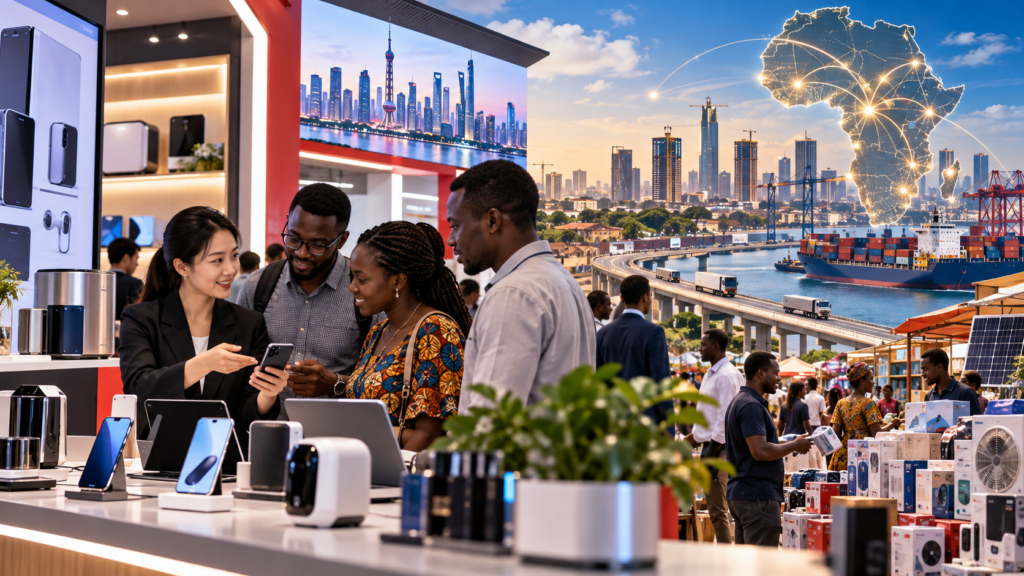
Electric Vehicles Are the Next Big Wave
Phones were the first category. Cars are the next one, and the numbers are moving fast. Africa’s electric vehicle sales reached about 25,000 units in 2025, up from roughly 4,000 two years earlier, according to the International Energy Agency. Chinese automakers drove most of that growth, and BYD alone accounted for 35 percent of regional sales, up from just 4 percent in 2023.
Ethiopia has become the unlikely testing ground for this shift. In 2024, the Ethiopian government banned imports of gasoline and diesel vehicles to accelerate the transition to electric mobility and reduce spending on imported fuel. Since then, Chinese EV brands have moved in quickly. Guangzhou Automobile Group, known as GAC, launched four models in the Ethiopian market in March 2026 and set a goal of capturing 30 percent market share for its AION brand by 2030. More than 140,000 electric vehicles, including private cars, minibuses, and public buses, are now on Ethiopian roads.
Kenya is taking a different approach. After sharp fuel price increases disrupted public transport, President William Ruto announced that the first 100,000 electric vehicles imported into Kenya would be duty free. Registered EVs in Kenya jumped from fewer than 1,400 in 2022 to more than 39,000 in 2025. That is a serious growth curve, and Chinese manufacturers are positioned to capture most of it.
For Nigerian readers, this matters because Nigeria is next. The federal government has already signalled interest in electric mobility, and fuel subsidy removal has made the cost of petrol a daily pain point for millions of drivers. Chinese EV makers are watching Nigeria closely. When the infrastructure and policy conditions are right, they will move in the same way they moved into Ethiopia and Kenya.
Why Chinese Brands Win: Localization, Speed, and Scale
The success of Chinese brands in Africa is not a mystery. It comes down to three things that are hard to copy and even harder to beat.
They Build for African Conditions
The first reason is localization. Chinese brands do not ship the same product they sell in Europe or China and hope it works here. They change the product to fit the market.
Look at the home appliance sector. Midea, Haier, and other Chinese manufacturers have invested in building factories in Egypt and other African countries, not just exporting finished goods. This serves two purposes. It reduces import tariffs, because assembling locally is cheaper than importing fully built products. It also allows companies to adapt products to local conditions, like designing washing machines that handle dusty environments or refrigerators that work reliably through power fluctuations.
The same logic applies to commercial vehicles. Beiqi Foton, a Chinese truck and bus manufacturer, spent years adapting its vehicles to African roads. When drivers in Madagascar needed buses that could handle rough terrain and high humidity, the company added intelligent temperature control systems, strengthened anti corrosion coatings, and adjusted the chassis to fit local conditions. That is not just selling a product. That is building a product for a specific place.
They Move Fast
The second reason is speed. Chinese companies are used to operating in a market where product cycles are short and competition is intense. They bring that speed to Africa.
When Foton entered the African commercial vehicle market in 2011, the company faced a problem that would have stopped many others. Its vans were reliable, but when a part broke, the entire assembly had to be replaced, which made repair costs too high for local buyers. The company’s country manager, Shen Changzhi, proposed breaking the assembly into separate parts so that only the broken component needed replacing. The change cut repair costs, sales rose, and the brand gained a foothold in a market that had been dominated by European and Japanese manufacturers for decades.
That kind of adaptation requires a company to be close to its customers and willing to change quickly. Chinese brands have built that capability. They do not wait for a global strategy to be approved in Beijing. They test, adjust, and ship.
They Operate at Scale
The third reason is scale. Chinese manufacturers have access to supply chains, component suppliers, and production capacity that most African companies cannot match. When Xiaomi decides to enter a new African market, it can draw on the same component suppliers and manufacturing partners that serve its operations in Asia, Europe, and Latin America. That gives it a cost advantage that is difficult to overcome.
That scale also allows Chinese brands to spread risk. If one market slows down, they can shift focus to another. When the Moroccan phone market declined by 7 percent in the second quarter of 2025, Chinese brands did not retreat. They increased their focus on Egypt, Nigeria, and South Africa, where growth was stronger. That flexibility is a competitive advantage that smaller players simply do not have.
The Coming Competition Between Chinese Brands
Here is something that many people miss. The biggest threat to Transsion in Africa is not Samsung or Apple. It is other Chinese companies.
Transsion’s market share slipped from 52 percent in early 2025 to 47 percent by the first quarter, before recovering to 51 percent later in the year. Xiaomi grew by 32 percent in the same period, and Honor grew by 161 percent. Both are Chinese brands. Both are targeting the same price sensitive buyers that made Transsion successful. Both are willing to spend heavily to gain ground.
This competition is good news for African consumers, at least in the short term. When Chinese brands fight each other, prices come down and features improve. You saw this in the phone market already. Cameras got better, batteries got bigger, and prices stayed low because no brand could afford to fall behind.
But there is a downside. As competition intensifies, margins shrink. When margins shrink, companies cut costs. They might reduce after sales support, slow down software updates, or use cheaper components. African consumers need to watch for that. A brand that was reliable at one price point might become less reliable when the company is fighting for survival.
The Real Problems That Are Coming
It would be dishonest to write about the future of Chinese brands in Africa without talking about the problems. There are three that I think will define the next five years.
The Trade Imbalance
The first problem is structural. China and Africa trade a lot, but the trade is lopsided. China Africa trade reached a record 348 billion dollars in 2025, according to Chinese government data. China exported about 225 billion dollars worth of goods to Africa and imported about 123 billion dollars, leaving Africa with a deficit of roughly 102 billion dollars. Africa sends raw materials. China sends manufactured goods. That pattern has been in place for years, and it is not changing quickly.
China has taken some steps to address this. In May 2026, China removed tariffs on imports from 53 African countries, a move that could help African agricultural exports like coffee, cocoa, avocados, and citrus. A shipment of South African apples entering China tariff free saved about 2,900 dollars in duties on the first day alone. That is real money for farmers and exporters. But the tariff removal does not solve the deeper problem. Africa still exports raw materials and imports finished goods. Until that changes, the imbalance will persist.
The Pressure on Local Industry
The second problem is the pressure that Chinese imports put on local manufacturing. Nigerian entrepreneurs who make furniture, clothing, or simple consumer goods often cannot compete with Chinese imports on price. Chinese factories operate at a scale and efficiency that Nigerian factories cannot match, at least not yet.
This is a real tension. On one hand, cheap Chinese goods make life more affordable for millions of Nigerians. A family that could not afford a locally made refrigerator can buy a Chinese one. On the other hand, that same refrigerator puts a local manufacturer out of business. The government has tried to manage this with tariffs and import restrictions, but the pressure remains.
The solution is not to block Chinese imports. That would raise prices and hurt consumers. The solution is to help Nigerian manufacturers move up the value chain. Instead of competing on price with Chinese mass produced goods, Nigerian businesses should compete on design, quality, and local relevance. That is where the opportunity is.
The Perception Problem
The third problem is perception. For older Nigerians, Chinese products still carry a stigma. They remember the cheap electronics that broke after a few months, the fake goods that flooded markets in the 1990s and 2000s. That reputation is changing, but it is changing slowly.
Younger Nigerians have a different view. They grew up with Tecno phones and Xiaomi earbuds. They do not see Chinese products as inferior. They see them as good value. That generational shift is good news for Chinese brands, but it also means that brands need to keep improving. If quality slips, the younger generation will notice faster than their parents would have.
What Chinese Brands Are Doing Right That Others Miss
There is a lesson here for African brands and for anyone trying to build a business on the continent. Chinese companies succeed in Africa because they are willing to do things that other companies are not.
They go where the customers are. Transsion built relationships with small shops and market traders across Nigeria, Kenya, and Ghana. They did not wait for big retail chains to emerge. They worked with the distribution system that already existed, and they made it work for them.
They adapt to local conditions. When Beiqi Foton realized that its vans were too expensive to repair, it changed the design. When Transsion realized that African users needed long battery life and multi SIM support, it built those features into its phones. When GAC entered Ethiopia, it partnered with a local company to provide after sales services, because it understood that trust is built through service, not just through price.
They invest for the long term. Chinese brands are not just selling products in Africa. They are building factories, training local workers, and establishing research and development centers. Midea, Haier, and other appliance makers have invested in factories in Egypt. Chinese EV makers are building manufacturing and research facilities on the continent. That is a sign that they are planning to stay, not just to extract.
What Nigerian Businesses Should Do About It
If you run a business in Nigeria, the rise of Chinese brands is not just something to read about. It is something that will affect your suppliers, your competitors, and your customers. Here are three specific things you can do right now.
Learn From Their Playbook
The first thing is to study how Chinese brands operate and apply the same principles to your own business. Chinese companies succeed because they listen to customers, adapt quickly, and build distribution networks that reach the last mile. You can do the same thing in your own market.
If you sell products, pay attention to what your customers complain about. Do they want faster delivery? Better packaging? Easier returns? Fix the thing they complain about most. That is what Chinese brands do. They find the pain point and they solve it.
Find Your Niche
The second thing is to stop competing head to head with Chinese imports on the things they do best. Chinese factories are very good at producing large volumes of standardized products at low cost. You probably cannot beat them at that. But you can beat them at things that require local knowledge, personal relationships, or customization.
A Nigerian furniture maker cannot compete with a Chinese factory on mass produced chairs. But that furniture maker can compete on custom designs for Nigerian homes, on delivery and assembly services, and on after sales support. That is the niche. Find it and own it.
Watch the Policy Landscape
The third thing is to pay attention to what the government is doing. Tariffs, import restrictions, and local content requirements can change the competitive landscape very quickly. If you are an importer, a new tariff could make your business model unworkable overnight. If you are a manufacturer, a new incentive could make you suddenly competitive.
Stay informed. Read the trade policy updates from the Ministry of Industry, Trade, and Investment. Follow news from the Central Bank of Nigeria on foreign exchange policy. Talk to other business owners in your sector. The businesses that survive are the ones that see changes coming and adapt before they hit.
The Next Five Years: What to Expect
So what does the future actually look like? Here is my read, based on the numbers and the trends I have seen on the ground.
Chinese brands will continue to gain market share in consumer electronics, home appliances, and vehicles. The phone market is already close to saturation for Chinese brands, but appliances and cars have a lot of room to grow. As Nigerian incomes rise and more households enter the middle class, demand for refrigerators, air conditioners, washing machines, and cars will increase. Chinese brands are positioned to capture a large share of that demand.
Electric vehicles will become a real option for Nigerian drivers within the next three to five years. The cost of batteries is falling, charging infrastructure is improving, and the federal government has signalled interest in supporting the transition. Chinese EV makers are watching Nigeria closely. When the conditions are right, they will move in fast.
Competition between Chinese brands will intensify. Transsion will face more pressure from Xiaomi, Honor, and others. This will be good for consumers in the short term, because prices will stay low and features will improve. But it will also mean that some brands will struggle, and some may exit the market.
African brands will have to fight harder to survive. The ones that succeed will be the ones that focus on what makes them different. Local knowledge, personal service, customization, and trust. Those are things that Chinese factories cannot replicate, no matter how efficient they are.
Conclusion
The future of Chinese brands in Africa is not a question of if, but of how far and how fast. Chinese companies now hold nearly half the African smartphone market. They are leading the electric vehicle transition in countries like Ethiopia and Kenya. They are building factories, training workers, and adapting their products to African conditions in ways that Western brands often fail to do.
The three most important things to remember are these. First, Chinese brands won by localizing, not by dumping cheap goods. They built products for African conditions and distribution networks that reached places other brands ignored. Second, the trade relationship is imbalanced, and that imbalance will not fix itself. African governments and businesses need to push for more value added exports and more local manufacturing. Third, competition between Chinese brands is coming, and it will change the market. Consumers will benefit in the short term, but local businesses need to prepare for a tougher fight.
If you take one step today, let it be this. Look at your own business, or the sector you work in, and ask one question. What do Chinese brands do well that you could learn from? Whether it is customer research, distribution, or speed of adaptation, there is a lesson there. Write down one thing you will change this month. That is how you start competing in a market where Chinese brands are no longer the underdogs. They are the standard.
For a deeper look at how to source products from China for your Nigerian business, you can read our guide on working with Chinese manufacturers. If you are still figuring out the import process, our article on understanding import documentation in Nigeria walks you through the basics.