
I’m the kind of person that pays attention to even the slightest details. I remember the exact moment I realized something had shifted. It was in a phone shop in Ikeja, and a man in his fifties was asking the seller for “the Chinese one.” Not a specific brand. Not a model number. Just “the Chinese one.” Ten years ago, that phrase would have been a warning. Today, it is a recommendation. That change did not happen because of a marketing campaign. It happened because millions of African consumers tried Chinese products, found they worked, and told their friends. The attention African consumers are paying to Chinese brands is not hype. It is the result of years of consistent delivery, and it is reshaping markets from Lagos to Nairobi to Johannesburg.
This article is for Nigerian importers, retailers, distributors, and anyone trying to understand what African consumers are actually thinking when they walk into a shop. I have spent years working with importers and watching buying behavior change on the ground. In this piece, I will show you the data behind the shift, explain the reasons driving it, name the categories where attention is growing fastest, and give you three practical steps to position yourself for what is coming.
The Trust Data That Changes Everything
Start with the numbers that most people have not seen. Ipsos, one of the largest market research companies in the world, released its 2025 China Brand Global Trust Index in December of that year. The findings were striking. Nigeria recorded an 89 percent net trust score for Chinese brands, placing it among the highest in the world. Egypt followed at 76 percent. These were not marginal markets where trust was slowly building. These were markets where Chinese brands had already crossed the threshold from curiosity to confidence.
The Ipsos report also found that across emerging markets, the net trust score for Chinese brands reached 51 percent in 2025, up 13 percentage points from the previous year. Thirteen of the markets surveyed saw increases of more than 15 percentage points. The shift is not gradual. It is accelerating.
A separate survey conducted by GlobeScan in partnership with Chatham House painted an even clearer picture. The survey covered 32,000 people across 33 countries between July and September 2025. In sub-Saharan Africa, 87 percent of respondents across Kenya, Nigeria, and South Africa said they were likely to consider buying Chinese-made solar panels. That is not a niche product for wealthy early adopters. That is a mainstream consumer intention.
The reasons behind this trust are worth understanding. The Ipsos report found that the top driver of trust was “providing high quality products and services,” which carried a weight of 10.9 percent. But three other factors gained ground in 2025. Consistency in delivering on brand promises. Bringing net benefits to the local economy. And actively caring about and supporting local communities. Trust in Chinese brands is no longer just about the product. It is about whether the brand feels like it belongs here.
Smartphones: Where the Attention Is Most Visible
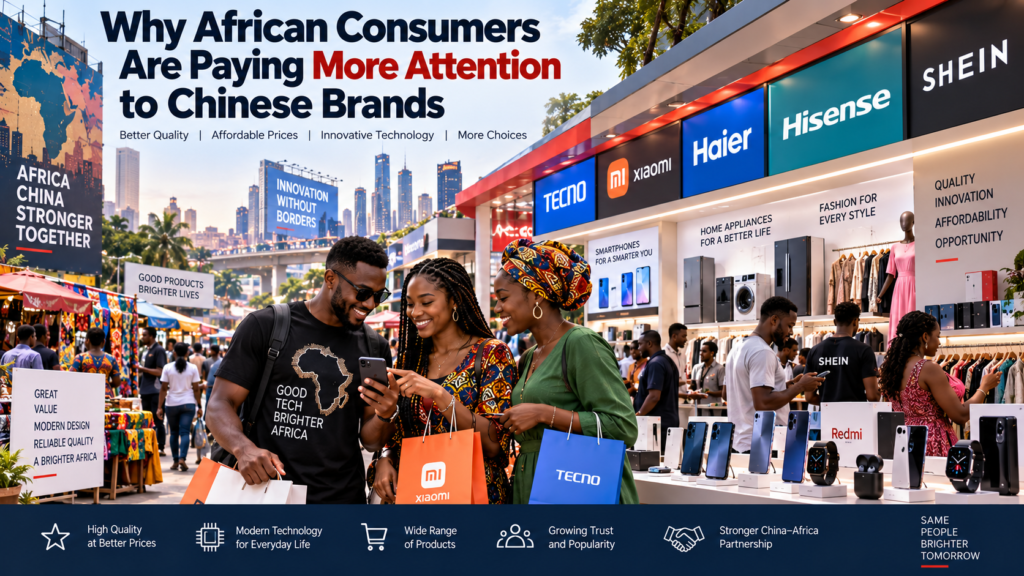
The smartphone market is where African consumer attention toward Chinese brands is easiest to see, and the data confirms what anyone who visits a phone shop already knows.
Transsion, the company behind Tecno, Infinix, and itel, shipped over 40.5 million smartphones across Africa in 2025 and held 48 percent market share for the year, according to Omdia. That is nearly one out of every two phones sold on the continent. In the first quarter of 2026, the company maintained a commanding 47 percent share after shipping 9.3 million smartphones during the quarter.
But here is what makes this moment interesting. In the first quarter of 2026, Samsung overtook Transsion to become the number one smartphone brand in Africa by market share, according to Counterpoint Research. Samsung held 26 percent, while Transsion held 24 percent. This was partly due to memory price increases that disproportionately affected the entry-level segment where Transsion is strongest, and partly due to Samsung’s ability to leverage its inventory and broader portfolio.
The bigger story is the competition between Chinese brands themselves. Honor grew by 98 percent year on year in the first quarter of 2026, reaching fourth place with 8 percent market share. Xiaomi held 11 percent. Oppo held 5 percent with 26 percent growth. The brands fighting for the African consumer’s attention are increasingly Chinese, and that competition is driving prices down and features up.
For Nigerian consumers, this competition is good news in the short term. More brands competing means more choices, better specs at lower prices, and faster innovation. But it also means that brand loyalty is weaker than it has ever been. A consumer who bought a Tecno phone three years ago may walk into a shop today and walk out with a Xiaomi or an Honor. Attention is high, but so is willingness to switch.
Electric Vehicles and Clean Technology: The Next Wave of Attention
The smartphone story is mature. The electric vehicle story is just beginning, and it is where African consumer attention is growing fastest.
In Egypt, Chinese car brands held 42.7 percent of the passenger car market in the first half of 2026, up from just about 10 percent in 2020. Brand names like Chery, MG, Changan, BAIC, and Haval are now among the top ten best-selling brands in the country. The MG ZS, Chery Tiggo 4 Pro, and Chery Arrizo 5 were among the top ten best-selling models in 2025.
In South Africa, Chinese brands’ share of the passenger car market climbed from 11.2 percent a year earlier to nearly 20 percent in 2026. Chery Group’s sales in South Africa jumped to second place in the industry for the first five months of 2026, behind only Toyota and ahead of Suzuki and Volkswagen. That is not a niche achievement. That is a direct challenge to established brands in one of Africa’s most competitive automotive markets.
The electric two-wheeler and three-wheeler market is moving even faster in some respects. Africa’s imports of electric motorcycles and three-wheelers from China rose 60 percent in the first half of 2026, reaching 114.6 million dollars. Morocco alone imported over 80,000 electric two and three-wheelers in that period. In Uganda, electric motorcycles now account for roughly 20 percent of new motorcycle sales. In Kenya, they account for about 15 percent. These are markets where the electric transition is not a future possibility. It is happening now.
What is driving this attention? Partly it is cost. A fuel-dependent motorcycle rider in Kampala or Nairobi spends a significant portion of daily income on petrol. An electric motorcycle with a battery swap model reduces that cost dramatically. Partly it is reliability. Electric motors have fewer moving parts and require less maintenance than combustion engines. And partly it is a broader shift in perception. Chinese electric vehicles are no longer seen as experimental. They are seen as practical.
E-Commerce: The Attention Is Real but Uneven
The e-commerce space tells a more complicated story about African consumer attention to Chinese brands.
Temu entered Nigeria in late 2024 and quickly became one of the country’s most downloaded shopping apps. In South Africa, Shein and Temu together captured 37 percent of the clothing e-commerce market, with Shein alone holding 28 percent of women’s wear. Approximately one third of South African consumers have used Temu. These are not marginal numbers. They represent a significant shift in where African consumers are spending their money online.
Jumia, the African e-commerce platform, has responded by doubling down on Chinese imports. The company reported a 39 percent increase in first-quarter revenue to 50.6 million dollars in 2026, with the volume of products sold by international sellers on its platform rising 87 percent year on year. Jumia’s CEO, Francis Dufay, said the company plans to continue increasing inventory from Chinese vendors while strengthening its position in Nigeria, now its largest market.
But the attention is not unconditional. Temu has scaled back operations in Nigeria because of high logistics costs and unreliable customs clearance. The platform’s model depends on low-cost shipping and efficient last-mile delivery, both of which are difficult in Nigeria. For consumers, this means that while the attention is there, the experience does not always match the promise. Delivery times are longer. Returns are harder. The gap between expectation and reality creates frustration.
The lesson for Chinese brands and for Nigerian businesses watching them is that attention alone is not enough. Attention must be converted into trust, and trust requires delivering on the promise every single time. A consumer who has a bad experience with one Chinese e-commerce platform may become skeptical of all of them. That is why the brands that will win in the long run are the ones that invest in logistics and customer service, not just marketing.
The Reasons Behind the Shift
Why are African consumers paying more attention to Chinese brands? The data points to five reasons, and each one has implications for anyone trying to sell to African consumers.
Value for Money That Actually Delivers
The first reason is value. African consumers are value-conscious in a way that consumers in richer markets often are not. When income is limited, every purchase decision carries weight. A product that offers more features, better durability, or longer battery life at the same price point as a competitor will win attention.
Chinese brands have built their reputation on this. A Transsion phone at 150 dollars offers features that a Samsung phone at the same price does not. A Chery SUV offers standard safety features that are optional extras on competitors. A Chinese solar panel offers the same output at a lower cost than a European or American alternative. Consumers notice.
Localization That Feels Genuine
The second reason is localization. Chinese brands have moved beyond translating their marketing materials. They are changing the product itself.
Transsion built cameras optimized for darker skin tones because the default algorithms on international phones were trained on lighter skin. The company collected 3D imaging data from African users and developed algorithms that could capture facial bone structure and provide intelligent fill light. That is not a marketing gimmick. That is a product decision that makes African users feel seen.
OPPO optimized its LCD screens for high-brightness outdoor visibility because consumers in equatorial regions were struggling to see their phones under direct sunlight. Dreame Technology designed specialized vacuum cleaner attachments for Thai households with mixed flooring. These are small details, but they add up. They signal that the brand understands the consumer’s actual life, not just their demographic profile.
Availability That Reaches the Last Mile
The third reason is distribution. Chinese brands built distribution networks that reached places other brands ignored. Transsion built relationships with small shops, market stalls, and local distributors across Nigeria, Kenya, and Ghana. Its Carlcare service network operates over 2,000 service points globally, with deep coverage in African cities and towns.
That distribution depth matters because it changes the buying experience. A consumer does not have to travel to a big city to buy a Chinese phone or get it repaired. The product is available where they live, and the service is available where they live. That convenience builds habit, and habit builds loyalty.
The Competition Effect
The fourth reason is competition. Chinese brands are competing with each other in African markets, and that competition is driving improvements that benefit consumers.
Transsion, Xiaomi, Honor, and Oppo are all fighting for the same customers. When one brand improves its camera, the others have to match it. When one brand offers a longer warranty, the others have to respond. The result is a market where quality is rising and prices are staying low. That is good for consumers, even if it is difficult for the brands.
The Shift in Global Perception
The fifth reason is broader. The perception of China as a source of technology and innovation has improved globally. The GlobeScan survey found that more than eight in ten people globally expressed interest in solar panels and electric vehicles, and around half would consider buying Chinese-made versions. In emerging markets, that number was much higher.
That perception shift is not just about products. It is about a broader sense that China is a source of practical, affordable solutions for the problems that developing countries face. When a Kenyan farmer buys a Chinese solar panel, they are not just buying a product. They are buying into a vision of development that feels more accessible than the alternatives.
The Categories Where Attention Is Growing Fastest
If you are trying to understand where African consumer attention toward Chinese brands is heading next, these are the categories to watch.
Electric Two-Wheelers and Three-Wheelers
This is the fastest-growing category in terms of attention. The 60 percent increase in imports from China in the first half of 2026 shows that consumers and businesses are adopting these products at scale. In Uganda, 20 percent of new motorcycle sales are electric. In Kenya, 15 percent. The economics are compelling, and the infrastructure, particularly battery swap networks, is improving.
Solar and Clean Energy Products
The GlobeScan survey found that 87 percent of respondents in Kenya, Nigeria, and South Africa would consider buying Chinese-made solar panels. That is an extraordinary level of stated intent. As grid reliability remains a challenge in many African countries, the demand for solar solutions will only grow.
Home Appliances
Midea, Haier, and Hisense are all investing heavily in African manufacturing. Midea’s South African subsidiary was established in July 2026, and its washing machine manufacturing plant is scheduled to begin production within the year. Haier’s Egypt ecological park phase two is planned for production by the end of 2026. Hisense has been manufacturing in South Africa for years. As these brands localize production, prices will fall, and attention will grow.
Affordable Smartphones and Accessories
The smartphone market is mature, but the attention is still intense. As feature phone users upgrade to smartphones, the battle for those first-time buyers will be fierce. The brands that offer the best combination of price, battery life, and local service will win.
The Risks and the Reality
It would be dishonest to write about the attention African consumers are paying to Chinese brands without acknowledging the risks and challenges.
The first risk is that attention does not always translate into loyalty. African consumers are willing to try Chinese brands, but they are also willing to switch if a better option appears. The competition between Chinese brands themselves is evidence of this. Transsion’s market share slipped in the first quarter of 2026, and Honor grew by 98 percent. Consumers are not loyal to country of origin. They are loyal to value.
The second risk is infrastructure. Temu’s scaling back in Nigeria is a reminder that even the best product can be undone by poor logistics and unreliable customs. Chinese brands that invest in African markets need to invest in the infrastructure that makes delivery and service possible, not just the products themselves.
The third risk is regulatory. As Chinese e-commerce platforms gain market share, African governments may introduce regulations to protect local industries. Nigeria has already seen complaints from local manufacturers about the de minimis rule. If import rules change, the cost structure for Chinese brands could shift.
The fourth risk is that the attention is uneven. Urban, younger, and more connected consumers are paying the most attention to Chinese brands. Rural consumers, older consumers, and those with less disposable income may be slower to adopt. The brands that win in the long run will be the ones that reach beyond the early adopters.
Three Steps You Can Take Today
If you are a Nigerian business owner, importer, or distributor, here are three specific things you can do this week to respond to the shift in consumer attention.
Audit Your Product Line for Chinese Brand Competition
Take a piece of paper and list every product you sell. For each one, ask a simple question. If a Chinese brand entered this category tomorrow with a product at a similar price point, would my customers switch? If the answer is yes, you have a vulnerability. If the answer is no, you have an advantage.
Write down the products where you are most vulnerable. Then think about what you can do to differentiate. It might be service. It might be customization. It might be a local manufacturing advantage. Whatever it is, start building it now, before the competition arrives.
Study What Chinese Brands Do That You Do Not
Pick one Chinese brand that operates in your sector or your region. Spend 30 minutes researching how it operates. Not what it sells, but how it thinks. How does it reach customers? How does it handle service? How does it adapt its product to local conditions?
Write down one thing that brand does that you could apply to your own business. Then apply it this month. The goal is not to copy the brand. The goal is to learn from its approach and adapt it to your own context.
Talk to Your Customers About What They Actually Want
The attention African consumers are paying to Chinese brands is driven by specific unmet needs. Value. Availability. Localization. Service. If you can identify which of those needs your customers have and address them, you can compete.
Talk to five of your best customers this week. Ask them one question. What is one thing you wish my product or service did better? Listen carefully. The answer might surprise you. Then act on it. That is how you build a business that earns attention, not just competes for it.
Conclusion
African consumers are paying more attention to Chinese brands because those brands have delivered on the things that matter. Value for money. Localization that feels genuine. Distribution that reaches the last mile. Competition that drives improvement. The data confirms what anyone who visits a market in Lagos or Nairobi already knows. In Nigeria, 89 percent of consumers express net trust in Chinese brands. In sub-Saharan Africa, 87 percent would consider buying Chinese-made solar panels. Chinese car brands hold 42.7 percent of the Egyptian market and nearly 20 percent of the South African market.
The three most important takeaways for Nigerian readers are these. First, attention is not the same as loyalty. African consumers are willing to try Chinese brands, but they are equally willing to switch. The brands that win will be the ones that deliver consistently. Second, the categories where attention is growing fastest are electric vehicles, solar products, home appliances, and affordable smartphones. If you operate in any of those categories, you need a strategy for competing with Chinese brands. Third, the reasons behind the attention are practical, not emotional. Value, availability, localization, and service. If you can deliver those things, you can compete, regardless of where your product comes from.
If you take one step today, let it be this. Look at your business and ask one question. What is one thing that a Chinese brand does better than you? It might be price. It might be distribution. It might be service. Whatever it is, write it down. Then spend 30 minutes thinking about how you can close that gap. Not by copying the brand, but by doing something it cannot do. That is how you compete in a market where African consumers are paying more attention than ever before.